
Leaving San Jose for a New Job? What California Holds Back at Escrow and How to Sell on Your Timeline
Relocating out of San Jose for work? How Form 593 withholding, California tax on your gain after you move, Santa Clara County and Measure E transfer taxes, the December 10 property tax deadline and required disclosures affect your sale, and when a cash offer makes sense. Call (405) 622-8705.
Short answer: Yes, you can sell your San Jose house before or after you start a new job somewhere else, and a direct cash sale can close on a date you pick. What catches relocating Silicon Valley sellers off guard is the paperwork at escrow, not the buyer. California can hold back 3 1/3% of your price unless you certify an exemption on Form 593, it still taxes your gain after you move, and a few required statements and the December 10 property tax deadline don’t wait for your moving truck.
Who is this San Jose relocation guide for?
Picture an engineer or product manager who accepted an offer in Austin, Seattle, Raleigh or Phoenix. The start date is six or eight weeks out. The house is a 1950s or ’60s ranch in Cambrian, Willow Glen, Berryessa or Evergreen, maybe one of the city’s Eichler tracts, bought a few years ago at a price that still makes your stomach drop. One partner may stay behind until the school semester ends. You don’t have time to stage, list, run weekend open houses and negotiate repair credits from 1,700 miles away.
If your house is updated and you can wait a month or two for a listing to run its course, a good San Jose listing agent may get you more. This guide is for the seller who needs to know what California will take out of the check, what has to be signed before the keys change hands and how to compare a fast sale against listing. For the wider Bay Area picture, see our California cash hub for San Diego and the Bay Area.
Will escrow hold back 3 1/3% of your price if you’ve already moved out?
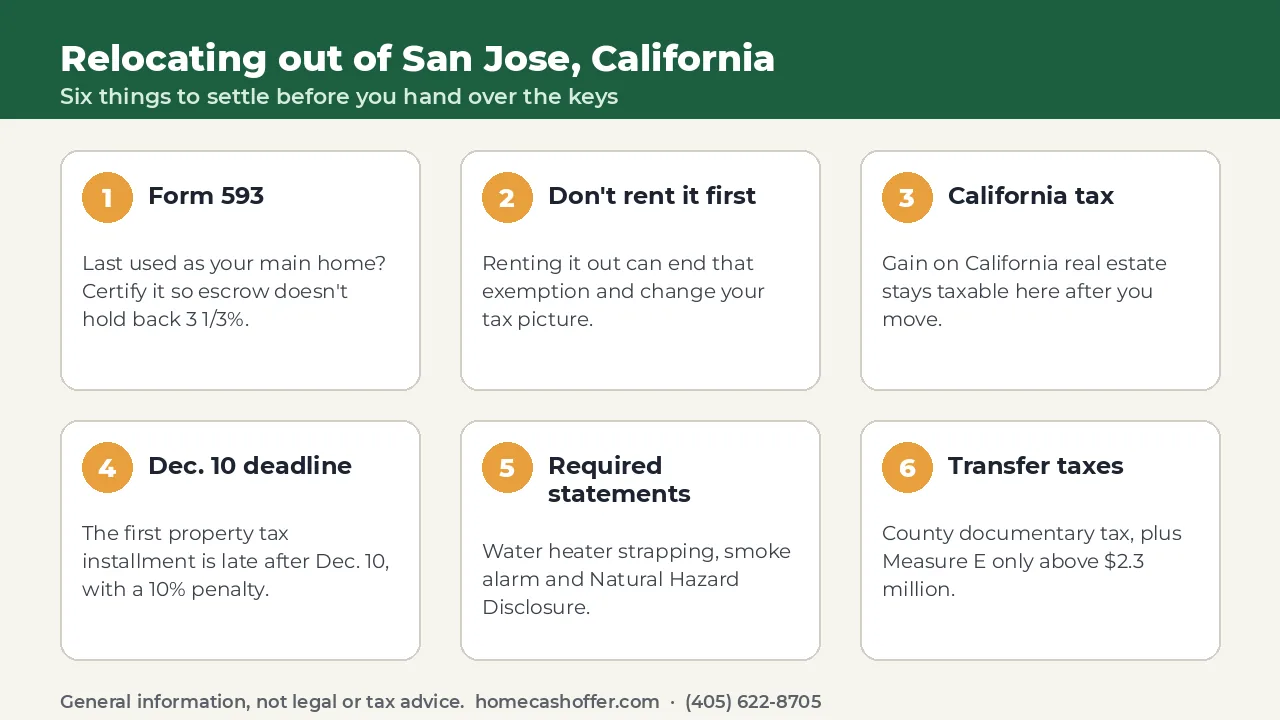
Not if you handle Form 593 correctly. California requires escrow to withhold income tax on most sales of California real estate over $100,000, and the default amount is 3 1/3% of the sales price, according to the Franchise Tax Board’s real estate withholding page. At San Jose’s September 2026 median sale price of $1,349,357, that’s about $45,000 that doesn’t reach you at closing. You’d get it back only as a credit when you file your California return.
The relief is on Form 593, Part III. Line 1 covers a home that qualifies as your principal residence under federal Section 121. Line 2 is the one that matters most for relocating sellers: it exempts a property that was last used as your principal residence, even if you haven’t met the two-year period. The Form 593 instructions say that if the last use was as a vacation home, second home or rental, you don’t qualify for that exemption.
That creates a trap. Say you moved in 18 months ago, get transferred and decide to rent the house for a year “to see how the market goes.” When you sell, the last use is a rental, Line 2 no longer works, and you’re likely to face withholding unless another exemption fits or you use the gain-based alternative calculation in Part IV. If you sell soon after you move out, with nobody else living there, the exemption is usually straightforward. Give the form to escrow before closing, signed.
Does California still tax your gain after you move to another state?
Yes, on whatever part of the gain isn’t excluded. The FTB’s guide to residency and nonresidency (Pub. 1031) says gain from selling real estate is sourced where the property is located, and if you sell your California home and move out of state, the gain is taxable by California even if you sell as a nonresident. A move to Texas or Washington, which don’t have a state income tax on wages, doesn’t change that for the San Jose house.
The federal home-sale exclusion still does most of the work for owner-occupants. IRS Publication 523 lets you exclude up to $250,000 of gain, or $500,000 for a married couple filing jointly, if you owned and lived in the home for two of the last five years. If you haven’t hit two years, the same publication allows a partial exclusion when the sale is caused by a work-related move, such as a new job at least 50 miles farther from the home than your old work location. In Santa Clara County, where many recent buyers paid well over a million dollars, the gap between a full exclusion, a partial one and none at all can be large. Run the worksheet with a CPA before you agree on a price, not after.
What transfer taxes come out of a San Jose sale?
Usually less than sellers fear, unless the price is above $2.3 million.
- County documentary transfer tax. California’s Revenue and Taxation Code section 11911 lets counties charge 55 cents per $500 of value, or $1.10 per $1,000. On a $1,349,357 sale that’s about $1,484.
- San Jose’s conveyance tax. The city has a separate real property conveyance tax under Municipal Code chapter 4.58. Escrow will calculate it.
- Measure E, only for higher prices. San Jose voters approved Measure E, the city’s real property transfer tax under Municipal Code chapter 4.59, in March 2020. The city’s real property tax summary says that since July 1, 2025 it applies to transfers over $2.3 million. Under the measure, the rate is 0.75% of the entire price up to $5 million, so a $2.4 million sale in Almaden Valley or Willow Glen would carry about $18,000 in Measure E tax on top of the others.
Who pays each tax is set by custom and by your purchase contract, so read the escrow instructions rather than assuming.
Should you pay the December 10 property tax installment before you go?
If you won’t close before December 10, yes. Under Revenue and Taxation Code section 2617, California taxes due November 1 become delinquent after 5 p.m. on December 10, and a 10% penalty attaches. On a Prop 13 assessment that reflects a recent Silicon Valley purchase, the first installment alone can run several thousand dollars, so the penalty adds up fast.
Moving week is exactly when a bill like that gets lost in a forwarded-mail pile. Pay it online before you leave. At closing, escrow prorates the tax year, so you’re credited for the days after the buyer takes ownership. If your mortgage has an impound account, check whether your servicer already paid it.
What California paperwork can’t you skip, even selling as-is?
Selling as-is means you don’t fix things. It doesn’t erase state-required statements. Three are easy to forget when you’re packing:
- Water heater strapping. Health and Safety Code section 19211 requires existing residential water heaters to be braced, anchored or strapped against earthquake motion, and the seller must certify that in writing. If the garage water heater in your ranch house is loose, a plumber can usually fix it in under an hour.
- Smoke alarms. Section 13113.8 requires an operable smoke alarm in a single-family home that’s sold, plus a written statement from the seller that it complies.
- Natural Hazard Disclosure. Civil Code section 1103.2 sets out the statement covering flood zones, fire hazard zones, earthquake fault zones and seismic hazard zones, including liquefaction. Santa Clara County sits between the San Andreas and Hayward fault systems, and the state maps official fault zones under the Alquist-Priolo Act. Most sellers order a third-party NHD report, which escrow can arrange.
Your own Transfer Disclosure Statement still matters too. Fill it out from memory before you leave, while you still remember when the roof was done and which bathroom had the slow leak. It’s much harder from a hotel room in another state.
Is the San Jose market fast enough to just list it after you move?
Often, for a house in good shape. Redfin’s San Jose housing market data shows a median sale price of $1,349,357 for September 2026, down 5.0% from a year earlier, with a median of 22 days on market. About 46.4% of homes sold above list price, but 28.5% had a price drop first. Redfin also reports that from April to June 2026, 16% of San Jose homebuyers searched to move out of the metro, with Sacramento the most popular destination.
Read those numbers as two markets. An updated house in a strong school area still draws multiple offers. A dated ranch with original electrical, a cracked slab-edge patio or an unpermitted garage conversion is the kind of listing that sits, takes a price cut and asks for repair credits after inspection. That’s harder to manage from another time zone, and every extra month means another mortgage payment on a house you no longer live in.
Should you rent it out, list it, or sell it directly?
Each path has a real cost:
- Rent it out. Prop 13 keeps your assessment where it is, and rent can cover a low-rate mortgage. But you become a long-distance landlord under San Jose’s tenant protection rules, you may lose the Form 593 last-use exemption, and if you rent long enough to fail the two-out-of-five-years test, the federal home-sale exclusion can disappear entirely.
- List it. Likely the best price for a house in good shape. Expect commissions, prep, staging, showings with nobody home, an inspection period and possibly repair negotiations by phone.
- Sell directly. No commissions, no showings and no repairs, with a closing date tied to your start date. The tradeoff is price: a direct buyer pays for the house as it sits, and in San Jose that discount can be meaningful in dollars. Compare the net, not the headline. Our cash offer vs. listing guide shows how to line up both.
From our deals
When we work with sellers who are relocating, the house is rarely the hard part. The calendar is. The ones who come through it smoothest decide early whether they’re selling before or after the move, sign the disclosures before the furniture is gone and get their exemption paperwork to escrow early. The ones who struggle usually waited, rented the house “for now” or left a list of half-finished projects behind. In a market as expensive as San Jose, small paperwork mistakes cost real money, so we’d rather talk through the timeline with you early, even if you decide to list.
When should a relocating San Jose seller not sell for cash?
- The house is updated and you can wait. If it would show well and you can carry it for a couple of months, listing will probably net more.
- Your employer’s relocation package pays selling costs. Some programs pay commissions or offer a buyout only if you sell through their partner brokers. Ask your relocation counselor in writing what a direct sale would do to the benefit before you sign anything.
- You’re near the two-year line. If you’re a few months short of two years of ownership and use, waiting could turn a partial exclusion into a full one. That can be worth far more than the cost of waiting.
- You haven’t compared both offers. Get a net sheet from a local agent and a written offer from a direct buyer, and put the two bottom lines next to each other.
How does a HomeCashOffer sale work after you’ve already moved?
Send us the address, your target closing date and what you know needs work. We’ll ask a few questions, arrange a walkthrough with whoever has the key, and give you a written offer for the house as it is, with no commissions and no repair list. If you accept, a California escrow and title company handles the closing, including Form 593, the transfer taxes, property tax prorations and the hazard disclosure report. You can sign with a mobile notary in your new city. Call (405) 622-8705 or request a cash offer here. You can also see our San Jose, CA page, and nearby pages for Fremont and Oakland.
HomeCashOffer buys houses nationwide from its office at 3000 W Memorial Rd, Ste 123 Unit 308, Oklahoma City, OK 73120. Questions about your exclusion, withholding or residency belong with a California CPA or tax attorney.
Related reading: Selling fast in San Diego and the Bay Area · Relocating out of Pittsburgh for a new job · Relocating out of New York City · Facing foreclosure in Sacramento · Selling a San Diego house with code violations · How cash home buyers work
Sell your house fast in these markets
Local cash offer pages—or start with a nationwide request.
Frequently asked questions
Will escrow withhold 3 1/3% of my sale price if I've already moved out of my San Jose house?
Not if the house was the last place you lived as your main home and you certify that on California Form 593. Line 2 of Part III exempts a property last used as the seller's principal residence under IRC Section 121, without regard to the two-year period. If you rented it out or used it as a second home after you moved, that line no longer fits, and escrow withholds 3 1/3% of the price unless another exemption or the gain-based alternative calculation applies.
Do I still owe California tax on the gain if I sell after moving to Texas or Washington?
Usually, yes, on any part of the gain that isn't excluded. The Franchise Tax Board's residency guide (Pub. 1031) says gain from selling real estate is sourced where the property is located, and it stays taxable by California even if you sell after becoming a nonresident. Moving to a state without an income tax doesn't change that for your San Jose house.
I've owned my San Jose home less than two years. Can I still exclude some of the gain because of the job?
Possibly. IRS Publication 523 allows a partial exclusion when the main reason for the sale is a work-related move, for example a new job at least 50 miles farther from the home than your old work location. The partial amount is figured on a worksheet, so get the numbers from a CPA before you set a price.
How much transfer tax will I pay selling a house in San Jose?
California counties can charge documentary transfer tax at 55 cents per $500, or $1.10 per $1,000, about $1,484 on a $1,349,357 sale. San Jose also has its own conveyance tax under Municipal Code chapter 4.58, and Measure E adds a separate city transfer tax only when the price is over $2.3 million: 0.75% of the whole price from there up to $5 million. Escrow will show the exact figures and who pays under your contract.
What happens if I miss the December 10 property tax deadline while I'm moving?
California's first property tax installment is due November 1 and becomes delinquent after 5 p.m. on December 10, when a 10% penalty attaches. If your sale won't close before then, pay the installment yourself. Escrow prorates the year at closing, so you get credit for the part of the year after the buyer takes over.
Do I have to strap the water heater before selling a San Jose house as-is?
The house can sell as-is, but California still requires the seller to certify in writing that the water heater is braced, anchored or strapped against earthquake motion, and to give a written statement that the home has an operable smoke alarm. Strapping is usually a small job. Have it done before you leave so you can sign the certification honestly.
Is it better to rent out my San Jose house instead of selling when I relocate?
It can be, if the rent covers your costs and you're ready to be a landlord from another state. Know the tradeoffs first: San Jose has its own tenant protection rules, renting can end the Form 593 'last used as my main home' exemption, and if you rent long enough to fail the IRS two-out-of-five-years test, you can lose the home-sale exclusion entirely.
Ready to see what a cash offer looks like?
No repairs required. No agent commissions when you sell to us. No obligation to accept.
Request your no-obligation cash offer
Prefer a dedicated form? Visit Get a Cash Offer Today.
Get My Cash Offer
Share your name, phone, and property address. No obligation. We will follow up shortly.