
Relocating Out of New York City for Work? How to Sell Your House Before (or After) You Move
Moving out of NYC for a new job? Why the day you become a nonresident changes your closing (IT-2663 at 10.90% on any non-residence gain), NYC and NYS transfer taxes, the PCDS with no $500 opt-out, DOF exemption removal, sidewalk liability once you move out, and when a cash sale beats listing. Call (405) 622-8705.
Short answer: Yes, you can sell a New York City house quickly when a job pulls you to another state, and a cash sale can be timed to land before your start date. The detail most relocating owners miss is that the date you stop being a New York resident can change what happens at the closing table, especially if you owned a two-family house and rented out the other unit. Settle the residency question with a CPA first, then put a written cash offer next to a realistic listing and compare the money you’d walk away with.
This guide is for one kind of New Yorker. Maybe you got the offer from a company in Miami, Charlotte, Austin or Denver. Your start date is close. And you own something most of your coworkers don’t: an attached brick two-family in Ridgewood or Woodhaven, a semi-detached house in Bay Ridge or Canarsie, a frame house on Staten Island, or a one-family in the northeast Bronx. You lived in one unit and maybe rented the other to help with the mortgage.
The city makes that kind of owner unusual. The Census Bureau’s 2020–2024 American Community Survey puts New York City’s owner-occupied housing rate at 32.8%, with a median owner-occupied home value of $777,600 (U.S. Census Bureau QuickFacts, New York city). Most people leaving for a job just give notice on a lease. You have a house to sell, and in NYC the paperwork works differently than in most of the country.
For the general picture, start with our New York City cash buyer hub and the New York City, NY city page.
Why does your move-out date matter more in New York than elsewhere?
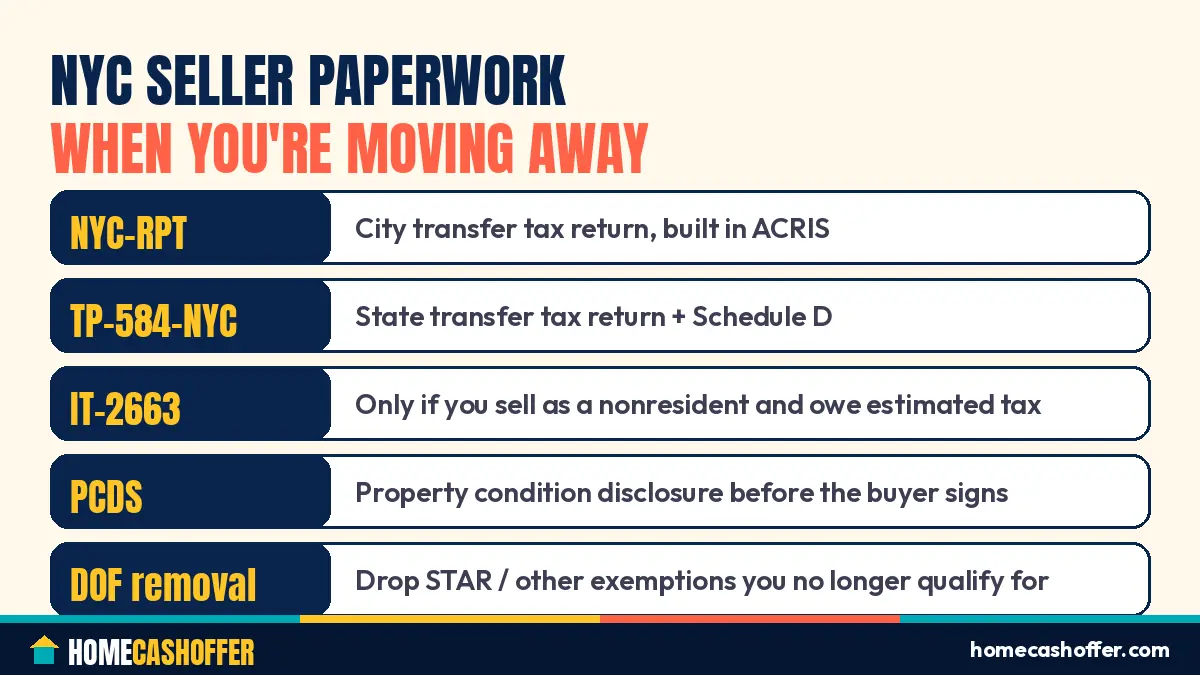
Because New York collects estimated income tax from nonresident sellers before the deed can be recorded. Under Tax Law Section 663, nonresident individuals, estates and trusts selling New York real property have to work out the gain on Form IT-2663 and pay the estimated tax at closing, unless an exemption applies. The 2026 instructions say a deed shouldn’t be recorded unless each seller either signs the exemption certification on Form TP-584-NYC, Schedule D, or hands over IT-2663 with full payment (NYS Tax Department, IT-2663 instructions for 2026).
Three points in those instructions matter for a relocating owner:
- If you’re still a New York resident on closing day, the nonresident estimated-tax rule doesn’t apply to you.
- If the whole house was your principal residence under the federal home-sale rule (IRC Section 121), you’re exempt even as a nonresident. You claim that on Schedule D, and it holds even if your gain is bigger than the federal exclusion.
- If only part of it was your residence, for example the downstairs unit you lived in while renting the upstairs, estimated tax is due on the gain allocated to the rented part. For 2026, the form applies the state’s top rate of 10.90% to that portion.
The money isn’t lost. It’s credited when you file your 2026 New York nonresident return. But the instructions are clear that it can’t be refunded before you file, so it’s cash you won’t have for the down payment in your new city. Whether you’ve actually become a nonresident depends on New York’s domicile rules, not just where your boxes are. That’s a conversation for a CPA, ideally before you pick a closing date.
Will the IRS give you a break if you haven’t owned it two years?
Possibly a partial one. The full exclusion generally needs two years of ownership and use as your main home within the five years before the sale. If you’re short, IRS Publication 523 allows a reduced exclusion for a work-related move, including when your new job is at least 50 miles farther from the home than your old work location. New York’s IT-2663 rules follow the same federal definition of principal residence, so getting the federal answer right also helps you fill out the state forms.
What transfer taxes come out of your proceeds?
Two, and both are typically yours as the seller. For a one-, two- or three-family house, the NYC Real Property Transfer Tax is 1% of the price at $500,000 or less and 1.425% above $500,000. The return is prepared online through ACRIS and is due within 30 days of the transfer. The packet also includes the registration forms for tax and water bills and a smoke detector affidavit.
New York State adds its own real estate transfer tax of $2 for every $500 of consideration, which works out to 0.4%. The state says the seller pays that base tax unless the contract says otherwise. The 1% mansion tax at $1 million and up, and the supplemental tax on NYC residential sales of $2 million and up, are paid by the buyer.
Here’s an illustration, not a quote: on a $900,000 two-family, the city tax would be about $12,825 and the state tax about $3,600. Both get paid whether the buyer is a family with a mortgage or a cash investor. A cash sale cuts out lender-driven costs and delays, not transfer taxes.
Can an as-is cash sale skip the property condition disclosure?
Not anymore. For years, New York sellers could give the buyer a $500 credit instead of filling out the Property Condition Disclosure Statement. That option ended on March 20, 2024. The same amendment added questions about FEMA flood zones, required flood insurance, FEMA assistance and past flood claims (New York State Bar Association on the amended PCDA). Real Property Law Section 462 still lets buyer and seller agree to an as-is sale, but the signed statement has to reach the buyer before they sign a binding contract.
The flood questions are the ones relocating sellers in low-lying parts of the city, such as Howard Beach, Broad Channel, Canarsie or Staten Island’s east shore, should answer carefully. If you once filed a flood claim, say so. Leaving it out is the kind of mistake that comes back after you’ve moved 1,000 miles away.
What do you owe the Department of Finance once you’ve moved?
Notice, if you get any personal exemptions. STAR, the Senior Citizen Homeowners’ Exemption, the Disabled Homeowners’ Exemption and the Veterans Exemption all depend on the house being a primary residence. NYC311 says DOF may remove a benefit when an owner has moved, and that a primary residence is where you live most of the year and are registered to vote (NYC311: Property Tax Exemption Assistance).
DOF’s own guidance for owners who’ve moved to another state points them to the application to remove previously granted exemptions. The $500 voluntary renunciation fee doesn’t apply when the property no longer qualifies (NYC DOF Exemptions Quick Help). Handle it yourself rather than waiting for a removal letter to show up at an empty house.
What changes about the house itself once nobody’s living there?
Your liability on the sidewalk, for one. NYC Administrative Code Section 7-210 makes owners liable for injuries caused by sidewalks they don’t keep reasonably safe, including snow and ice. But it exempts one-, two- and three-family houses that are at least partly owner-occupied and used only as residences. The Appellate Division applied exactly that exemption to an owner-occupied two-family in a 2013 Brooklyn case. Once you’ve moved out, you may lose that protection while you still hold title.
The duty to shovel doesn’t go away either. The Department of Sanitation says that if snow stops between 7 a.m. and 4:49 p.m., you have four hours to clear the sidewalk, and if it stops overnight, you have until 11 a.m. (DSNY snow removal responsibilities). From another state, that means paying someone and trusting they show up.
Attached houses add another wrinkle. A frozen pipe in a vacant rowhouse doesn’t just damage your house; water can reach the shared wall and your neighbor’s place. Leave the heat on, have someone check the boiler, and ask your insurer what its vacancy terms are before you hand over the keys to a mover.
What if a tenant still lives in the other unit?
Then the sale has to account for them, and New York’s newer tenant protections may come into play. The state’s Good Cause Eviction law applies in New York City, and HPD lists several exemptions. Two matter here: buildings with 10 or fewer units where the owner lives in the building, and “small landlords” who own 10 or fewer units total in New York State (NYC HPD: Good Cause Eviction). The owner-occupied exemption depended on you living there. Before you promise any buyer the house will be delivered vacant, have a New York landlord-tenant attorney tell you which rules apply after you move.
Many investors, including us, are fine buying with a paying tenant in place. That’s often simpler than trying to get the unit empty in time for your start date.
Is the NYC market fast enough to just list it?
For some houses, yes. For a dated two-family with a tenant, plan on patience. Over the three months ending September 2026, Redfin reported a New York City median sale price of $899,572, up 1.6% from a year earlier, a median of 58 days on market, and price drops on 31.2% of homes (Redfin New York housing market). Redfin’s search data also showed 22% of New York homebuyers looking to move out of the metro in April through June 2026, with Miami, Philadelphia and Orlando the top searched destinations. That’s search behavior, not actual moves, but it matches what relocating sellers tell us.
Financing is still expensive for the buyers you’d be listing to. Freddie Mac’s average 30-year fixed rate was 7.32% on October 22, 2026, compared with 6.19% a year earlier (Freddie Mac PMMS). And a median of 58 days on market is only part of the timeline. In New York it’s followed by attorney review, a mortgage commitment and a closing date. For someone paying rent in a new city at the same time, that’s a long stretch of double housing costs.
From our deals
Relocating owners rarely call us first. Usually they’ve already talked to an agent, gotten a reasonable list price, and then done the math on two housing payments, a winter of snow calls, and a tenant upstairs whose lease runs into spring. What goes smoothly in those cases is boring: the seller hires a New York attorney early, tells their CPA the move date before choosing a closing date, and we agree in writing who handles the tenant and the security deposit. What goes badly is usually a surprise at the end, like an old exemption still on the tax bill or a power of attorney the title company won’t accept. Ask about both in the first week, not the last.
When should a relocating New Yorker not sell for cash?
When time and condition are on your side. A listing will probably net more if:
- The house is updated, vacant, and in a neighborhood buyers are competing for. Retail buyers will pay for that, even with a 58-day median.
- Your employer’s relocation package pays selling costs or offers a buyout only if you use its program. Read the policy before you sign with anyone, including us.
- You’re not in a hurry and you’re staying a New York resident a while longer, for example a later start date or a remote start. That time can go into preparing and listing.
- The rental income works and you have a reliable manager. Keeping the house can be a reasonable decision, as long as you go in clear on the Good Cause rules and the sidewalk liability.
A cash sale fits better when the house needs work, has a tenant, sits in a flood-question neighborhood, or when the start date is fixed and you’d rather close on a date you choose than manage a listing from far away.
How does a HomeCashOffer sale work from your new city?
We’re a nationwide cash home buyer, and we buy across all five boroughs as well as nearby markets like Yonkers and Newark and Jersey City.
- Tell us the address, whether a tenant is in place, and your start date.
- We see the house through photos and a walkthrough with someone you trust. You don’t need to fly back.
- We send a written as-is offer. Asking for one doesn’t commit you to anything.
- Your New York attorney reviews the contract, and the title company handles payoffs, transfer tax returns and exemption paperwork. Many relocating sellers sign through New York’s statutory short form power of attorney or a mail-away package. Confirm early that the title company will accept whichever you use.
- You pick the closing date, before or after the move, once your CPA has weighed in on residency.
Call (405) 622-8705 or request a cash offer online. Moving from somewhere else too? Compare how a job move plays out when relocating from Pittsburgh, San Antonio, or Detroit.
HomeCashOffer, 3000 W Memorial Rd, Ste 123 Unit 308, Oklahoma City, OK 73120. (405) 622-8705. We’re a home buyer, not a law firm or a tax advisor.
Related reading: Sell my house fast in New York City · New York City, NY city page · Cash offer vs. listing with an agent · Selling a vacant or inherited house for cash · What to expect from a cash offer
Sell your house fast in these markets
Local cash offer pages—or start with a nationwide request.
Frequently asked questions
Does it matter whether I close on my NYC house before or after I move out of New York State?
It can. New York requires nonresident individuals selling New York real property to estimate and pay personal income tax on the gain at closing using Form IT-2663, unless an exemption applies. A house that qualifies in total as your principal residence under IRC Section 121 is exempt, and you claim that on Form TP-584-NYC, Schedule D. If you close while you're still a New York resident, the nonresident estimated-tax requirement doesn't apply. Whether and when you become a nonresident is a tax question for a CPA.
I lived in one unit of my two-family house in Queens and rented the other. What happens if I sell after I've moved to another state?
The IT-2663 instructions say that when only part of the property was your principal residence, estimated tax is required on the gain allocated to the other part. For 2026 the form uses New York's top rate, 10.90%, on that portion of the gain. The payment is credited when you file your 2026 New York nonresident return, and it can't be refunded before then. Ask your CPA to run the allocation before you set a closing date.
What transfer taxes will I pay as a seller in New York City?
For a one- to three-family house, the NYC Real Property Transfer Tax is 1% of the price at $500,000 or less and 1.425% above $500,000. New York State's transfer tax is $2 for each $500 of consideration, and the state says the seller pays that base tax unless the contract says otherwise. The 1% mansion tax at $1 million and up is the buyer's tax. Paying cash doesn't change any of these.
Can I skip the New York property condition disclosure if I sell as-is to a cash buyer?
No. Since March 20, 2024, the seller can no longer give the buyer a $500 credit instead of the Property Condition Disclosure Statement. Real Property Law Section 462 requires the signed statement to be delivered before the buyer signs a binding contract, though it still allows the parties to agree to an as-is sale. The current form also asks about flood zones, flood insurance and past flood claims.
Do I need to tell the NYC Department of Finance that I moved?
If you get STAR, the Senior Citizen Homeowners' Exemption, the Veterans Exemption or similar benefits, yes. Those require the house to be your primary residence. DOF has an application to remove previously granted exemptions because an owner moved, and it says the $500 voluntary renunciation fee doesn't apply when the property no longer qualifies.
Who is responsible for the sidewalk in front of my NYC house after I move out?
You still are, until the sale closes. Under NYC Administrative Code Section 7-210, abutting owners are liable for failing to keep the sidewalk reasonably safe, including snow and ice, but one- to three-family homes that are at least partly owner-occupied and used only as residences are exempt from that liability. Once nobody who owns the house lives there, that exemption may no longer protect you, so line up snow removal and check your insurance.
Can HomeCashOffer buy my New York City house after I've already started the new job?
Yes. We buy houses nationwide, including all five boroughs. We can walk the house with someone you trust, give you a written as-is offer, and close with New York attorneys and a title company. Many sellers sign through a power of attorney or a mail-away package. Call (405) 622-8705 to start.
Ready to see what a cash offer looks like?
No repairs required. No agent commissions when you sell to us. No obligation to accept.
Request your no-obligation cash offer
Prefer a dedicated form? Visit Get a Cash Offer Today.
Get My Cash Offer
Share your name, phone, and property address. No obligation. We will follow up shortly.