
Selling a San Diego House With Code Violations: Garage Conversions, BLUE Notices, Recorded Violations and the AB 2533 Permit Path
Got a City of San Diego Building and Land Use Enforcement notice over an unpermitted garage conversion, granny flat or addition? How Notices of Violation, daily civil penalties, recorded violations, code enforcement liens, AB 2533 retroactive ADU permits and California's transfer disclosure affect selling as-is. Call (405) 622-8705.
Short answer: You can sell a San Diego house with an open code enforcement case, but you can’t sell around it. California’s disclosure form asks about unpermitted work and citations, and if the City records a Notice of Violation or a code enforcement lien, it stays with the property until the work is permitted and closed out. If the problem is a garage conversion or granny flat built before 2020, check whether AB 2533 lets you legalize it first; if not, an as-is sale to a buyer who takes over the fix is often the cleaner way out.
Who is this guide for?
Picture a 1950s ranch in Clairemont, Serra Mesa or Allied Gardens. Years ago, someone walled in the garage, added a kitchenette and a bathroom, and rented it out. Maybe you did it, maybe a previous owner did, maybe you inherited it with the tenant already living there. Then a neighbor complained about parking, or a buyer’s inspector asked questions, and a notice from the City’s Building and Land Use Enforcement section (the City calls it BLUE) showed up in the mail.
Now you want to sell, and you’re trying to figure out whether you have to fix it first, whether you even can, and what it does to your price. This guide walks through how the City of San Diego handles that kind of case, what California makes you disclose, and how to compare legalizing, removing or selling as-is. If you’re in a different city in the county, like Chula Vista or El Cajon, the state rules below still apply, but the code enforcement steps are your own city’s, so read your notice closely.
For the wider market, see our San Diego and Bay Area cash buyer hub and the San Diego, CA city page.
What is the City actually asking you to do?
It’s asking you to bring the property into compliance by a date, and it has to tell you exactly what that means. Under Municipal Code section 12.0103, a Notice of Violation must list the record owner, the address, the code sections violated, a description of the condition, the corrections needed, a deadline, and the consequences if you miss it. Those consequences can include prosecution, an injunction, abatement, civil penalties, revoked permits, recording the notice and withholding future permits.
The City’s Building & Land Use Enforcement page says that in most cases the responsible person gets a chance to comply voluntarily first. So the notice is usually the start of a conversation, not the end of one. The investigator’s name and number are on it. Call before the deadline, especially if you’re planning to sell, and ask what “corrected” will mean for your specific violation: a permit, a removal, or a final inspection.
Keep every page you get. Buyers, escrow officers and title companies will ask for the case number, and so will the City if you later apply for a permit to fix it.
How fast can penalties add up?
They can add up fast on paper, though the real numbers are set case by case. Municipal Code section 12.0803 says each day a violation exists is a separate violation. It sets the maximum daily rate at $10,000 per violation and caps penalties at $500,000 per parcel or structure in a calendar year for a related series of violations, adjusted each year for San Diego-area inflation, plus a 5% administrative fee. The section was amended again in 2026, and the City notes those changes won’t apply inside the Coastal Overlay Zone until the California Coastal Commission certifies them.
The daily amount in a real case comes from criteria in the code, and it’s set in a written Notice and Order that you can contest. The point for a seller isn’t the maximum. It’s that penalties keep accruing for each day the violation stays open, so a house that sits on the market for months with an open case can get more expensive to close out.
Can the City put the violation on my title?
Yes, in two different ways, and a seller should know which one they’re facing.
A recorded Notice of Violation. Under Municipal Code Division 10, if the property is still in violation after the deadline, the City can record the notice with the San Diego County Recorder. It has to send you a letter first, and the City’s appeals page says you can appeal an intent-to-record letter within 10 calendar days of its issue date. Once recorded, the City may withhold most other permits on the property until a Notice of Compliance is issued, except permits needed to fix the violation or serious safety problems.
A code enforcement lien. This is about money. Once a final decision sets the penalties and costs, Municipal Code section 13.0203 lets the City record a lien for the unpaid amount after giving you at least 10 days to pay. A separate nuisance abatement lien, for work the City paid to have done, carries the force and priority of a judgment lien.
To clear a recorded notice, you request a Notice of Compliance. The City reinspects within 30 calendar days and issues it only when the violations are corrected, permits are finalized, penalties are paid and an administrative fee is paid. Recording that notice cancels the recorded violation. In escrow, the lien gets paid from your proceeds, and the open violation either gets fixed before closing or becomes the buyer’s job under the contract.
Can I legalize the garage conversion instead of tearing it out?
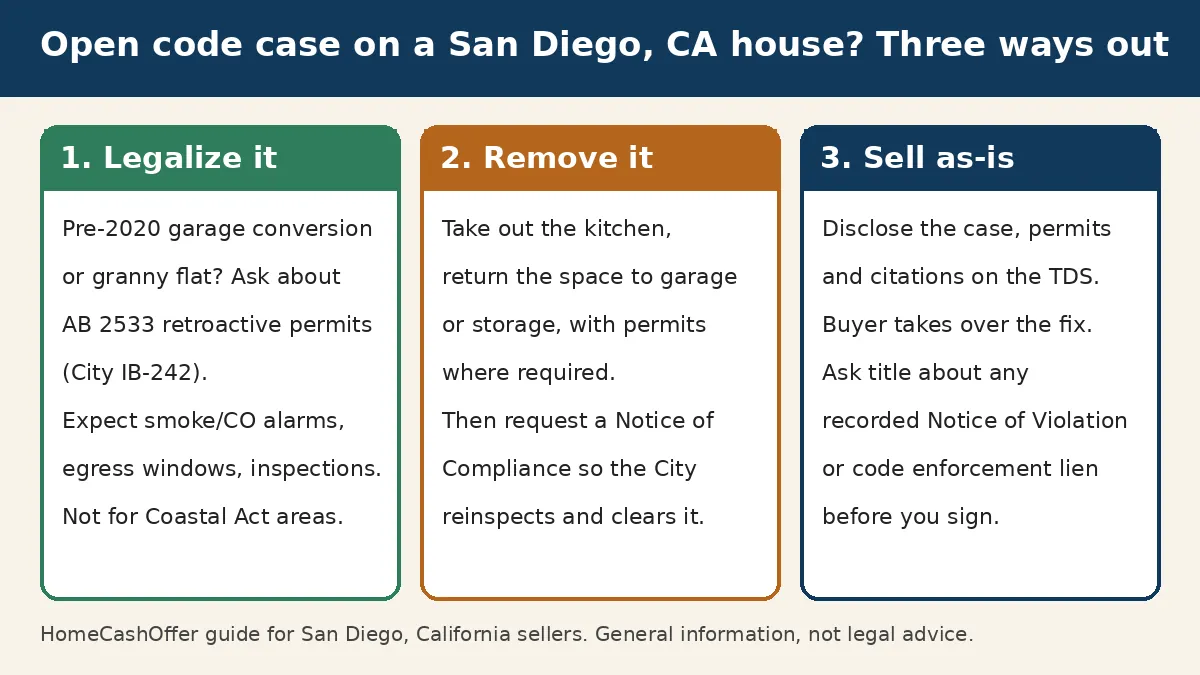
Often yes, if it was built before January 1, 2020. State law, AB 2533, took effect in 2025, and the City explains how it applies in Information Bulletin 242. In short, the City can’t deny a permit for an eligible unpermitted ADU or junior ADU just because it breaks building standards or local ADU rules. It can deny only if fixing a violation is needed to address a substandard condition. Under the bill text, the City also can’t penalize you for having had the unit and can’t charge impact fees or connection or capacity charges except in narrow cases.
What the City asks for, per IB-242:
- Proof of the construction date, such as contractor bills, material receipts, utility or insurance records, a dated lease, an appraisal or MLS listing, old code enforcement records, or dated photos.
- Your BLUE case number in the permit’s scope of work, if you’re applying because of a notice.
- A site plan and floor plan showing the unit, setbacks, easements, utility connections, alarms, exits and escape windows.
- A completed Attachment A checklist of the conditions in Health and Safety Code section 17920.3 that would make a unit substandard.
Expect to install smoke and carbon monoxide alarms and make sure every bedroom has an emergency escape window, among other fixes. The bulletin also says you can get a confidential third-party inspection from a licensed design professional or general contractor before you apply, which is a smart first step if you’re not sure the unit will pass.
Some units don’t fit the streamlined path: ones in a fault zone, landslide or liquefaction area, ones created by digging out under the house, ones built with materials the code doesn’t allow, ones sitting on an easement, and ones attached to an apartment or commercial building. Those may need full architectural and structural plans and soils reports.
Why does being near the coast change the answer?
Because IB-242 says the streamlined permit path can’t be used for unpermitted work in areas subject to the California Coastal Act. Those projects have to meet the City’s Coastal Development rules instead. If your house is in a coastal neighborhood, in Ocean Beach, Point Loma, Pacific Beach or La Jolla, for example, check whether your lot is in the Coastal Overlay Zone before you assume AB 2533 will get you a permit. Coastal lots can also run into the Proposition D height limit in the Coastal Height Limitation Overlay Zone, which the bulletin flags too.
For a coastal seller, that often tilts the math. If legalizing means a coastal development review on top of a building permit, the time and cost can be enough that selling as-is makes more sense.
What do you have to tell a buyer in California?
More than most sellers expect. The Real Estate Transfer Disclosure Statement required under Civil Code section 1102.6 (reproduced in the California Department of Real Estate’s disclosure guide) asks whether you know of:
- room additions, structural modifications or other alterations or repairs made without necessary permits,
- additions or alterations not in compliance with building codes,
- zoning violations, nonconforming uses or setback violations, and
- notices of abatement or citations against the property.
If any answer is yes, you explain it. For an unpermitted garage unit with an open case, that usually means yes on several lines, plus the case number and what the City has asked for. A cash buyer doesn’t make the form go away. What changes is that a cash buyer reads it, prices it, and doesn’t need a lender’s appraiser to sign off on a unit the City doesn’t recognize.
If someone is renting the unit, talk to a California landlord-tenant attorney before you remove it or sell. Ending a tenancy because a unit was never permitted raises its own questions under state and local rules, and those are separate from the code case.
What is a San Diego house with an open case worth?
Less than the same house with clean permits, but San Diego’s prices mean there’s often still real equity. Redfin’s San Diego data for September 2026 shows a median sale price of $979,034, a median of 28 days on market, an average sale-to-list ratio of 99.0%, and 34.3% of homes with a price drop (Redfin San Diego housing market). The Census Bureau’s 2020–2024 survey puts the median value of owner-occupied homes at $906,700, the owner-occupied rate at 47.3%, and the median gross rent at $2,313 (U.S. Census Bureau QuickFacts, San Diego city).
That rent figure explains why so many garage conversions exist. It also explains the trap: a buyer can’t count income from a unit the City says shouldn’t be there, and many lenders won’t either. In a market where well-presented, fully permitted houses sell close to list price, a house with an open case and an unpermitted unit competes in a smaller pool of buyers.
Legalize, remove or sell as-is: how do they compare?
| Legalize (AB 2533) | Remove and restore | Sell as-is | |
|---|---|---|---|
| Upfront money | Permit fees, plans, safety fixes | Demolition and permits | None |
| Time | Plan review plus inspections | Weeks of work, then reinspection | Days to a few weeks |
| Keeps rental income | Yes, as a legal unit | No | Buyer decides |
| Risk | Unit may fail substandard check | Tenant issues if occupied | Lower price |
| Who clears the case | You | You | Usually the buyer, per contract |
Gross price isn’t what you keep. Compare what’s left after commissions, closing costs, months of carrying the house, any penalties still accruing, and what the permit work actually costs. Our cash offer vs. listing comparison and sell as-is vs. fixing up guide walk through that net-sheet math.
From our deals
The code cases we see on older houses usually involve work a previous owner did, not the person selling. The sellers who get through it most smoothly have three things ready: the City’s notice with the case number, any permits or records they could find for the property, and a straight answer about who lives in the unit. With those, we can tell quickly whether we’d legalize the unit, take it back to a garage, or something else, and we can write the contract so the case and any penalties are handled clearly at closing instead of discovered halfway through escrow.
When is a cash sale the wrong call?
- The unit qualifies for AB 2533 and the fixes are small. If it was built before 2020, isn’t in a coastal or hazard area, and mostly needs alarms and an egress window, legalizing can add a legal rental unit and a stronger listing. That’s usually worth more than a discount.
- You have time and want top dollar. With San Diego homes selling near list price, a permitted house on the open market will usually bring more.
- The case is minor. A fence height, a weedy yard or a junk complaint is cheap to fix. Fix it and list.
- You haven’t read the notice closely. Find out exactly what the City wants and whether anything’s been recorded. That answer changes every offer, including ours.
How does a sale with an open case work with HomeCashOffer?
Send us the address, a copy of the notice, a few photos of the unit or addition, and whether anyone lives there. We’ll look at the case, the permit history and the title, and give you a cash offer that accounts for the work, with the contract spelling out who clears the violation and how any lien gets paid in escrow. Call (405) 622-8705 or request a cash offer, and we’ll tell you plainly if legalizing or listing would net you more.
HomeCashOffer is a nationwide cash home buyer. We aren’t lawyers, contractors or permit expediters, and nothing here is legal advice. For questions about your notice, a tenant or an appeal, talk to a California real estate attorney.
Related reading: Code violations in Las Vegas · Code violations in Cincinnati · Code violations in Baltimore · Selling a vacant house in Riverside · Selling during a divorce in Los Angeles
Sell your house fast in these markets
Local cash offer pages—or start with a nationwide request.
Frequently asked questions
Can I sell my San Diego house while a code enforcement case is open?
Yes. An open Building and Land Use Enforcement case doesn't stop a sale by itself. California's Real Estate Transfer Disclosure Statement asks whether you know of notices of abatement or citations against the property and of work done without permits, so you disclose the case, and the buyer either fixes it or prices it in. If the City has recorded a Notice of Violation or a code enforcement lien, it shows up in the title search and has to be dealt with in escrow.
What happens if I miss the deadline on a City of San Diego Notice of Violation?
Under the San Diego Municipal Code, once the deadline passes the City can move to further steps, including administrative abatement, civil penalties, a civil or criminal case by the City Attorney, and recording the Notice of Violation with the San Diego County Recorder. Before it records, the City has to send you a letter, and you get 10 calendar days to appeal. Call the investigator named on your notice before the deadline if you need more time or plan to sell.
How big can San Diego code enforcement penalties get?
Municipal Code section 12.0803 says each day a violation exists is a separate violation, sets the maximum daily rate at $10,000 per violation, and caps penalties at $500,000 per parcel or structure in a calendar year for a related series of violations. Those amounts are adjusted for inflation and include a 5% administrative fee. The actual daily amount is set case by case, based on criteria in the code, and is usually far below the maximum.
Does AB 2533 let me legalize an unpermitted granny flat or garage conversion in San Diego?
Often, if it was built before January 1, 2020. The City's Information Bulletin 242 explains that it can't deny a permit for an eligible unpermitted ADU or junior ADU unless fixing a violation is needed to address a substandard condition. You apply for a building permit, prove the construction date with things like receipts, utility bills, leases or dated photos, and correct items such as smoke and carbon monoxide alarms and emergency escape windows. The streamlined path doesn't apply in Coastal Act areas, fault or landslide zones, or units dug out under the house.
Does a recorded Notice of Violation go away when I sell?
No. It's recorded against the parcel, so it stays until the City issues a Notice of Compliance and it's recorded, which cancels it. To get that notice, the violations have to be corrected, permits finalized, penalties paid and an administrative fee paid. Many buyers who take the house as-is agree to do that work after closing, but the contract should say who is responsible.
Do I have to tell a buyer about the unpermitted unit if I'm selling for cash?
In general, yes. The California Transfer Disclosure Statement asks about additions and alterations made without permits, work not in compliance with building codes, zoning violations and nonconforming uses, and notices of abatement or citations. Selling as-is or for cash doesn't erase that duty, though some transfers are exempt, such as certain sales by court-supervised fiduciaries. Ask your agent or a California real estate attorney which forms apply to your sale.
Can the City refuse to issue me other permits while a violation is recorded?
Yes. Municipal Code section 12.1008 lets the City withhold permits for alterations, repairs or new construction on the property after a Notice of Violation is recorded or an appeal fails, until a Notice of Compliance is issued. It can't withhold the permits you need to fix the violation or to correct serious health and safety problems. That matters to a buyer who planned a remodel, and it's one reason open cases push some sellers toward an as-is sale.
Ready to see what a cash offer looks like?
No repairs required. No agent commissions when you sell to us. No obligation to accept.
Request your no-obligation cash offer
Prefer a dedicated form? Visit Get a Cash Offer Today.
Get My Cash Offer
Share your name, phone, and property address. No obligation. We will follow up shortly.