
Relocating Out of Des Moines for Work? Selling Your Iowa House From Your New City
Transferred out of Des Moines? What a relocating seller has to handle in Iowa in 2026: the new lead service line disclosure, the homestead credit notice, the 48-hour sidewalk rule while the house sits empty, septic inspections on acreages, the IRS 50-mile rule and Iowa's 3.8% tax. Call (405) 622-8705.
Short answer: If your job is moving you out of Des Moines, you can sell the house after you’ve left and sign the closing papers with a notary in your new city. Before you go, check three things: whether the water service line is lead or galvanized (Iowa’s disclosure form has asked since January 2026), who will clear the sidewalk if the house sits empty this winter, and what notice the Polk County assessor needs about your homestead credit. Then compare a listing with a direct offer on what you’d actually net.
What should you sort out the week the transfer becomes official?
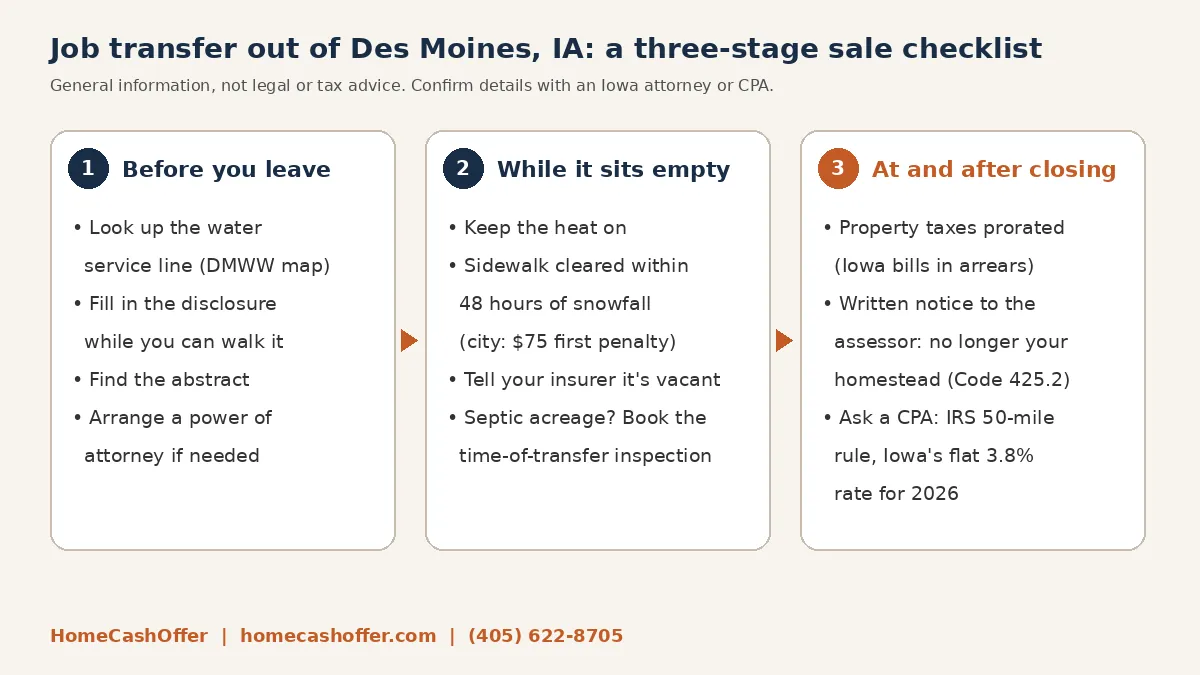
Sort out the paperwork only you can find. The typical case: a two-story house in Beaverdale or near Drake, a start date in Minneapolis or Kansas City six to ten weeks away, and a spouse who may stay for the school year. The house is fine; the calendar is the problem. Do these four things while you still have keys and a free Saturday:
- Look up your water service line. Put your address into the Des Moines Water Works service line lookup. The result goes straight onto your disclosure form (more on that below).
- Find the abstract of title. Iowa proves title with an abstract that gets updated for each sale, not with a standard title insurance policy. If it’s in a fireproof box in the basement, pack it in your carry-on, not the moving truck. Our Des Moines metro guide explains how abstracts and title opinions work.
- Ask your employer what the relocation package covers. Some employers cover selling costs or offer a buyout through a relocation company, and many have rules about when you list or who you can sell to. Read those terms before you sign a listing agreement or accept any offer.
- Decide who looks after the house: snow, mail, the furnace and a weekly walk-through. If the honest answer is “nobody,” that pushes you toward a faster sale.
Why does the water service line matter on an Iowa disclosure now?
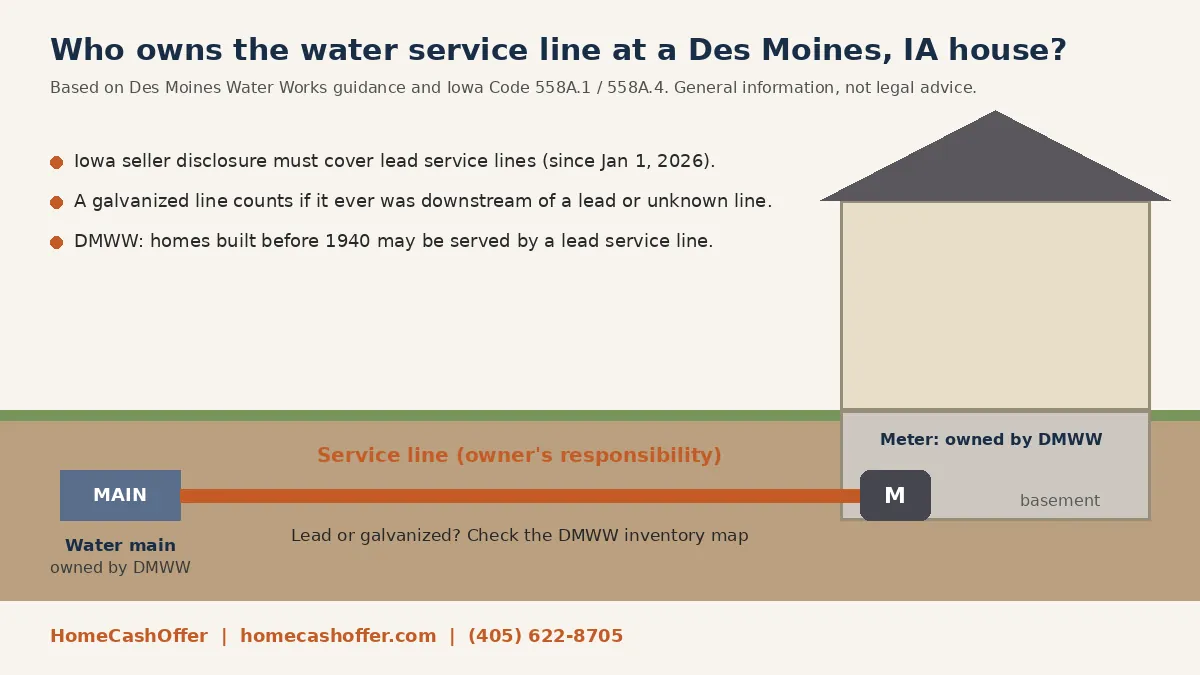
It matters because Iowa added it to the seller disclosure statement on January 1, 2026. A 2025 amendment to Iowa Code 558A.4 requires the disclosure to cover “the presence of lead service lines,” and Iowa Code 558A.1 now defines the term broadly. A galvanized line counts as a lead line if it ever was, or still is, downstream of a lead line or a line of unknown material. The service line includes the pipe from the main to the water meter.
This hits older Des Moines houses hardest. Des Moines Water Works says homes built before 1940 may be served by a lead service line and estimates there could be as many as 20,000 lead or galvanized lines in its system. The utility owns the main and the meter. You own the service line, so on paper this is your disclosure item, not the utility’s.
Three practical points for a seller who’s leaving:
- Answer from records, not memory. If the inventory map says “unknown,” the utility runs a self-reporting survey that walks owners through identifying the pipe where it enters the house. Do it before the basement is full of boxes.
- Read the letters. Owners in parts of the Drake neighborhood have been offered fully funded replacements. When the program launched in July 2025, Des Moines Water Works CEO Amy Kahler said, “It’s important that any property owner or tenant who receives a letter from Des Moines Water Works reads it because it will contain information about how to access their free service line replacement” (DMWW announcement). Forward your mail and keep the utility’s notices with your sale file.
- Know what’s at stake. The same 2025 announcement put the cost of replacing a service line at $10,000 to $12,000. A retail buyer’s inspector may raise it, and a buyer may ask for a credit. A direct buyer prices it into the offer from the start.
Does signing by power of attorney change the disclosure rules?
Technically, yes, but don’t build your plan around it. Chapter 558A excludes “a transfer by a power of attorney” from its definition of a transfer, but that narrow wording doesn’t excuse hiding a known problem, and most purchase contracts ask for the form anyway. Fill it out before you leave, while you can still remember when the water heater was replaced.
A power of attorney is still worth arranging if one spouse has moved ahead, because Iowa requires a spouse’s signature, or a power of attorney, to sell a married owner’s homestead (the Des Moines guide covers that rule). An Iowa attorney can tell you which form your closing agent will accept.
Who clears the sidewalk once you’re gone?
You do, or whoever you pay. The City of Des Moines requires owners and tenants to clear snow and ice from the sidewalk within 48 hours after a snowfall ends. A first offense carries a $75 administrative penalty, and repeat violations within three years cost more. Enforcement depends on complaints, and an unshoveled walk in front of an empty house tends to draw them.
An empty house also needs the heat on and someone checking it after hard freezes. Call your insurer before you move out, because homeowners policies often restrict coverage for vacant houses and the wording varies. Those weekly costs belong on your net sheet next to the mortgage payment.
What happens to your homestead credit when you move?
It ends once the house stops being your home, and Iowa expects you to say so. Under Iowa Code 425.2, the credit continues only while the owner lives in the house at least six months of the year and claims Iowa residency for income tax. An owner who stops using it as a homestead has to give the assessor written notice by July 1 following the change. A seller also gives written notice when the property is sold. The credit is modest (Iowa Code 425.1 sets it at the levy on the first $4,850 of value), but the notice is easy to forget from another state.
Property tax proration is the bigger closing item. Iowa taxes are paid in arrears in two halves, so the buyer usually gets a credit for the months you owned the house that the county hasn’t billed yet.
Will the IRS tax your gain if the job moved you early?
Possibly not all of it. The full home-sale exclusion requires two years of owning and living in the house within the five years before the sale. If a transfer cuts that short, the IRS rules in Publication 523 can still give you a prorated partial exclusion when the move is work-related; the publication’s test is a new workplace that sits at least 50 miles farther from the house than the old one did.
Iowa follows its own rules. Since Senate File 2442, Iowa has a flat individual rate, and the Iowa Department of Revenue confirmed that all taxable income is taxed at 3.8% for 2026. Iowa Code 422.5 applies that rate to nonresidents and part-year residents on income allocated to Iowa. A gain on an Iowa house usually counts, even if you file from Minnesota or Texas next spring. A December or January closing also decides which tax year the sale lands in, so ask a CPA before you pick the date.
Is your house on a septic system or a private well?
If you’re selling an acreage outside the city sewer lines, near Polk City, Norwalk or rural Warren and Dallas counties, there’s an extra step. Iowa Code 455B.172 requires a certified time-of-transfer inspection of any private sewage system before the county recorder will record the deed. The tank has to be pumped at the inspection unless you can show it was professionally pumped within the past three years. The inspection is good for two years, so if you had one done recently, find the report.
The statute covers winter: if weather prevents the inspection, the buyer can sign a binding acknowledgment with the county board of health to inspect as soon as practical and handle any required fixes. Many financed buyers won’t; an as-is investor often will. Separately, Iowa Code 558.69 requires a groundwater hazard statement with the declaration of value for any known well, septic system, underground tank or private burial site. You’re the one who knows where the old well is.
How fast are Des Moines houses selling this fall?
At a moderate pace, which is a long time if you’ve already moved. Over the three months ending October 2026, Des Moines’ median sale price was $223,844, up 1.7% from a year earlier. The median home went under contract in 32 days and sold for 97.8% of list price on average, while 45.4% of homes had a price drop, according to Redfin’s Des Moines housing market data. Those 32 days are on-market time only; inspection, financing and the abstract update come after, and a remote seller pays for every week.
Census figures explain the price level. The U.S. Census Bureau’s QuickFacts for Des Moines puts the median value of owner-occupied homes at $194,700 in the 2020–2024 American Community Survey, with an owner-occupancy rate of 60.5%. The city’s population estimate fell 0.9% between April 2020 and July 2025. Within the metro, newer suburbs like Ankeny and West Des Moines compete for the same move-up buyers, so a dated, pre-war house in the city has to price against new construction 20 minutes away.
Should you list, rent it out, take the relocation buyout or sell direct?
The right choice depends on who will be on site, not just the price:
- Listing with an agent usually brings the highest gross price when the house is updated and someone can keep it show-ready. If your spouse stays through the school year, that’s often your best option.
- An employer buyout, if your package includes one, trades some price for certainty on a set timeline. Read its inspection and disclosure terms closely. The lead line question applies there too.
- Renting it out keeps options open but makes you a long-distance landlord in an Iowa winter; our Omaha tired-landlord guide shows how that often feels a few years in.
- A direct sale makes sense when the house needs work no one will be around to oversee, the service line or septic situation would scare off a financed buyer, or your new job starts before a listing could realistically close.
Put all four side by side on what you’d keep: subtract commissions, repair credits, each month of heat, insurance and mortgage, and the flights back to Iowa. Our cash offer versus listing comparison lays out how to line them up.
From our deals
The relocating sellers we talk to rarely have a bad house. They’re short on time and people: one spouse is already at the new job, the other is packing, and the closing date slides because the abstract is missing or a disclosure question can’t be answered from 300 miles away. When sellers send the inventory map result, a photo of where the water line enters the basement and the abstract’s whereabouts, we can usually give a firm number and a workable date. Sellers who wait until after they’ve moved usually end up flying back for something.
When is a cash sale the wrong call for a relocating Des Moines seller?
A cash sale is the wrong call when the house would sell well on the open market and someone can manage that sale. Skip a direct offer, or at least test the market first, if:
- the house is updated, the service line is copper on the map, and a family member nearby can handle showings and snow;
- your employer’s relocation benefit pays selling costs only on a listed sale, or requires you to use their program;
- you’d be selling below your mortgage payoff, which needs your lender and probably an attorney before any buyer;
- you haven’t seen a local agent’s net sheet. Get one, then get a written direct offer, and compare.
How does a remote HomeCashOffer sale work from your new city?
Send us the address, a few photos, the service line result and what you know about the roof, furnace and basement. After a walk-through with you on video or a key holder you choose, we send a written, no-obligation cash offer for the house as it is. No repairs, no commission. Once you accept, an Iowa closing agent handles the abstract update, the declaration of value and any groundwater hazard statement, and you can sign the papers with a notary in your new city. You pick the closing date, including one that lands before your first mortgage payment on the new place.
To start, call (405) 622-8705 or ask for your cash offer here, or read our Des Moines, IA page first.
HomeCashOffer’s office is at 3000 W Memorial Rd, Ste 123 Unit 308, Oklahoma City, OK 73120, and we buy in Des Moines and across the country. For questions about a specific contract, title problem or tax bill, talk to an Iowa attorney or CPA.
Related reading: Selling a house fast in Des Moines, West Des Moines and Ankeny · Selling a San Jose house after a job relocation · Selling a Detroit house during a job transfer · Selling a house fast in Omaha
Sell your house fast in these markets
Local cash offer pages—or start with a nationwide request.
Frequently asked questions
Do I have to tell a buyer about a lead water service line when I sell my Des Moines house?
Yes, under the disclosure rules in effect since January 1, 2026. Iowa Code 558A.4 now says the seller disclosure statement must cover the presence of lead service lines, and 558A.1 counts a galvanized line as a lead line if it ever was downstream of a lead line or a line of unknown material. Look up your address on the Des Moines Water Works service line inventory map before you fill in the form.
What do I owe the Polk County assessor once I move out of Iowa?
A written notice. Under Iowa Code 425.2, an owner who stops using a property as a homestead, or doesn't plan to live there at least six months of the calendar year, has to notify the assessor by July 1 following the change. When you sell, you also give written notice that it's no longer your homestead. The buyer refiles for their own credit.
Who is responsible for shoveling the sidewalk at my empty Des Moines house?
You are, until closing. The City of Des Moines requires owners and tenants to clear snow and ice from the public sidewalk within 48 hours after a snowfall ends, and a first violation carries a $75 administrative penalty, with larger penalties for repeats. If you've already moved, line up a snow contractor or a neighbor before the first storm.
Can I sell an Iowa acreage with a septic system in January if the ground is frozen?
Usually, yes. Iowa Code 455B.172 requires a certified time-of-transfer inspection of a private septic system before the deed can be recorded, but if weather prevents it, the buyer can sign a binding acknowledgment with the county board of health to inspect at the earliest practicable time and take responsibility for any required fixes. An inspection stays valid for two years.
Will I pay capital gains tax if my job moves me before I've lived in the house two years?
Maybe less than you fear. IRS Publication 523 allows a partial exclusion when the main reason for the sale is a work-related move, for example a new job at least 50 miles farther from the home than your old work location. The allowed exclusion is prorated by how long you owned and lived there. Ask a tax professional to run your numbers.
Does Iowa still tax the gain after I've moved to another state?
It can. Iowa taxes nonresidents and part-year residents on income allocated to Iowa, and a gain on Iowa real estate is the kind of income that usually is. For 2026, Iowa's individual rate is a flat 3.8%. How much of the gain is taxable at all depends on your federal exclusion, so ask a CPA before closing.
Ready to see what a cash offer looks like?
No repairs required. No agent commissions when you sell to us. No obligation to accept.
Request your no-obligation cash offer
Prefer a dedicated form? Visit Get a Cash Offer Today.
Get My Cash Offer
Share your name, phone, and property address. No obligation. We will follow up shortly.