
Selling an Omaha Rental This Winter: Leases, Deposits, Rental Registration and Nebraska's 2027 Tax Cut
Tired of being an Omaha landlord? How to sell a Nebraska rental with tenants in place, what happens to deposits and Omaha rental registration at closing, how property taxes in arrears and the 2027 income tax rate cut affect timing, and when a cash sale makes sense. Call (405) 622-8705.
Short answer: You can sell an Omaha rental with the tenants still in it, and many investors would rather buy it that way. The leases stay in force, the deposits move to the buyer at closing, and the buyer re-registers the property with the city. What makes a sale this winter different is the calendar: Nebraska property taxes are paid a year in arrears, the state income tax rate drops again on January 1, 2027, and every lease end date you’re waiting on falls in the coldest part of the year.
Which Omaha landlord is this written for?
One in particular: you own a side-by-side duplex or an old foursquare cut into two units somewhere east of 72nd Street, maybe near Hanscom Park, Field Club, Benson or the edges of South Omaha. You bought it years ago, or you inherited it. One side has a long-time tenant on month-to-month. The other side turned over twice in two years. The furnace is original enough that you hold your breath each November, and you’ve stopped enjoying the 10 p.m. calls.
You don’t need a pep talk about passive income. You need to know what Nebraska and the City of Omaha actually require when you sell, and whether to do it now, in January or after the next lease ends. If your rental is a newer single-family house out in Elkhorn or Papillion with a good tenant and no deferred maintenance, keeping it or listing it may be the better move. For the wider metro picture, start with our guide to selling fast in Omaha, Bellevue and Lincoln.
Can you sell an Omaha rental with tenants still living in it?
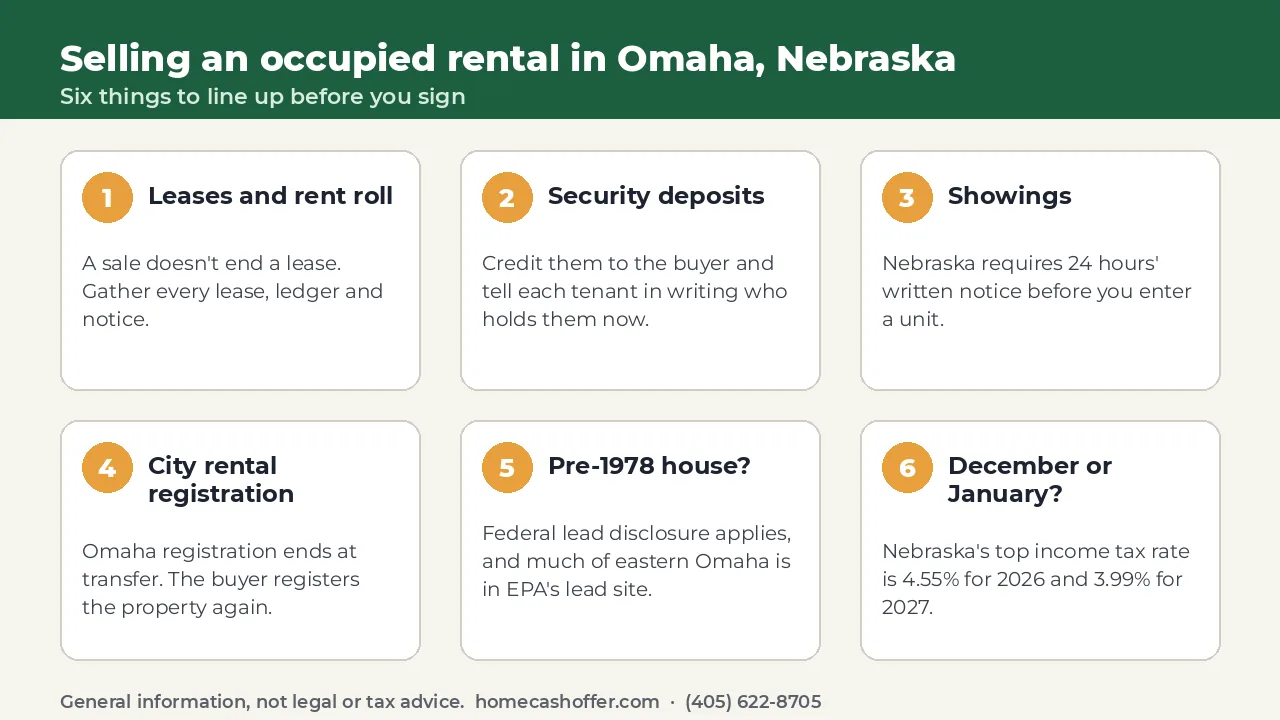
Yes, and it’s often the simplest route. A sale doesn’t end a lease. The buyer steps into your shoes as landlord, takes the rent from the closing date forward and has to honor the existing terms. A tenant with a lease through May 2027 stays through May 2027 unless they agree to leave early.
Two Nebraska rules shape how that sale goes:
- Showings need notice. Under Neb. Rev. Stat. 76-1423, a tenant can’t unreasonably refuse entry to show the unit to prospective buyers, but outside emergencies you have to give at least 24 hours’ written notice, delivered to each unit, stating the purpose and a reasonable window. A buyer who needs one walkthrough is easier on a tenant than six weekends of open houses.
- Month-to-month tenants get 30 days, timed to the rent date. Neb. Rev. Stat. 76-1437 says either side can end a month-to-month tenancy with written notice at least 30 days before the periodic rental date in the notice. Notice given in mid-November for rent due on the 1st usually means a January 1 termination, not mid-December.
If a tenant is behind, the clock is different. Under 76-1431, a landlord can terminate if rent isn’t paid within seven calendar days after a written nonpayment notice, but an eviction still runs through county court. Plenty of tired landlords sell with a slow-paying tenant in place rather than start that process. If you do, disclose the ledger honestly.
What does the Nebraska calendar mean for a sale this winter?
More than most landlords expect. Three dates land on or around January 1.
Property taxes are a year behind. Under Neb. Rev. Stat. 77-203, the taxes levied for 2026 become due on December 31, 2026, and in counties over 100,000 people, which includes Douglas County, 77-204 makes the first half delinquent April 1 and the second half August 1. So if you close in December 2026, you probably haven’t paid a dollar of 2026 taxes yet. Expect the title company to credit the buyer for your share of the year. That’s normal, but it surprises sellers who think of the taxes as “paid up.”
The state income tax rate drops again. Neb. Rev. Stat. 77-2715.03 sets Nebraska’s top rate at 4.55% for 2026 and 3.99% for 2027, and the Department of Revenue’s 2026 tax calculation schedule applies 4.55% from about $24,760 of taxable income for single filers. Nebraska generally taxes a rental sale gain at those regular rates. On a $100,000 gain, waiting until January saves about $560 in state tax. That’s real money, but it’s smaller than one month of mortgage, insurance and heating a vacant unit for many owners, and it’s nothing next to a split supply line in a January cold snap. Run both numbers.
Federal tax doesn’t change on January 1. The IRS taxes the part of your gain that comes from depreciation you took, or could have taken, as unrecaptured section 1250 gain at a maximum 25% rate, according to IRS Topic 409. That’s the number that surprises long-time landlords most. A CPA can tell you what it means for your basis before you sign anything.
One cost is fixed whatever month you pick: Nebraska’s documentary stamp tax. Neb. Rev. Stat. 76-901 charges the seller $3.32 per $1,000 of value for transfers before 2032, about $953 on a $287,000 sale.
What happens to the tenants’ security deposits at closing?
They follow the tenants, not you. In most Omaha rental sales the deposits are listed on the settlement statement and credited to the buyer, who then owes them back when each tenancy ends. Nebraska’s rules for that eventual return are in Neb. Rev. Stat. 76-1416: a deposit can’t exceed one month’s rent, plus a pet deposit of up to a quarter of a month’s rent, and the balance with a written itemization is due within 14 days after the tenancy ends. A willful failure can cost the landlord up to one month’s rent or twice the deposit, whichever is less, plus attorney fees.
Pull your records before you price the house. If you collected more than the cap years ago, or you can’t say what you’re holding for the tenant who moved in in 2019, sort it out now. A buyer will ask for a rent roll and estoppel-style confirmation of what each tenant paid.
The other step is a letter. Neb. Rev. Stat. 76-1417 requires the landlord to give tenants, in writing, the name and address of the manager and of the owner or agent for notices, and says that duty extends to any successor owner. After closing, both of you should tell each tenant who holds the deposit, where rent goes and who to call when the water heater quits.
Does Omaha’s rental registration follow the house to the buyer?
No, the buyer has to register it again. Omaha’s rental registration and inspection ordinance, in effect since January 2020, makes it unlawful to lease or keep leasing a rental dwelling that isn’t registered with the city’s Permits and Inspections Division. The city’s program overview says a registration stays in effect until the owner transfers the property. It covers rentals inside city limits and in Omaha’s three-mile extraterritorial jurisdiction within Douglas County.
What matters for your sale:
- Registration is free, inspections aren’t. According to the city’s rental registration FAQ, each annual or ten-year inspection costs $125 per unit, as does a missed inspection the owner fails to reschedule. Single-family and duplex rentals are inspected unit by unit.
- Problem properties are inspected every year. Rentals with code violations not fixed within the time allowed on a notice of violation, or ones that weren’t registered on time, go on the annual list. Everything else is on a ten-year cycle.
- Open violations don’t vanish at closing. If you have an unresolved notice from the city, give the buyer a copy. A cash buyer can usually price it. A financed buyer’s lender may not close around it.
If you never registered, register now rather than hoping it doesn’t come up. The buyer’s title and due-diligence work tends to surface it anyway.
Why do house age and the Omaha lead site matter for an east Omaha rental?
Because lead is a disclosure issue on most of the older rentals in town. Federal law requires sellers and landlords of housing built before 1978 to disclose known lead-based paint and hazards and hand over any reports. EPA’s lead disclosure rules for sales and leases cover the form and the buyer’s inspection window. Much of Omaha’s older rental stock, from Dundee and Gifford Park to the bungalows of North and South Omaha, was built long before that date.
Omaha also has a lead problem in the soil. The EPA’s Omaha Lead Superfund site profile describes a 27-square-mile site centered on downtown, where residential yards were contaminated by emissions from former lead smelting and battery-recycling operations. If you have paperwork showing your yard was tested or remediated, keep it with your lease files and share it. It’s the kind of document that makes an older east Omaha house easier to buy.
What is the Omaha market telling a landlord this fall?
That it’s still a market where sound houses sell. Redfin’s Omaha market data put the median sale price at $286,863 for the three months ending September 2026, up 2.5% from a year earlier, with a median of 19 days on market. About 30.8% went for more than the asking price and 30.7% saw a price cut first.
Those numbers describe mostly owner-occupied single-family sales. An occupied duplex with dated units and a tenant who won’t allow Saturday showings isn’t competing in that pool. Its buyers are other investors, and they price it on the rent roll, the condition and how much work the next turnover will take. That’s why a landlord with a clean, updated house can often list and do well, while one with a tired building and complicated tenants may net about the same from a direct sale once commissions, turnover and months of carrying are counted. Our cash offer vs. listing guide shows how to line those up side by side.
Should you sell occupied, wait for a vacancy, or fix and list?
Each route has a real cost in Omaha:
- Sell occupied. Fastest, and you keep collecting rent until closing. The buyer pool is mostly investors, and the price reflects the leases and the condition you can’t show well.
- Wait for a vacancy, then sell. You can show it, paint it and reach owner-occupant buyers. You also carry an empty unit through an Omaha winter, with the heat on and someone checking it, and you lose the rent.
- Fix and list. Often the best price for a house in decent shape, but it means contractors, a turnover, a city inspection that may surface items, and a listing that might stretch into spring.
The honest test: add up what the next six months cost you under each option, including your time, and compare the net, not the headline price.
From our deals
The tired-landlord houses we see in the Midwest are rarely disasters. They’re usually decent older buildings run by owners who have simply done it long enough, often with one great tenant, one difficult one and a list of repairs that keeps getting pushed to next season. What makes these sales go smoothly is paperwork: current leases, a ledger that shows who has paid what, the deposit amounts and any city notices. When we have that up front, we can make an offer that holds and work around the tenants instead of disrupting them. When records are missing, it isn’t a deal-breaker. It just takes longer to sort out.
When should an Omaha landlord not sell for cash?
- The house is in good shape and a vacancy is coming. If one unit empties in spring and needs only paint, listing it then will likely net more.
- You want to stay invested. If you plan to buy another rental, talk to a qualified intermediary about a 1031 exchange before you sign. It has to be set up before closing.
- The numbers still work. If rents cover the mortgage, taxes, insurance and repairs with room to spare, and the frustration is one tenant rather than the whole business, a property manager may solve the problem.
- You haven’t priced both paths. Ask a local listing agent for a net sheet on the house as it sits, get a written offer from a direct buyer, and put the two bottom lines next to each other.
Selling direct tends to win when deferred repairs have piled up, a tenant situation would make showings miserable, you live out of state or across the river in Iowa, or you want a known closing date instead of a winter of maybes.
How does a HomeCashOffer rental purchase work in Omaha?
Send us the address, the number of units, the rents, the lease end dates and what you know needs work. We’ll ask for the leases and ledger, look at the property with the tenants’ notice requirements in mind, and put a written offer in front of you that assumes the building as it stands. You don’t fix anything and there’s no commission. If you accept, a Nebraska title company handles the closing, including the stamp tax, tax prorations and the deposit credits, and you choose a closing date, December or January. Reach us at (405) 622-8705 or start an offer request here. You can also see our Omaha, NE page and nearby Bellevue, NE page.
HomeCashOffer buys houses nationwide from its office at 3000 W Memorial Rd, Ste 123 Unit 308, Oklahoma City, OK 73120. A specific lease, deposit dispute or tax question belongs with a Nebraska attorney or CPA.
Related reading: Selling a house fast in Omaha, Bellevue and Lincoln · Selling a Kansas City rental as a tired landlord · Selling a Milwaukee rental with tenants · Selling an inherited house with tenants · Selling a house fast in Des Moines
Sell your house fast in these markets
Local cash offer pages—or start with a nationwide request.
Frequently asked questions
Can I sell my Omaha rental while the tenants are still living there?
Yes. A sale doesn't cancel an existing lease, so the buyer takes the house with the tenants and their lease terms. You can show the house, but Nebraska's landlord-tenant act generally requires at least 24 hours' written notice before you enter a unit, and entry has to be at reasonable times.
How much notice do I need to give a month-to-month tenant in Nebraska if I want the house empty before I sell?
At least 30 days' written notice before the periodic rental date named in the notice, under Neb. Rev. Stat. 76-1437. If the tenant pays on the first of the month and you give notice on November 10, the earliest clean termination date is usually January 1, not December 10. A fixed-term lease can't be ended early just because you're selling.
What happens to my tenants' security deposits when I sell?
They're usually credited to the buyer on the settlement statement, and the buyer becomes responsible for returning them when each tenancy ends. Nebraska caps a deposit at one month's rent plus a pet deposit of up to a quarter month's rent, and the landlord at move-out has 14 days to return the balance with an itemization. Tell each tenant in writing who holds the deposit and who the new owner or manager is.
Does Omaha's rental registration transfer to the buyer?
No. Under Omaha's rental registration ordinance, a registration stays in effect until the owner transfers the property, so the new owner has to register it again. Registration is free; city inspections cost $125 per unit. Open code violations don't disappear at closing, and a buyer will want to know about them.
Should I close my Omaha rental sale in December 2026 or January 2027?
It depends on the size of your gain and your carrying costs. Nebraska's top individual income tax rate is 4.55% for 2026 and drops to 3.99% for 2027, so pushing closing into January saves 0.56% on the Nebraska-taxed gain. On a $100,000 gain that's about $560, which a month of mortgage, insurance, utilities and winter risk can easily outweigh. Ask your CPA before you pick a date.
Who pays the Nebraska documentary stamp tax when I sell?
The seller. Neb. Rev. Stat. 76-901 sets it at $3.32 per $1,000 of value for transfers before 2032, so a $287,000 sale carries about $953 in stamp tax. It's paid when the deed is recorded with the Douglas County Register of Deeds and usually comes out of your proceeds at closing.
Ready to see what a cash offer looks like?
No repairs required. No agent commissions when you sell to us. No obligation to accept.
Request your no-obligation cash offer
Prefer a dedicated form? Visit Get a Cash Offer Today.
Get My Cash Offer
Share your name, phone, and property address. No obligation. We will follow up shortly.