
Selling a Vacant House in Rochester, NY: The 60-Day Registry, the Management Plan, and What Winter Costs You
Own an empty house in Rochester, NY? How the city's Vacant Building Registry and management plan work, why the registration doesn't pass to a buyer, the 60-day insurance vacancy clause, city tax installments and the New York disclosure form, plus when a cash sale makes sense. Call (405) 622-8705.
Short answer: Yes, you can sell an empty Rochester house as-is, and a direct cash sale can close without you making repairs or flying in for showings. The city’s clock is the part to watch: once a house has been vacant more than 60 days, Rochester expects it on the Vacant Building Registry with a fee and a written management plan, and your insurance and the city tax installments keep running all winter whether anyone lives there or not.
Who is this guide written for?
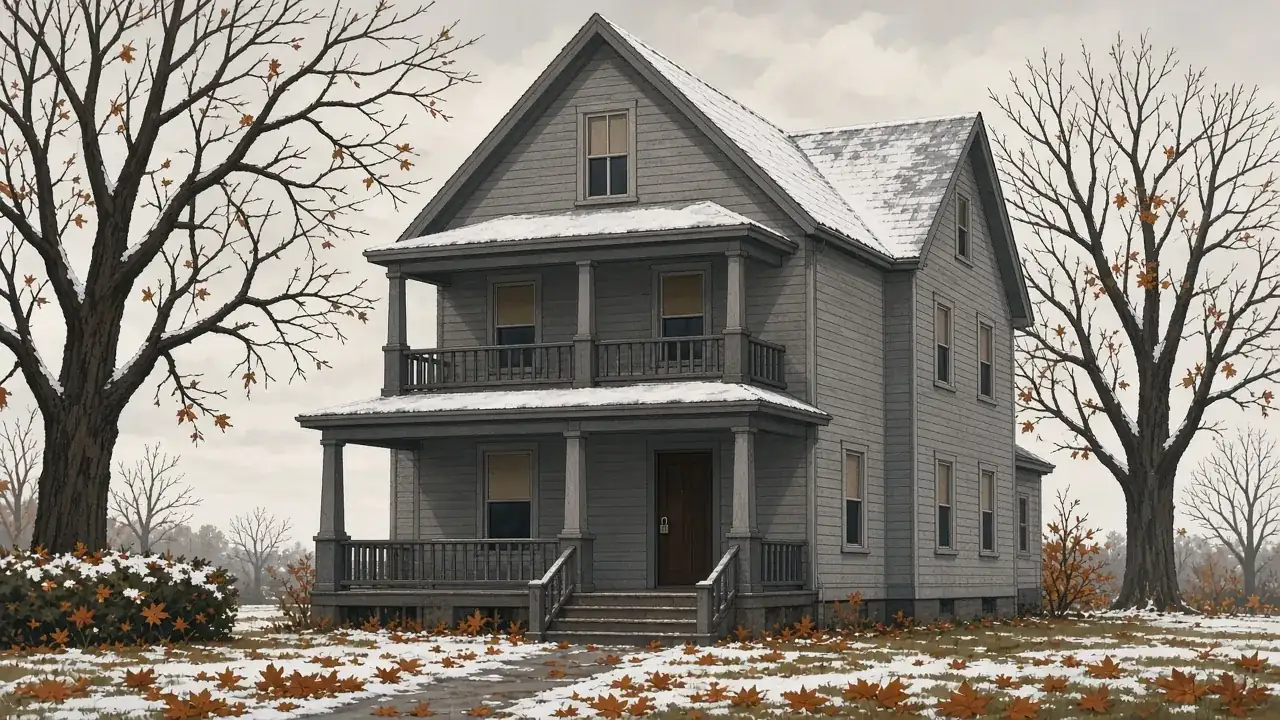
Think of someone who lives in Charlotte, Phoenix or Long Island and owns a house in Rochester they don’t live in. Maybe it was a parent’s house in the 19th Ward or Maplewood. Maybe it was a two-family near Beechwood that lost its last tenant in the summer and never got re-rented. The furnace is set low, a neighbor is collecting the mail, and the first lake-effect snow is on the way.
If that’s you, you’re probably weighing three questions: what does Rochester require of you while the house is empty, what does it cost to keep it that way, and is it worth fixing, renting or listing instead of selling as-is? This post works through those in order. For the wider upstate picture, our Buffalo and Rochester cash hub covers the region.
When does Rochester consider your house “vacant”?
As soon as no one lawfully lives there. The city’s Property Code defines a vacant building as one where no occupant lawfully resides, no tenant is in lawful possession, or the building isn’t otherwise in lawful use. Furniture inside doesn’t change that, and neither does a relative stopping by once a week.
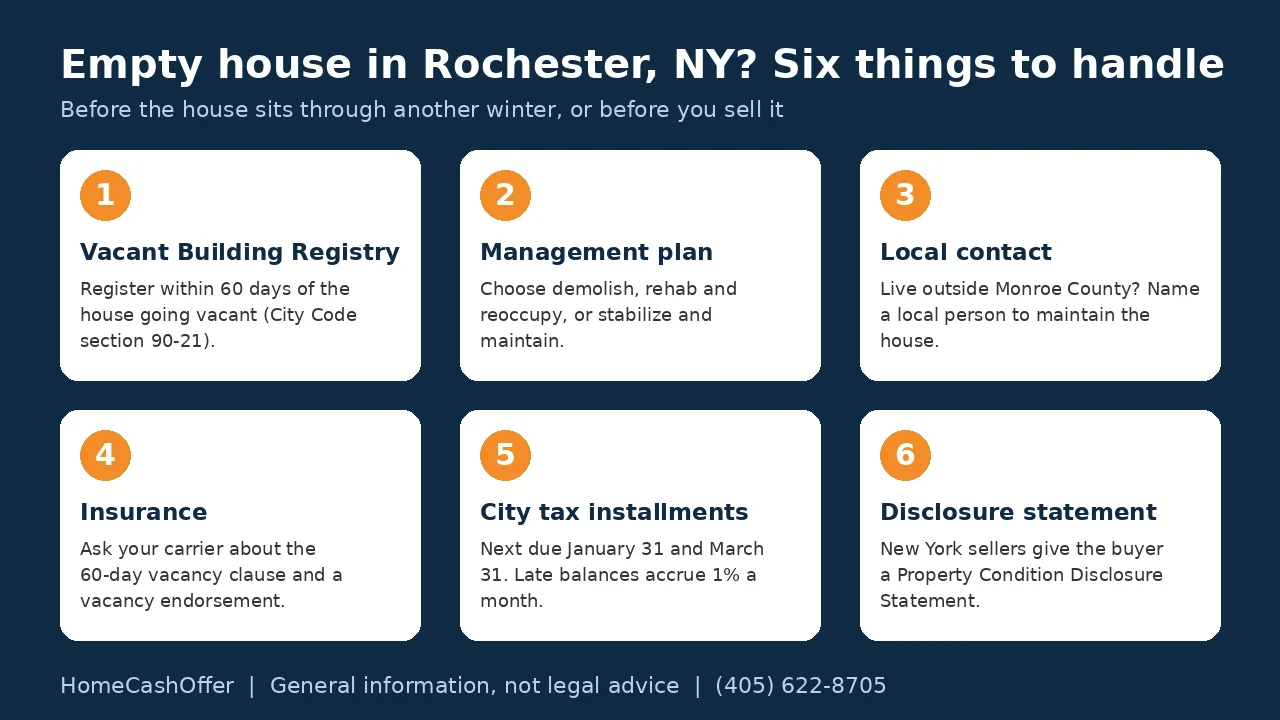
The same section lists what every owner of a vacant building has to do: keep it safe and sanitary, secure it against entry, keep the yard free of trash and high grass, paint any boarded openings a neutral color and, once it has been vacant more than 60 days, register it. You can read the full text in Rochester City Code chapter 90.
There is one narrow exemption worth knowing about. A single-family, owner-occupied house whose owner leaves Rochester for the winter doesn’t have to register if it’s secured so it doesn’t look empty, has no open code violations, has someone handling snow removal and lawn care, and the owner returns within 180 days. An inherited house or an empty rental doesn’t fit that exemption.
What does the Vacant Building Registry cost and require?
The city’s Vacant Building Registry page explains that City Council added the requirement in March 2023 and it took effect January 1, 2024. Owners of buildings vacant over 60 days have to apply for each property and pay a fee every year. Properties that don’t comply can be cited and ticketed.
For a 1- to 3-unit house, which covers most single-family homes and doubles, the fee schedule in the code is:
- Year 1: $250
- Year 2 (first renewal): $500
- Year 3 and every year after: $1,000
The application also asks for each owner’s name, address and a copy of a photo ID, LLC member details if an LLC owns it, a certificate showing the house is insured while vacant, and a management plan.
That climbing fee is the city telling owners it doesn’t want houses to sit. A house that stays empty for four winters costs $2,750 in registry fees alone, before heat, insurance, taxes or a single repair.
What goes in the management plan, and where does “I’m selling” fit?
The plan has to pick one or more of three paths: demolition, rehabilitate and reoccupy, or stabilize and maintain. A rehab plan needs a schedule of the major work, finished before the registration expires. A stabilize-and-maintain plan needs a schedule for keeping the house secure and up to code, plus a written reason why it’s staying vacant. The registration isn’t complete until the city approves the plan.
Selling isn’t one of the three options on its own. Most owners who intend to sell will file a stabilize-and-maintain plan and give the planned sale as the reason it’s vacant. The code gives a lower $100 first-year fee when the plan is to demolish or to rehab and reoccupy, but if that plan isn’t approved or isn’t carried out on time, a surcharge is added at renewal. Don’t promise a rehab you aren’t going to do just to save $150.
Does the registration follow the house to the buyer?
No, and this matters when you compare offers. The code says one owner’s registration isn’t transferable. A new owner of a building that’s still vacant has to file its own registration, with its own fee and its own management plan, within 60 days of taking title.
In practice, when you sell an empty house to an investor who plans to renovate it, the registry becomes the buyer’s paperwork after closing. Your job is to make sure your own registration and any tickets are dealt with, so nothing unexpected shows up when the closing attorneys review the file.
What if you don’t live in Monroe County?
The registry has a rule aimed squarely at out-of-town owners. If you live outside Monroe County, your registration has to name a person or business located in Monroe County who is responsible for maintaining the property. A cousin in Greece or Irondequoit can do it, as can a property manager or a contractor you trust.
Pick someone who will actually go inside. A Rochester winter is hard on an empty house. Furnaces fail, pipes in exterior walls freeze, and snow piles up on porch roofs and walks. A quick monthly drive-by won’t catch a burst pipe in the basement.
Is the house still insured after 60 days empty?
Maybe not fully, so call your agent this week. New York’s standard fire insurance policy, written into Insurance Law section 3404, says the insurer isn’t liable for loss while a described building is vacant or unoccupied beyond a period of 60 consecutive days, unless something different is added to the policy in writing. Homeowners policies are built on that standard and many add their own vacancy terms.
The fix is usually a vacancy endorsement or a separate vacant-dwelling policy, which costs more than a normal homeowners policy. You need proof of coverage for the registry anyway, so the two tasks go together. If the house is in an estate, make sure the policy names the estate or the executor, not just your late parent.
What is the city tax bill doing while the house sits?
It keeps coming. The City of Rochester property tax page splits city taxes into four installments due July 31, September 30, January 31 and March 31. An unpaid installment starts accruing interest at 1% a month. The city’s bill doesn’t include Monroe County charges, which are billed separately. The same page lists “add to tax” charges, which is how some unpaid city charges end up on the tax bill.
If the taxes fall behind, the city runs its own in rem tax foreclosure. Its tax foreclosure FAQ says a lien becomes delinquent when taxes are unpaid for more than one year, and auctions happen roughly 16 months after that. According to the city’s auction page, the 2026 auction is set for November 18, 2026, at the Joseph A. Floreano Rochester Riverside Convention Center, and the opening bid is the balance owed to the city. The current owner isn’t allowed to bid on their own property at that auction. If an empty house you own is on this year’s list, talk to the Treasury Bureau or a lawyer now. The deadline to apply for a tax agreement to keep a property out of this year’s auction was October 30, 2026.
What is an empty Rochester house worth right now?
Probably more than you’d guess if you last looked a few years ago. Redfin’s Rochester housing market page put the city’s median sale price at $189,910 for the three months ending September 2026, up 5.5% from a year earlier, with homes typically selling in about 11 days. For all of Monroe County, Redfin’s county data showed a median of about $299,000 over the same period.
Those numbers are for houses that sold through the market, usually in move-in condition. An empty house that needs a new furnace, has a wet basement, or still has a family’s belongings in the attic won’t get those days on market or that price from a retail buyer with a mortgage.
The city is also mostly renters. The Census Bureau’s QuickFacts for Rochester puts the owner-occupied rate at 38.1% for 2020 to 2024, with a median gross rent of $1,081. That’s why so many vacant Rochester doubles are former rentals, and why investors are a big part of the buyer pool for them.
Do you still owe New York’s disclosure form for a house you haven’t lived in?
Usually, yes. New York’s Property Condition Disclosure Act asks sellers to give the buyer a Property Condition Disclosure Statement before the contract is signed. For years, many sellers gave a $500 credit at closing instead. As the New York State Bar Association explains, a 2023 law removed that option effective March 20, 2024 and added seven questions about flood risk and flood insurance.
Being away from the house doesn’t change what you owe: honest answers based on what you actually know. If you don’t know whether the basement takes on water, say “unknown” rather than guessing “no.” Some sellers, such as executors and administrators selling for an estate, may be exempt under the statute, so ask the closing attorney. If the house was built before 1978, the federal lead-based paint disclosure rule applies to the sale separately.
What comes out of your proceeds at a Rochester closing?
Less than in many states, but plan for it. New York’s real estate transfer tax is $2 for every $500 of consideration, according to the state Department of Taxation and Finance. On a $189,910 sale, that’s about $760. The seller customarily pays it, but your contract controls.
Expect the closing attorney to also pay off any mortgage, prorate the city and county taxes, clear any unpaid registry fees, tickets or “add to tax” charges, and settle water and refuse balances. Upstate, both sides usually have their own real estate attorney, so get yours involved early.
Should you rent it, fix it, list it, or sell it as-is?
Rent it again if the house is close to rent-ready and you have a local manager you trust. Before you sign a lease, check what the city currently requires for rental properties, especially older ones.
Fix it and list it if the work is cosmetic and you can be in town, or trust someone who is, for a month or two of contractors. Rochester’s quick days on market reward a clean, updated house.
Sell it as-is if the repairs are big, the contents are still inside, you’re paying registry fees, vacancy insurance and heat for a house nobody uses, or the tax bill is starting to slip. A direct buyer takes it in its current condition, and the registry becomes their responsibility after closing.
From our deals
When we talk with owners of empty houses in older cities, the house has usually been sitting longer than they planned. A tenant left, a parent moved to assisted living, or a sale stalled, and then a winter went by. The owners who come out ahead decide early. They get the insurance right, keep the taxes current and make a choice before the second registry renewal. The ones who struggle usually find the costs had been stacking up quietly for a year or more. We’d rather talk it through with you early, even if you end up listing.
When should you not sell a vacant Rochester house for cash?
- The house only needs paint and a cleanout. With Rochester homes selling in about 11 days, a light-touch listing could net more than an as-is offer.
- You want to own it long term. If you’d rather keep it as a rental and can fund the repairs, selling just to avoid a registry fee is a poor trade.
- The title isn’t settled. If the owner died and no executor or administrator has been appointed by the Monroe County Surrogate’s Court, nobody can sign a deed yet. Start there. Our Buffalo probate guide walks through the New York process.
- You haven’t compared numbers. Get a net sheet from a local agent and a written offer from a direct buyer, and compare what you’d actually take home.
How does a HomeCashOffer sale work if you’re not in Rochester?
Tell us the address, what you know about its condition, and whether anything is still inside. We’ll arrange a walkthrough with your local contact, then send a written offer for the house as it is, with no repairs, cleanout or commissions. If you accept, the closing is handled through New York real estate attorneys and a title company, and you can usually sign with a mobile notary wherever you live. You choose the closing date once the title is clear. Call (405) 622-8705 or request your cash offer. You can also visit our Rochester, NY page, or nearby pages for Buffalo and Syracuse.
HomeCashOffer buys houses nationwide from its office at 3000 W Memorial Rd, Ste 123 Unit 308, Oklahoma City, OK 73120.
Related reading: Vacant and inherited houses: selling for cash · Selling a vacant house in Cleveland · Selling a vacant house in Philadelphia · Inherited house in Buffalo probate · Leaving New York City for a new job · Selling as-is vs. fixing up
Sell your house fast in these markets
Local cash offer pages—or start with a nationwide request.
Frequently asked questions
How long can a house in Rochester, NY sit empty before I have to register it?
Sixty days. Under section 90-21 of the Rochester City Code, the owner of a building that has been vacant more than 60 days must register it on the city's Vacant Building Registry and renew the registration every year it stays vacant. The rule took effect January 1, 2024. A building counts as vacant when no occupant lawfully lives there and no tenant is in lawful possession.
How much does Rochester's Vacant Building Registry cost for a single-family or two-family house?
For a 1- to 3-unit residential building, the code sets the fee at $250 for the first year, $500 for the first renewal and $1,000 for each year after that. The first-year fee drops to $100 if your registration comes with an approved plan to rehab and reoccupy or demolish, but if that plan isn't carried out on time, a surcharge is added at renewal.
If I sell my vacant Rochester house, does my registration transfer to the buyer?
No. The code says a registration isn't transferable. A new owner of a building that's still vacant has to file its own registration, with its own fee and management plan, within 60 days of taking title. When you sell to an investor who plans to renovate, that obligation becomes theirs after closing.
I live in another state. Can I still register and manage an empty house in Rochester?
Yes, but if you live outside Monroe County, the registration has to name a person or business located in Monroe County who is responsible for maintaining the property. Many out-of-town owners use a property manager, a contractor or a relative in the area. That person should be someone who will actually check the house through the winter.
Does my homeowners insurance still cover a Rochester house that has been empty for months?
Check with your insurer before assuming it does. New York's standard fire policy in Insurance Law section 3404 suspends coverage for loss while a building is vacant or unoccupied beyond 60 consecutive days, unless the policy says otherwise in writing. Ask your agent about a vacancy endorsement or a vacant-dwelling policy, especially since the registry asks for an insurance certificate.
What happens if the city taxes on an empty Rochester house go unpaid?
Late installments accrue 1% interest a month. The city's tax foreclosure FAQ says a lien becomes delinquent when taxes are unpaid for more than a year, and foreclosure auctions happen roughly 16 months after that. The 2026 auction is November 18, 2026. If you're behind, talk to the city's Treasury Bureau or an attorney early, because the deadline to apply for a tax agreement before this year's auction has passed.
Do I have to fill out New York's disclosure form for a vacant house I never lived in?
Usually, yes, unless an exemption applies, such as certain sales by an estate's executor or administrator. Since March 20, 2024, sellers can no longer give the buyer a $500 credit instead of the Property Condition Disclosure Statement. Answer only from what you actually know, and mark what you don't know as unknown.
Ready to see what a cash offer looks like?
No repairs required. No agent commissions when you sell to us. No obligation to accept.
Request your no-obligation cash offer
Prefer a dedicated form? Visit Get a Cash Offer Today.
Get My Cash Offer
Share your name, phone, and property address. No obligation. We will follow up shortly.