
Selling a Grand Rapids House During Divorce: Entireties Deeds, the Uncapping Trap, and Kent County Timelines
Divorcing in Grand Rapids? How Michigan's tenancy by the entireties turns into a tenancy in common at divorce, why a buyout's timing can uncap property taxes, the 60-day and 6-month waits, PRE rescission and transfer tax rules for a Kent County sale. Call (405) 622-8705.
Short answer: In Grand Rapids, both spouses usually have to sign to sell a house they own together, and that stays true after the divorce, because Michigan turns an entireties or joint deed into a tenancy in common at judgment. Selling during the case is fine if you both agree. If one spouse is buying the other out, do the deed while you’re still married, or the property’s taxable value may uncap.

Who is this guide for?
It’s for the couple in Creston, Garfield Park, Eastown or a 1990s subdivision in Kentwood who filed in Kent County and now have to decide what happens to the house. Maybe one of you already moved into an apartment off 28th Street. Maybe the furnace is twenty years old, the basement takes on water every spring, and neither of you wants to pay for it alone.
You want to know whether you can sell before the judgment, who has to sign, and how to avoid a tax bill you didn’t see coming. This guide covers the Michigan rules that apply anywhere in the state and the Grand Rapids details that change the math. For the wider West Michigan market, see our Grand Rapids cash buyer hub and the Grand Rapids, MI city page.
How is your deed titled, and why does it matter now?
Pull the deed before you do anything else. The Kent County Register of Deeds has it on record. Most married couples in Michigan take title “as husband and wife” or as tenants by the entireties. That form of ownership protects the house from one spouse’s separate creditors and passes automatically to the survivor.
Divorce changes it. Under MCL 552.102, spouses who own real estate as joint tenants or tenants by the entireties become tenants in common when they’re divorced, unless the judgment says otherwise. That has two practical effects:
- After the judgment, each of you owns a share. A title company will want both signatures, or a judgment that clearly awards the house to one person.
- If the judgment is silent, the house doesn’t sell itself. One former spouse can’t list it alone. You’d need a deed from the other, or a court order.
If only one name is on the deed, don’t assume the other spouse has no say. A house bought during the marriage is usually treated as marital property in the case regardless of whose name is on title, and the judge can divide its value.
When can a Kent County divorce actually end?
Michigan sets a minimum wait. Under MCL 552.9f, no proofs or testimony can be taken until 60 days after the complaint is filed. If there are dependent children under 18, the wait is six months. A judge can shorten the six-month period to 60 days for unusual hardship or compelling necessity.
That matters for the house. A carrying cost you can manage for two months may be very hard to manage for six, especially if one of you is also paying rent. Couples often agree to sell during the case and have the title company hold the net proceeds, or pay them into an account both attorneys control, until the judgment divides them.
Will a buyout raise our property taxes?
This is the Michigan trap most people miss. Michigan caps how fast a home’s taxable value can rise each year, at 5% or the inflation rate, whichever is less. When there’s a “transfer of ownership,” the cap comes off the next year and taxable value jumps to half of market value. Assessors call it uncapping.
According to the State Tax Commission’s Transfer of Ownership Guidelines:
- A transfer from one spouse to the other is generally not a transfer of ownership, under MCL 211.27a(7)(a).
- A transfer between former, divorced spouses generally is. The guidelines say no exemption exists for it.
- The exception: a conveyance made solely to end a tenancy by the entireties isn’t a transfer of ownership.
So timing matters. If the spouse keeping the house gets a quitclaim deed while you’re still married, the taxable value usually stays capped. If the same deed is signed months after the judgment, it may not. For a house bought years ago, the difference can be large. Ask your attorneys to look at this before anyone signs.
Who pays the bills, and who lives there, while the case is open?
Usually whatever you agree to, or whatever the judge orders in a temporary order. Write it down. The most common fights we see over a Grand Rapids house during a divorce aren’t about price. They’re about who pays the mortgage in month three, who fixes the furnace when it quits in January, and whether the spouse who moved out can get in to show the house.
Also check the property tax exemption. If you claimed Michigan’s principal residence exemption and the house stops being your principal residence, the instructions on Form 2368 say you must file a request to rescind (Form 2602) or a conditional rescission (Form 4640) with the City of Grand Rapids assessor, or your township assessor, within 90 days. A conditional rescission is worth asking about when the house is for sale and you’d like to keep the exemption while it’s on the market.
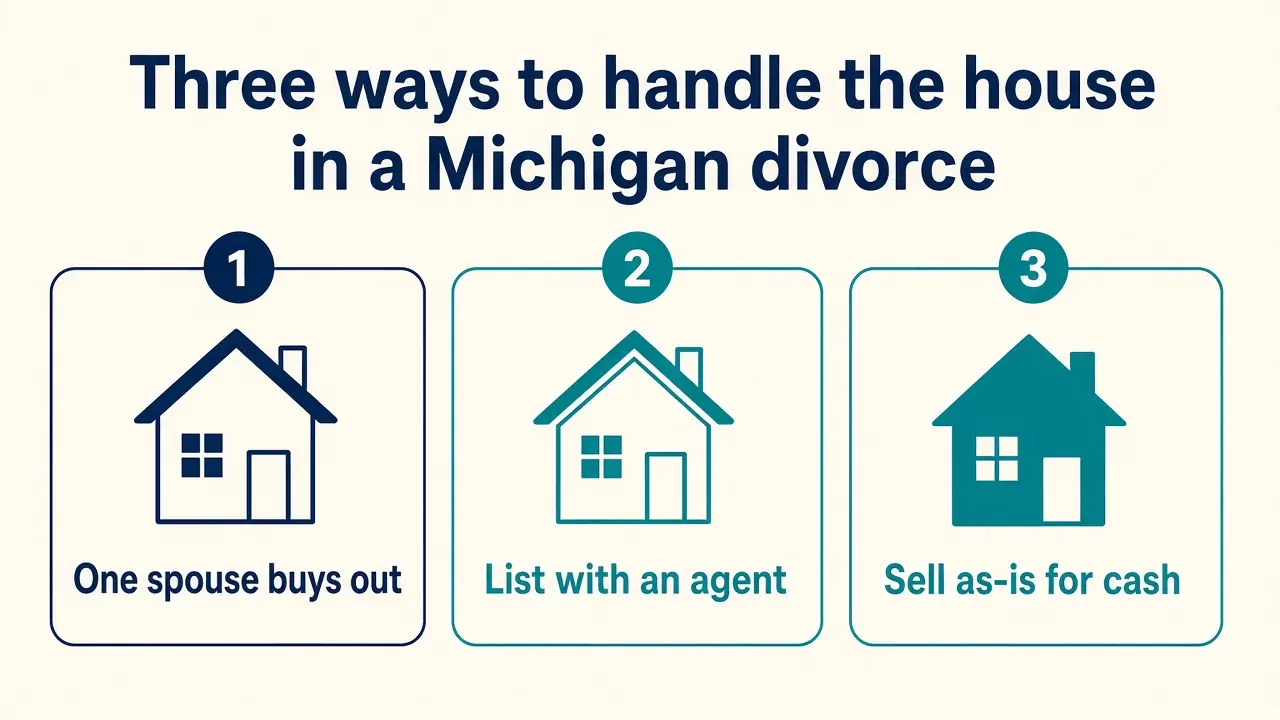
Buyout, listing, or cash sale: how do they compare?
| Question | One spouse buys out | List with an agent | Sell as-is for cash |
|---|---|---|---|
| Who has to qualify? | The buyer spouse, for a refinance that removes the other from the loan | A buyer’s lender | Nobody |
| Repairs before sale | None | Often, after inspection | None |
| Showings | None | Yes, with both of you cooperating | One walkthrough |
| Price | Agreed or appraised value | Usually the highest | Usually lower than a listing |
| Tax issue to check | Uncapping, if deeded after the judgment | Transfer tax, gain | Transfer tax, gain |
A buyout only works if the spouse keeping the house can refinance. A judgment that says “wife keeps the house” doesn’t take the husband’s name off the mortgage. Only the lender can do that, so a judgment that leaves both names on the loan leaves both of you on the hook if payments stop.
What will a Grand Rapids sale cost at closing?
Michigan charges transfer tax on most sales. According to the Michigan Department of Treasury, the state real estate transfer tax is $3.75 for each $500 of value, and the seller is legally responsible for it. Michigan’s county transfer tax adds $0.55 for each $500. On a $310,000 sale, that’s $2,325 in state tax and $341 in county tax.
There’s a narrow exemption. Under MCL 207.526(u), the state tax doesn’t apply to the sale of a home the seller claimed as a principal residence if its state equalized value is no higher than when the seller acquired it and the price is arm’s length. In a city where values have climbed, most long-time owners won’t qualify, but a title company can check your SEV history quickly. If you qualify and paid the tax anyway, Treasury’s Form 2796 lets you ask for a refund within four years and 15 days of the sale.
Federal income tax is separate. A married couple filing jointly can generally exclude up to $500,000 of gain on a main home, and a single filer up to $250,000, under the rules in IRS Publication 523. If you sell after the divorce, each of you looks at your own share and your own exclusion. A tax preparer should run your numbers before you pick a closing date.
What is the Grand Rapids market doing right now?
It’s fast. According to Redfin’s Grand Rapids housing market page, the median sale price was $309,852 in September 2026, up 3.3% from a year earlier, and homes sold after a median of 9 days. There were 596 sales in September, down 13.1% from a year earlier, and homes received about three offers on average.
For a divorcing couple, that’s useful. A house in good shape that you can both agree to price and show will probably sell quickly, and a short listing means fewer months of arguing over the mortgage. It’s less useful when the house has an old roof, a wet basement, knob-and-tube wiring in an older home near Heritage Hill, or a room full of things neither of you wants to sort. A buyer’s inspection can reopen the price, and that’s a negotiation two people in a divorce often can’t finish.
From our deals
When we buy during a divorce, the house is rarely the hard part. The hard part is two people agreeing on one number and one date. We send the same written offer to both spouses, or to both attorneys, and we close through a title company that pays the lender and holds or splits the rest exactly as your agreement or judgment says. Couples who send us the deed, a recent mortgage statement and their attorneys’ contact information on the first call usually get a clear yes or no from us within days.
When is a cash sale the wrong move in Grand Rapids?
- One of you can refinance and wants to stay. A buyout keeps the house in the family and avoids selling costs. Do the deed before the judgment if you can.
- The house is updated and you can cooperate on showings. With homes going pending in about nine days, a listing will usually net more.
- You can’t agree on anything yet. Don’t sign a contract with anyone, including us, until you both agree, in writing, on the price and how the money will be split.
- There’s a lot of equity and no rush. If neither of you is paying two housing costs, time is on your side.
A cash sale makes more sense when the house needs work neither of you will pay for, one spouse has moved out and the other can’t keep it ready, there are deadlines in your agreement, or you just want the house to stop being something you have to talk about.
How does a HomeCashOffer purchase work during a Michigan divorce?
Send us the address, whose names are on the deed, where the case stands, and how to reach both of you or both attorneys. We’ll look at the house as it is and send one written as-is offer to both sides. If you both accept, a Michigan title company handles the closing, pays off the mortgage and any liens, and distributes the proceeds the way your agreement or judgment says. Nobody has to make repairs or clean out the house first. Call (405) 622-8705 or request a cash offer online.
HomeCashOffer is a nationwide cash home buyer with its office at 3000 W Memorial Rd, Ste 123 Unit 308, Oklahoma City, OK 73120. For questions about your judgment, the deed or taxes, talk to a Michigan family law attorney and a tax professional.
Related reading: Selling a house during divorce in Columbus · Divorce and the house in Miami · Relocating from Detroit · Sell my house fast in Detroit · What to expect from a cash offer
Sell your house fast in these markets
Local cash offer pages—or start with a nationwide request.
Frequently asked questions
What happens to a jointly owned Grand Rapids house when the divorce is final?
Under MCL 552.102, a married couple who own real estate as joint tenants or as tenants by the entireties become tenants in common when they divorce, unless the judgment says otherwise. Each of you then owns an undivided share, and a buyer will usually need both signatures. Most Kent County judgments spell out who gets the house or how it will be sold, so read yours closely.
Will a spousal buyout raise the property taxes on our Grand Rapids house?
It can, depending on timing. Michigan's State Tax Commission says a transfer from one spouse to the other generally isn't a transfer of ownership, so taxable value stays capped. A transfer between former spouses after the divorce generally is, unless it's solely to end a tenancy by the entireties. Ask your attorney to plan the deed with the assessor's rules in mind.
How long does a divorce take in Michigan before the house can be divided?
MCL 552.9f says no proofs or testimony can be taken until 60 days after filing, or six months when there are dependent children under 18. A judge can shorten the six-month wait to 60 days for unusual hardship or compelling necessity. Many couples agree to sell during the case, with the proceeds held until the judgment.
Do we have to tell the assessor when we move out of the Grand Rapids house?
Yes, if you claimed the principal residence exemption. Michigan's Form 2368 instructions say an owner must file a request to rescind, Form 2602, or a conditional rescission, Form 4640, within 90 days of no longer owning or occupying the house as a principal residence. Missing that can lead to back taxes, penalty and interest.
Can we avoid Michigan's state transfer tax when we sell?
Sometimes. MCL 207.526(u) exempts the sale of a home the seller claimed as a principal residence if its state equalized value is no higher than when the seller acquired it and the price is arm's length. Many Grand Rapids homes have risen in value, so many sellers won't qualify, but ask the title company to check before closing.
Should we list the Grand Rapids house or sell it for cash during a divorce?
List it if it's in good shape, you can agree on price and showings, and you can share the costs for a few weeks. Grand Rapids homes have been going pending fast. A cash sale is more useful when the house needs work, one spouse has moved out and the other can't keep it ready, or the court or your agreement needs a firm closing date.
Ready to see what a cash offer looks like?
No repairs required. No agent commissions when you sell to us. No obligation to accept.
Request your no-obligation cash offer
Prefer a dedicated form? Visit Get a Cash Offer Today.
Get My Cash Offer
Share your name, phone, and property address. No obligation. We will follow up shortly.