
Selling a Tucson House As-Is: Monsoon Roofs, Swamp Coolers, Septic Inspections and What Arizona Still Makes You Disclose
Selling an older Tucson house as-is? What Arizona's disclosure rules still require, the ADEQ septic transfer inspection, pool and historic-zone rules, which repairs are worth doing before monsoon season, and when a cash sale makes sense. Call (405) 622-8705.
Short answer: You can sell a Tucson house as-is, with no repairs, to a cash buyer or on the open market. “As-is” doesn’t erase Arizona’s duty to disclose defects you know about, and a few state rules still apply no matter who buys: a septic transfer inspection if you’re not on sewer, a pool-safety notice if you have a pool, and an Affidavit of Property Value with the deed. The real decision is whether one or two small fixes would net you more than they cost.
Who is this guide for?
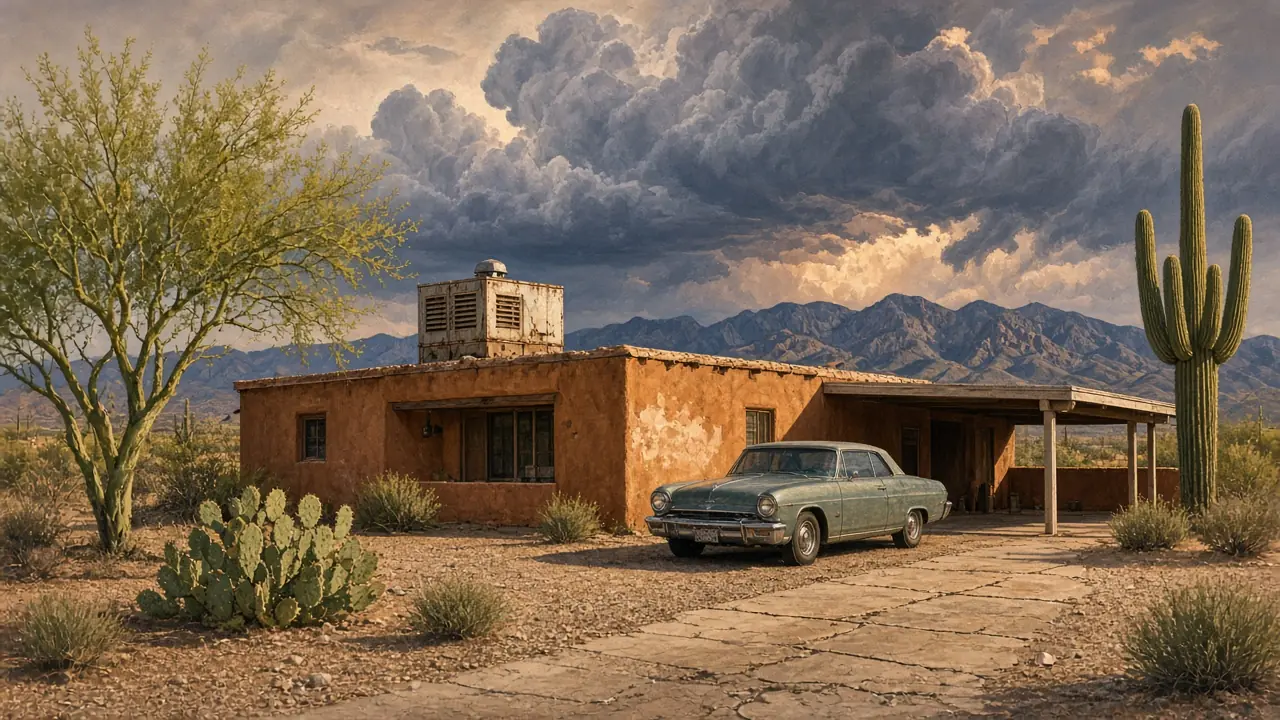
Picture a block ranch off East Broadway or in Midtown, built sometime between the 1950s and 1970s. The flat roof was recoated a long time ago and the ceiling in the back bedroom stained again after the last monsoon storm. The swamp cooler on the roof hasn’t run in two summers. The kitchen is original. You aren’t going to spend the next six months managing contractors, and you’d like to know what selling it the way it sits actually involves in Arizona.
That’s who this is for. If your house is a newer stucco build in Marana or Vail that only needs paint and carpet, much of this won’t apply, and listing it is probably the better move. For the wider southern Arizona market, see our Tucson cash buyer hub and the Tucson, AZ city page.
How old is Tucson’s housing, and why does it matter for an as-is sale?
Older than most of Arizona’s. Census figures from the 2020–2024 American Community Survey, compiled by US Cities Info, put the median Tucson housing unit at 1979, compared with 1992 for Arizona as a whole. About 30.9% of Tucson’s housing units were built between 1960 and 1979, and another 18.3% between 1940 and 1959.
That age shows up in the same places over and over: original galvanized supply lines, cast-iron drains under the slab, flat or low-slope roofs that need recoating, single-pane windows, older electrical panels and evaporative coolers sitting on roof curbs. None of that makes a house hard to sell. It does mean a buyer’s inspector will find a long list, and a buyer using a mortgage may need some of it fixed before the lender will close.
Age also triggers one federal rule. If the house was built before 1978, the seller has to give the buyer the EPA lead-based paint disclosure and any known lead reports, whether the sale is as-is or not. The EPA’s real estate disclosure page explains what’s required.
What does “as-is” still require of an Arizona seller?
Honesty about what you know. Arizona doesn’t have a state-written disclosure form, but its courts have been clear. In Hill v. Jones (1986), the Arizona Court of Appeals held that a seller has a duty to disclose known facts that materially affect the property’s value when the buyer doesn’t know them and can’t readily see them. That case was about termite damage, which is still one of the most common issues in Tucson houses.
In practice:
- If you list with an agent, the standard Arizona purchase contract requires you to deliver the Seller’s Property Disclosure Statement, the form agents call the “SPDS,” within a few days of accepting an offer.
- If you sell directly to a cash buyer, the contract may not use the SPDS, but your duty to disclose what you know doesn’t disappear. Tell the buyer about the leak, the old termite treatment or the settled patio in writing.
- Some things you don’t have to disclose. A.R.S. 32-2156 says no legal action may be brought against a seller for not disclosing that a death or felony occurred at the property, that a prior occupant had HIV/AIDS, or that a sex offender lives nearby.
The safest approach is simple. Write down everything you know is wrong with the house, hand it over, and let the buyer price it.
Which repairs are worth doing before you sell, and which aren’t?
Most aren’t, if you’re selling as-is. A new foam roof, a cooler-to-AC conversion or a repipe can easily cost more than it adds to a cash offer, because any buyer prices the work at their own cost. The repairs that sometimes pay are small ones that stop the house from getting worse:
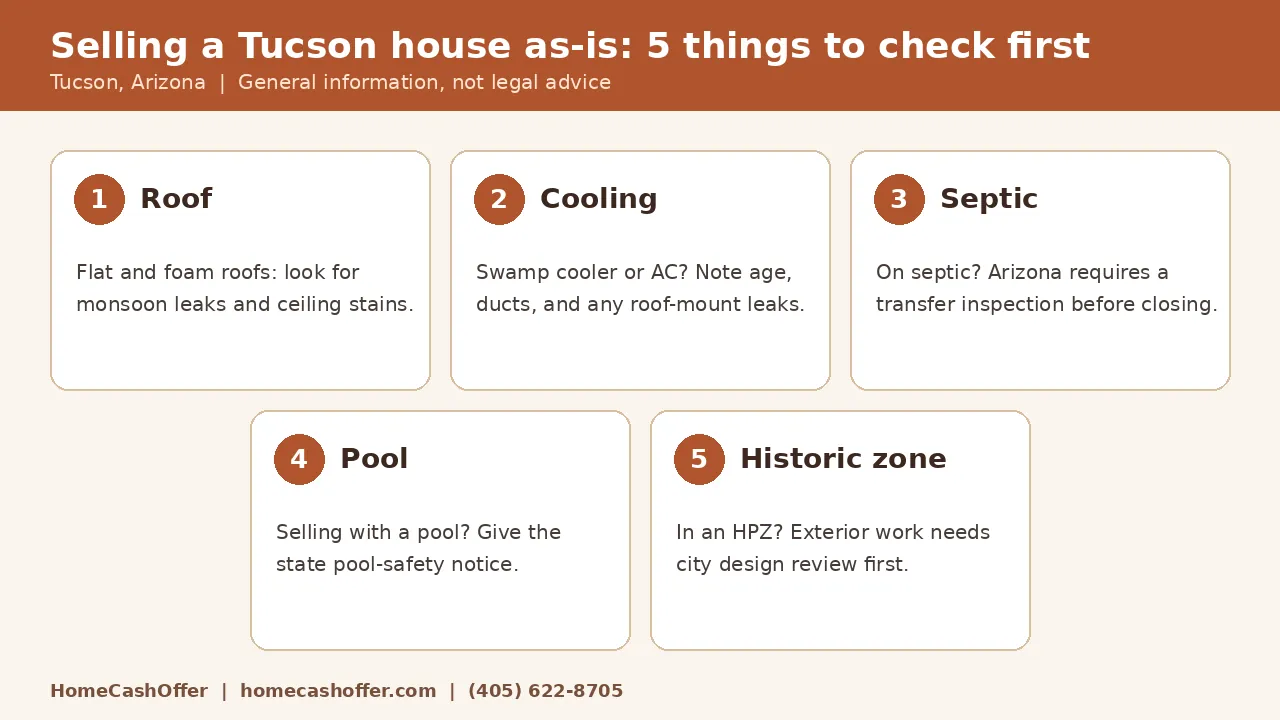
- An active roof leak during monsoon season. The National Weather Service defines the Southwest monsoon as June 15 through September 30. A modest patch that prevents a soaked ceiling and a mold smell is worth it. A full re-roof usually isn’t.
- A broken lock, window or gate on a vacant house. Securing the house protects the value you’re selling.
- Cleaning out and hauling away. It costs little and makes a big difference to how the house shows. If you’re selling to a cash buyer who takes it with the contents, even this is optional.
Things to leave alone: the original kitchen, the 1970s bathrooms, the dated terrazzo or carpet, and the cooler that needs replacing. Disclose them and let the price reflect them. Our as-is versus fixing up guide walks through the math in more detail.
Is your house on septic, and what does Arizona require if it is?
Most houses inside Tucson city limits are on sewer, but many in unincorporated Pima County aren’t. Think of the larger lots out toward Tanque Verde, Picture Rocks, parts of Vail or the far east side. If yours has a septic tank or an alternative onsite system, a specific state rule applies to every sale, including a cash sale.
Under Arizona Administrative Code R18-9-A316, the seller has to hire a qualified inspector within six months before the transfer. The inspector fills out a Report of Inspection, and the tank is usually pumped as part of it. Before closing, you give the buyer that report plus any permits or maintenance records you have. The buyer then files a Notice of Transfer within 15 days after closing. ADEQ’s FAQ on the process says the requirement applies to any transfer of ownership, including sales from an estate or as part of a divorce.
If the inspection finds a failed leach field, you don’t have to fix it to sell. You do have to disclose it, and it will change the price. A cash buyer can take that on. Many financed buyers can’t.
One more rural-parcel rule: if you’re selling a parcel in an unincorporated area that isn’t part of a recorded subdivision, A.R.S. 33-422 requires an Affidavit of Disclosure at least seven days before the transfer. It covers access, flood zone status, utilities and whether the lot meets the land-division rules, and the buyer has five days after receiving it to back out.
What else applies to a Tucson sale no matter who buys?
Two more items show up regularly.
A pool. Plenty of Tucson ranches have one, often older and sometimes empty. A.R.S. 36-1681(E) says a person selling a home with a pool must give the buyer a pool-safety notice approved by the Arizona Department of Health Services. It’s a one-page form that escrow usually supplies. A cracked or drained pool is a condition to disclose, not something you have to repair.
The deed affidavit. Under A.R.S. 11-1133, every deed recorded in Arizona needs an Affidavit of Property Value attached, listing the price, financing type and whether the house will be owner-occupied or rented. The Pima County Recorder will refuse the deed without it. Your escrow officer prepares it, but expect to sign it.
Does a Tucson historic zone change anything?
It can, if your house sits in one. The City of Tucson has five Historic Preservation Zones: West University, Armory Park, Barrio Histórico, El Presidio and Fort Lowell. According to the city’s Historic Preservation office, exterior changes in those zones need design review, and even work that normally needs no permit, such as replacing windows, can need a minor review.
Selling as-is doesn’t trigger any review. But it explains why some buyers price historic-zone houses differently. A renovation buyer knows new windows or an addition will mean an advisory board meeting and months of waiting. For a seller, it’s one more reason not to start exterior work before you sell. You’d be the one waiting.
What is the Tucson market saying to as-is sellers right now?
It’s taking its time. According to Redfin’s Tucson housing market page, the median sale price was $315,850 in September 2026, down 1.3% from a year earlier, and homes sold after a median of 66 days, up from 62. Only 19.9% of homes sold above list price, while 36.9% had a price drop. Redfin’s hot homes went pending in around 36 days.
For a house that only needs paint and a deep clean, that’s still a workable market for a listing. For a house with a leaking roof, a dead cooler and original plumbing, the math changes. Many financed buyers will pass, an inspection report can reopen the price, and every extra month adds a mortgage payment, insurance, utility bills and the property taxes the Pima County Assessor has on record. That’s the window where an as-is cash offer is worth comparing side by side with a list price minus repairs, commissions and holding time.
From our deals
The as-is houses we see in southern Arizona usually aren’t wrecks. They’re solid, older houses with three or four big-ticket items stacked up at once, often a roof, a cooler or HVAC system and plumbing, and an owner who doesn’t want to finance and supervise all of it. What helps most is when the seller tells us everything up front: the leak, the cooler, the septic, the old termite treatment. That lets us make an offer that holds, instead of one that changes after a walkthrough. We’d rather price a known problem once than renegotiate a surprise.
When is a cash sale the wrong move for a Tucson house?
- The house mostly needs cosmetics. If it’s sound and the work is paint, flooring and fixtures, a listing will usually net more, especially in neighborhoods like Sam Hughes or the Catalina Foothills where buyers compete for location.
- You have time and the cash to carry it. If two or three extra months of payments won’t strain you, the open market can pay for your patience.
- One repair unlocks financing. If a lender would approve buyers once a single item is fixed, such as a leaking roof, it may be worth doing that one thing and listing.
- You haven’t compared numbers. Get a realistic list-price estimate from a local agent and a written cash offer, then compare what you’d actually take home from each.
A cash sale makes more sense when the repair list is long, the house is vacant or you live out of state, the septic or roof has failed, or you simply want a firm closing date without showings.
How does a HomeCashOffer as-is purchase work in Tucson?
Tell us the address, what you know is wrong with the house, and whether it’s on sewer or septic. We’ll look at it as it is and send a written as-is cash offer, with no repair requests and no commissions. If you accept, an Arizona title and escrow company handles the closing, including the Affidavit of Property Value, payoffs and any septic paperwork, and you pick the closing date that works for you. Call (405) 622-8705 or request a cash offer online.
HomeCashOffer is a nationwide cash home buyer with its office at 3000 W Memorial Rd, Ste 123 Unit 308, Oklahoma City, OK 73120. For questions about disclosure, title or a specific defect, talk to an Arizona real estate attorney.
Related reading: Phoenix cash buyer hub · Selling a house during divorce in Phoenix · Selling a Denver house as-is · Selling a Portland fixer as-is · What to expect from a cash offer
Sell your house fast in these markets
Local cash offer pages—or start with a nationwide request.
Frequently asked questions
Does selling my Tucson house as-is mean I don't have to disclose problems?
No. Arizona courts have held, starting with Hill v. Jones in 1986, that a seller must disclose known facts that materially affect the value of the house and that the buyer can't readily see. Writing 'as-is' in the contract changes who pays for repairs. It doesn't let you hide a roof leak or termite damage you know about.
Do I need a septic inspection to sell a house outside Tucson city limits?
If the house is on a septic or alternative onsite system, yes. Arizona rule R18-9-A316 requires the seller to hire a qualified inspector within six months before the transfer and give the buyer the Report of Inspection and any system records before closing. It applies to cash sales too, and the tank usually has to be pumped as part of the inspection.
Should I replace the roof before selling my Tucson house?
Usually not, if you're planning to sell as-is. A roof replacement is a large cost you may not get back, and any buyer will price the roof's age anyway. If the roof is actively leaking, though, a small patch or a tarp can stop new interior damage while the house is on the market, especially from June 15 through September 30, which the National Weather Service treats as monsoon season.
What paperwork does Arizona require when I sell a house with a pool?
A.R.S. 36-1681(E) says a person selling a home with a swimming pool must give the buyer a pool-safety notice approved by the Arizona Department of Health Services. Your title or escrow company can usually supply it. The pool's barrier rules are separate and depend on when the pool was built and local ordinances.
Is my Tucson house in a historic zone, and does it matter for an as-is sale?
It matters if you or the buyer plan exterior work. Tucson has five Historic Preservation Zones: West University, Armory Park, Barrio Histórico, El Presidio and Fort Lowell. Exterior changes there need city design review, which can take weeks or months. Selling as-is doesn't trigger review, but buyers who plan to renovate will factor it in.
How fast is the Tucson market for a house that needs work?
Slower than a few years ago. Redfin reported a median of 66 days on market in Tucson in September 2026, and 36.9% of homes had a price drop. Houses that need major repairs usually take longer than that and draw fewer financed buyers, which is when an as-is cash offer is worth comparing.
Ready to see what a cash offer looks like?
No repairs required. No agent commissions when you sell to us. No obligation to accept.
Request your no-obligation cash offer
Prefer a dedicated form? Visit Get a Cash Offer Today.
Get My Cash Offer
Share your name, phone, and property address. No obligation. We will follow up shortly.