
Selling a Charleston House As-Is: Flood Zones, the 50% Rule, Termite Letters and What Buyers Really Price In
Selling an older Charleston, SC house as-is? How the city's 50% flood rule, BAR demolition review, the CL-100 termite report and South Carolina's disclosure form shape what buyers pay, plus when a cash sale makes sense. Call (405) 622-8705.
Short answer: You can sell a Charleston house as-is, and South Carolina law expressly allows it, but you still owe the buyer an honest disclosure form unless an exemption applies. What really sets the price on a Charleston fixer is the flood map: in the city’s flood zones, a renovation that hits 50% of the building’s value forces the house up to current elevation rules, and every serious buyer prices that in. Know your flood zone, elevation certificate and termite history before you compare offers.
By HomeCashOffer Team. For general selling basics in the Lowcountry, see our Charleston hub and Charleston city page.
We wrote this for one owner in particular: someone with a 1950s or 1960s house on a crawlspace in West Ashley, James Island or North Charleston (or an older place on the peninsula) that needs a roof, has soft spots in the subfloor, took water in a past storm, and would cost more to fix than they want to spend. If your house is newer and in good shape, a regular listing is probably your best route, and we’ll say why below.
What does “as-is” actually mean for a South Carolina seller?
It means you won’t make repairs, not that you can stay quiet about defects. S.C. Code § 27-50-110 says nothing in the disclosure law stops the parties from agreeing to sell “as is.” The same chapter, in § 27-50-40, still requires a written disclosure statement on most sales of one to four units, delivered before the contract is signed.
The South Carolina form has a feature many sellers miss. Under § 27-50-40(B), each item lets the owner say they have actual knowledge of a condition or that they’re “making no representations” about it. That helps a seller who truly doesn’t know, such as an heir who never lived in the house. It doesn’t help someone who knows the crawlspace floods every king tide: § 27-50-65 makes an owner who knowingly gives false, incomplete or misleading information liable for the buyer’s actual damages and court costs, and a court can award attorney fees.
The form also asks specifically about water, including flood hazards and designations and flood insurance. Since January 2020 it has also asked whether FEMA claims were filed on the property and, if so, when, as South Carolina REALTORS explained when the question was added. In Charleston, that question matters more than any other line on the form.
Some sales skip the form entirely. Section 27-50-30 exempts, among others, transfers by a fiduciary administering an estate, court-ordered and foreclosure sales, sales between co-owners, and any sale where buyer and seller both agree in writing not to complete one. A cash buyer may ask for that written waiver; your closing attorney can tell you whether it makes sense for you.
Why does the flood map decide what a buyer will pay?
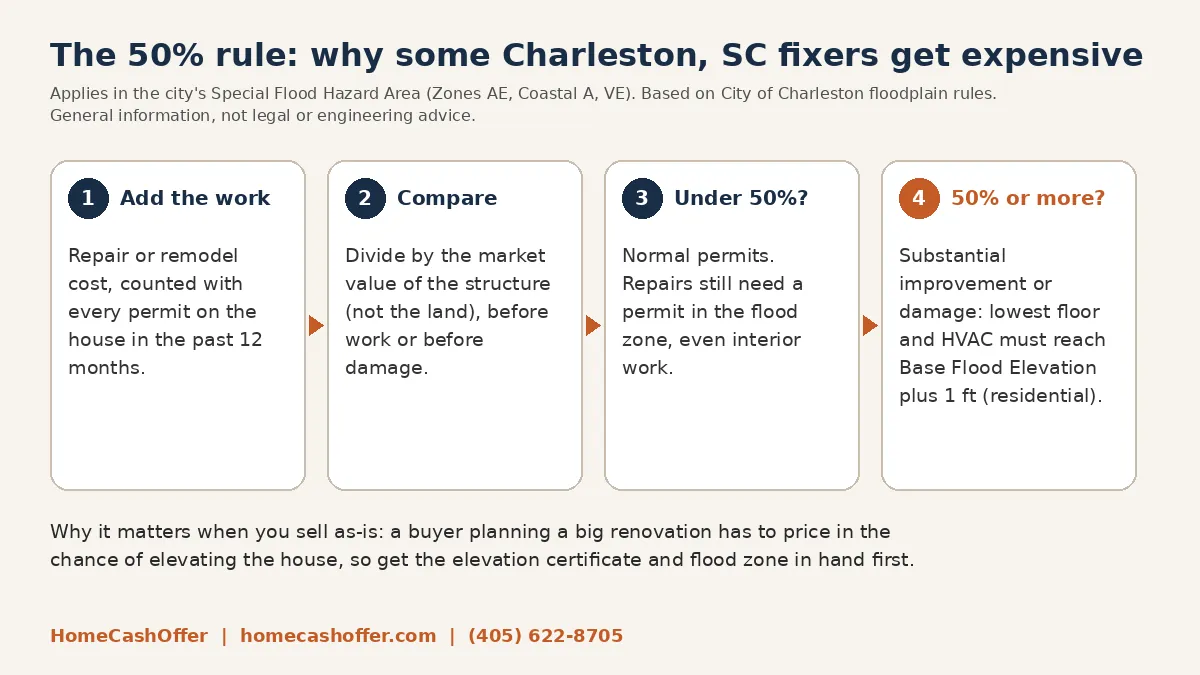
Because of a rule that turns some renovations into elevation projects. The City of Charleston applies what it calls the “50% rule” in its Special Flood Hazard Area, Zones AE, Coastal A and VE. If repair, reconstruction or improvement costs, counted together for a one-year period, equal or exceed 50% of the structure’s market value before the work (or before the damage), the building must meet current flood design rules, according to the city’s Substantial Improvement and Substantial Damage guidance.
For a house, that means the lowest habitable floor, plus equipment like the HVAC system, has to reach the Design Flood Elevation, which is Base Flood Elevation plus 1 foot of freeboard for a residential substantial improvement. New homes need 2 feet, and since January 1, 2024 the city prohibits slab-on-grade foundations for new single-family homes in its 100-year floodplain, per the city’s Floodplain Development page.
Three practical consequences for an as-is seller:
- Every repair in the flood zone needs a permit. The city says that includes storm repairs, HVAC duct replacement and non-structural interior work. Unpermitted past work can surface when a buyer pulls the permit history.
- The value in the math is the building, not the lot. On the peninsula or near the water, land can be most of a home’s price, so the structure value the 50% test uses may be smaller than you think.
- A buyer who wants to gut the house is pricing two scenarios: the remodel they want, and the cost of raising the house if the remodel crosses the line.
How do you find your flood zone and elevation before you sell?
Start with paperwork you may already have. If you’ve ever carried flood insurance, the policy or your agent should have the flood zone and possibly an elevation certificate, the surveyor’s document that records how high the lowest floor sits. The city’s Building Construction in Flood Zones page explains which zones are inside the Special Flood Hazard Area (AE, Coastal A and VE) and which aren’t (X).
Bring three things to any offer conversation, from us or anyone else:
- Your flood zone and, if you have one, the elevation certificate.
- Dates and amounts of any flood insurance or FEMA claims, because the disclosure form asks for claim dates anyway.
- A list of permits pulled in the past year, since those count toward the 50% total.
A seller who walks in with those documents usually gets a tighter, more confident offer, because the buyer doesn’t have to guess at the worst case.
Will a termite or wood-rot report sink an as-is sale?
It rarely sinks it, but it changes the number. Charleston’s heat, humidity and crawlspace construction make wood-destroying insects and fungal rot common findings. In South Carolina, the standard document is the Official South Carolina Wood Infestation Report, known as the CL-100, completed by a licensed pest control inspector and regulated by the state’s Department of Pesticide Regulation at Clemson. The form states that it’s valid for 30 days only, isn’t a warranty against future damage, and recommends the buyer, not the seller, obtain it.
Inspectors also record moisture readings in the substructure, which is where older raised homes tend to show trouble: wet sills, sagging joists, a vapor barrier that’s torn or missing. For an as-is seller, the useful question isn’t “should I treat it first?” It’s “do I know what’s there?” Disclosing a known past infestation with unrepaired damage is part of the state form under § 27-50-40(A)(4), so a fresh report can protect you as much as the buyer.
Does the historic district change anything if you sell downtown?
It can, mostly for the buyer’s plans. Charleston’s Board of Architectural Review reviews new construction and exterior changes visible from the street in the historic districts. It also reviews all demolitions in the Old and Historic District, demolitions of buildings 50 years or older anywhere south of Mount Pleasant Street, and anything on the Landmark Overlay list.
Under the city ordinance, the board can delay demolition of an older structure in the Historic Materials Demolition District north of the Old City for 180 days or deny it outright, and the city’s demolition submittal requirements include photographs, construction-date documentation, an on-site meeting and, where structural failure is the reason, a structural engineer’s report.
So if your plan was “knock down the back addition, then list,” that may cost months. Selling the house as it stands, with the restrictions disclosed, is usually faster, and buyers who work downtown already expect BAR review.
What is the Charleston market telling as-is sellers right now?
That buyers have time to be choosy. Over the three months ending September 2026, Charleston’s median sale price was $659,636, up 8.1% from a year earlier, and homes took a median 72 days to sell, according to Redfin’s Charleston housing market data. The average sale-to-list ratio was 97.8%, and 32.7% of listings had a price drop in September 2026.
The same Redfin page, using First Street’s flood model, rates Charleston’s flood risk as severe, with an estimated 78% of properties at risk of severe flooding over the next 30 years. Financing adds pressure: Freddie Mac’s survey put the 30-year fixed rate at 7.18% on November 5, 2026, up from 6.22% a year earlier (Freddie Mac PMMS).
Put together, a move-in-ready house in a good flood zone still sells. A tired house that needs a roof, a crawlspace fix and an insurance quote is competing with a lot of inventory for buyers who are paying 7% to borrow and know about the 50% rule. That’s where the price gap between “as-is” and “renovated” gets wide.
When should you not sell your Charleston house for cash?
When the house mostly needs cosmetic work and sits outside the flood zone. If a few thousand dollars of paint, flooring and landscaping would put it in line with retail comps in Mount Pleasant or Summerville, where Redfin shows homes selling about 1% to 3% under list, a listing will very likely net you more than any investor offer.
Cash also makes less sense if you have time and the repairs are clearly under the 50% line, or if you’re in Zone X with no water history and buyers can get ordinary financing. Our guide to selling as-is versus fixing up walks through how to estimate that tradeoff, and cash offer versus listing with an agent shows how to compare real net proceeds.
From our deals
In coastal markets, the as-is houses we’re asked to look at tend to share a pattern: an owner who’s lived with a problem for years, such as a damp crawlspace, an old roof or a past storm repair done without a permit, and who only discovers how much it matters when a buyer’s lender or insurer asks questions. What helps most in those conversations isn’t a perfect house. It’s a seller who has the flood zone, any elevation certificate and an honest list of what they know, because that lets us price the real risk instead of the worst case. We’d rather make a fair offer on a known problem than a nervous one on a mystery.
How does a HomeCashOffer as-is sale work in Charleston?
You share the address and what you know about the house, we review it and the flood and permit picture, and if it fits we send a written, no-obligation offer. You don’t make repairs or clean out the crawlspace. If you accept, a South Carolina closing attorney handles the closing, title and payoff, and you choose a closing date that suits you.
On closing costs, South Carolina’s deed recording fee under S.C. Code § 12-24-10 is $1.85 per $500 of value, split between state and county, and § 12-24-20 places it on the seller. As an example only, on a $400,000 sale that works out to $1,480. Ask any buyer, including us, to show you the net figure after that fee, your payoff and prorated taxes.
Selling elsewhere in the Lowcountry? See our pages for North Charleston, Mount Pleasant and Summerville. If unpaid taxes or liens are part of the picture, our Greenville back-taxes guide covers South Carolina’s penalty schedule and tax sale. For other coastal as-is situations, compare our Jacksonville as-is guide and New Orleans fire-damage guide.
Call (405) 622-8705 or request a cash offer online. Have your flood zone, any elevation certificate and a rough list of repairs ready, and we’ll give you a straight answer on whether cash or a listing makes more sense for your house.
Sell your house fast in these markets
Local cash offer pages—or start with a nationwide request.
Frequently asked questions
Can I sell my Charleston house as-is without fixing anything?
Yes. S.C. Code § 27-50-110 says nothing in the state's disclosure law stops a buyer and seller from agreeing to an as-is sale. As-is means you aren't promising repairs. It doesn't erase the disclosure form, and a knowingly false or misleading answer on that form can still make you liable for the buyer's actual damages under § 27-50-65.
Do I have to fill out the South Carolina disclosure form if I'm selling as-is?
Usually, yes. Most sales of one to four units require the state's Residential Property Condition Disclosure Statement before the contract is signed. Exceptions in § 27-50-30 include estate administration by a fiduciary, foreclosure and court-ordered sales, and sales where both parties agree in writing not to complete one. The form lets you mark 'No Representation' on items, but that option isn't a shield for something you actually know about.
What is the 50% rule in Charleston, and does it affect my sale?
In the city's Special Flood Hazard Area, if repairs or improvements over a 12-month period equal or exceed 50% of the building's market value, the house must be brought up to current flood rules, which for a home means raising the lowest floor and equipment to Base Flood Elevation plus 1 foot. It doesn't stop you from selling, but any buyer planning a big renovation will price that risk in.
Who pays for the CL-100 termite report when selling a house in Charleston?
It's negotiable. The official South Carolina Wood Infestation Report, called the CL-100, is completed by a licensed pest control inspector and is valid for 30 days. The form itself recommends that the buyer, rather than the seller, obtain it. Many cash buyers skip it or order their own; ask before you pay for one.
Can I demolish or heavily change an old house downtown before selling?
Not without approval in many cases. Charleston's Board of Architectural Review reviews any demolition in the Old and Historic District and demolition of buildings 50 years or older south of Mount Pleasant Street, plus Landmark Overlay properties. Selling the house as it stands is often simpler than starting that process yourself.
What closing costs does a Charleston seller pay on an as-is sale?
South Carolina's deed recording fee is $1.85 per $500 of value under S.C. Code § 12-24-10, and § 12-24-20 makes it the seller's liability, with the buyer secondarily liable. You'll also typically pay off your mortgage, prorated property taxes and any agreed fees. A cash buyer may agree to cover some costs, so get the net figure in writing.
Ready to see what a cash offer looks like?
No repairs required. No agent commissions when you sell to us. No obligation to accept.
Request your no-obligation cash offer
Prefer a dedicated form? Visit Get a Cash Offer Today.
Get My Cash Offer
Share your name, phone, and property address. No obligation. We will follow up shortly.