
Selling a Greenville, SC House With Back Taxes or Liens: The 15% Penalty, the Seizure Letter, and the October Tax Sale
Behind on Greenville County property taxes, or carrying a contractor or judgment lien? How South Carolina's 3%, 7% and 5% penalties, the Notice of Seizure, the annual tax sale and the 12-month redemption work, why a house you moved out of can jump from 4% to 6% assessment, and how a sale pays it all off. Call (405) 622-8705.
Short answer: Yes, you can sell a Greenville house that’s behind on Greenville County property taxes or has a lien on it, and a sale is often the cleanest way to clear everything, because the South Carolina closing attorney pays the county and each lienholder from your proceeds before you get your check. What makes South Carolina different is the penalty math and the calendar: an unpaid bill picks up a 15% penalty by mid-March, and if nothing changes, the house goes to the county’s tax sale each October.
Who is this guide for?
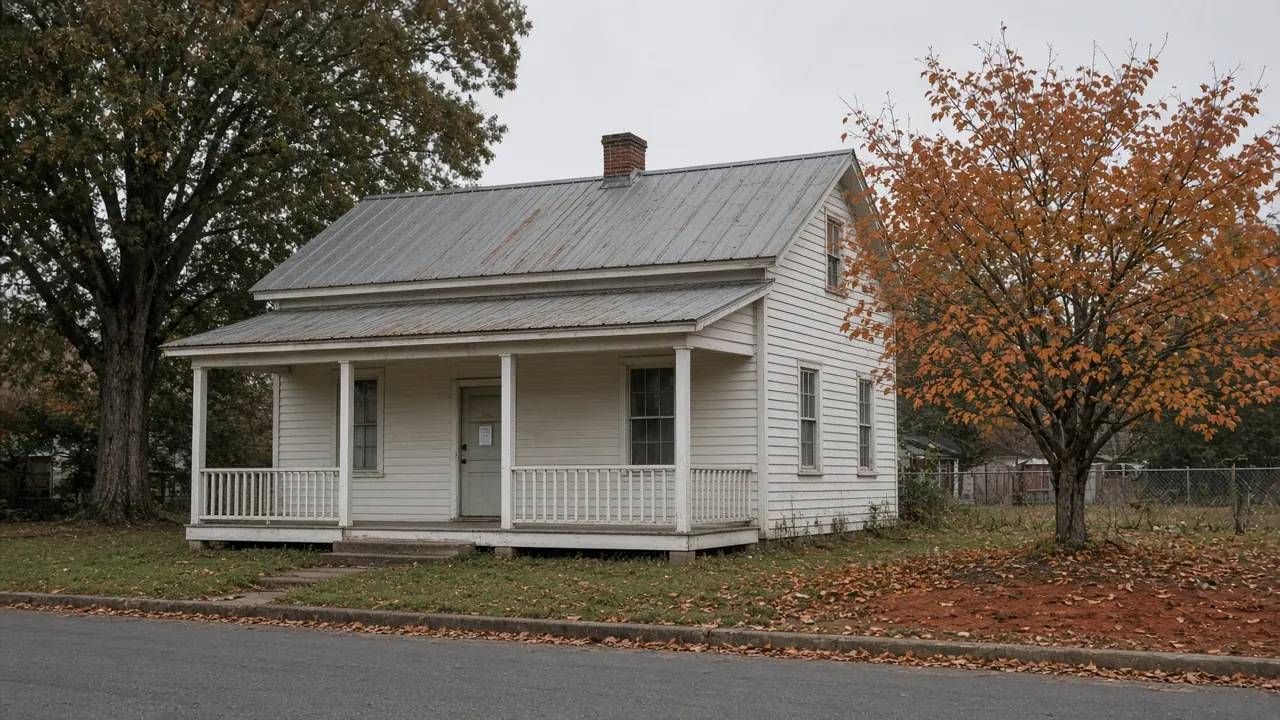
Picture someone who owns a small frame house in one of Greenville’s old mill villages, the kind with a deep porch and a metal roof off Pendleton Street or near Judson or Monaghan. It was paid off years ago, so there’s no mortgage escrow paying the tax bill. A few years back the owner moved in with family in Simpsonville or Greer and let a relative live in the old house for little or nothing.
Then a few things happened at once. The tax bill went up and nobody noticed why. A roofer who patched the porch roof didn’t get his last payment and filed a lien. An old credit card judgment turned up. This fall a certified letter from the Greenville County Tax Collector arrived with the word “seizure” in it.
That’s the reader we wrote this for. If your story is different, the steps below still apply. HomeCashOffer buys Greenville houses as-is for cash, liens and all, and we’ll tell you plainly when paying the taxes or listing would leave you more money. For the wider Upstate picture, see our Greenville and Columbia cash buyer hub and the Greenville, SC city page.
How fast does an unpaid Greenville County tax bill grow?
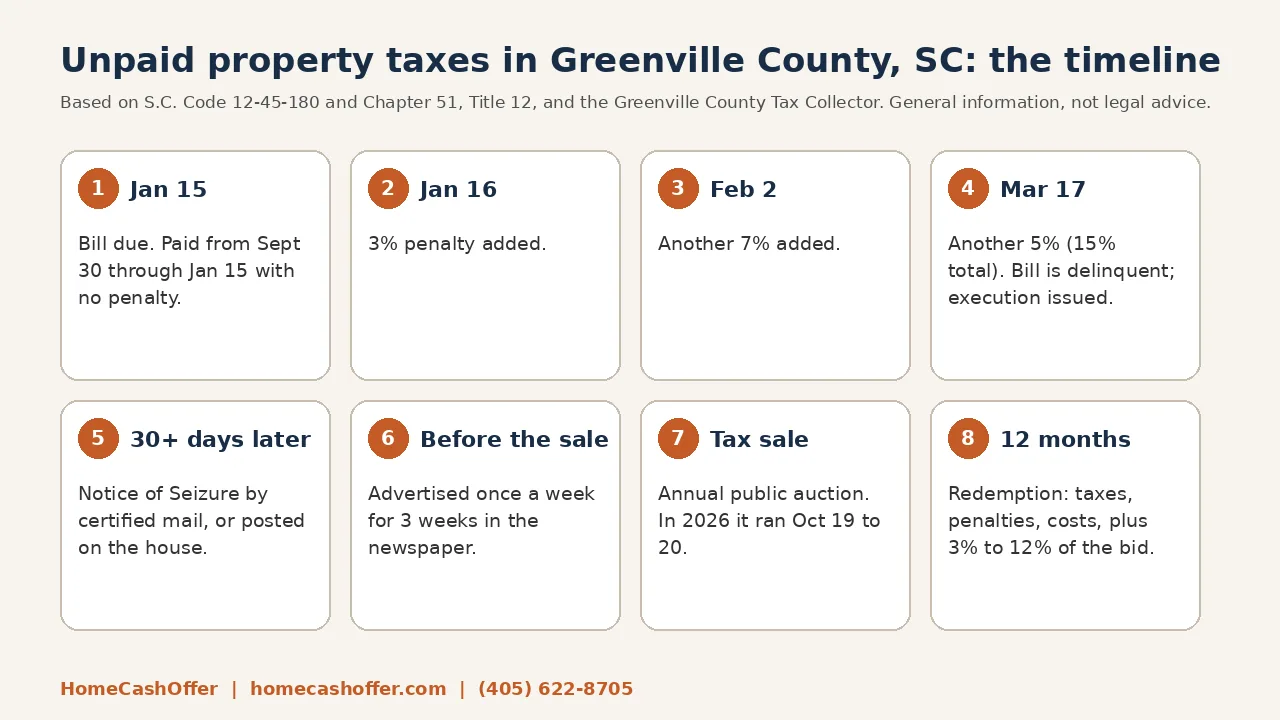
Faster than most people expect, because South Carolina uses flat penalties instead of slow monthly interest. According to the Greenville County Tax Collector, taxes are payable between September 30 and January 15. After that, S.C. Code 12-45-180 adds three penalties in a row:
- 3% if the bill isn’t paid before January 16
- another 7% if it isn’t paid before February 2
- another 5% if it isn’t paid before March 17
That’s 15% in about two months. A $2,000 bill becomes $2,300 before the county has done anything but mail notices, and collection costs come on top of that. On March 17 the bill is officially delinquent, and the county issues a tax execution so the Tax Collector can begin the steps that end at the tax sale.
One small mercy is built into the same statute. If the house changed hands during the tax year and the county mailed the notice to the old owner, the treasurer has to waive the penalties for the new owner who never got a timely notice. That rarely helps the person who’s behind, but it’s worth knowing if you recently inherited or bought into the house.
Why did the tax bill jump after you moved out?
This catches a lot of Greenville owners by surprise. South Carolina assesses your legal residence at 4% of fair market value under S.C. Code 12-43-220, subsection (c). The same section says the 4% ratio doesn’t apply to rented homes, and any other property falls under subsection (e) at 6%.
The jump from 4% to 6% means the assessed value goes up by half on the same house, before the millage rate is applied. If you moved out and started renting the house, even cheaply to family, it may no longer qualify for the owner-occupied ratio, and the bill can rise sharply. Many owners who fall behind didn’t ignore the bill. They just didn’t expect it to be that much bigger.
If you’re 65 or older, totally and permanently disabled, or legally blind, the state homestead exemption in S.C. Code 12-37-250 takes the first $50,000 of your dwelling’s value off the tax rolls. It only covers the place you actually live, though, not a house you’ve moved out of. Ask the Greenville County Assessor or Auditor how your parcel is classified before you decide anything. Sometimes the fix is paperwork, not a sale.
What does the “Notice of Seizure” letter actually mean?
It means the tax sale process has formally started, but you still own the house. Under S.C. Code 12-51-40, here’s what happens after a bill is delinquent:
- The Tax Collector mails a delinquent notice warning that the property will be advertised and sold.
- If the bill is still unpaid 30 days later, the Tax Collector sends a notice by certified mail, restricted delivery. The signed return receipt counts as legally “levying by distress,” which is the old phrase for seizing the property for sale.
- If nobody signs for it, the county posts the seizure notice on the house. Out-of-town owners sometimes learn about the problem from a neighbor who saw the sign.
- The property is advertised in a newspaper under the heading “Delinquent Tax Sale” once a week for three weeks before the sale, with the owner’s name and the map-block-parcel number.
Every step adds its costs to what you owe, including advertising and certified mail. If you’re going to sell, the best time to start is before the advertisement runs, when there’s still room to choose a closing date instead of racing the auction.
What happens at the Greenville County tax sale?
Greenville County holds its delinquent tax sale once a year as a public auction at the Greenville Convention Center on Exposition Drive. The county’s 2026 tax sale notice set this year’s sale for October 19 and 20, 2026. The list covers houses in the city of Greenville and in towns like Greer, Mauldin, Simpsonville, Fountain Inn and Travelers Rest, because the county collects those taxes too.
The opening bid is placed for the county’s Forfeited Land Commission and equals all the delinquent taxes, penalties and costs plus the current year’s taxes, as S.C. Code 12-51-55 requires. Investors bid from there. If you own more than one parcel on the list, the county stops selling your parcels once it has collected enough to cover everything you owe.
Winning bidders don’t get the house right away. They get a claim that turns into a tax deed only if nobody redeems.
Can you still sell during the 12-month redemption period?
Yes, and this is the part most owners don’t realize. Under S.C. Code 12-51-90, the defaulting owner, any grantee from the owner, or a mortgage or judgment creditor can redeem within 12 months of the sale. The redemption amount is the delinquent taxes, penalties and costs, plus interest on the winning bid:
- 3% if redeemed in the first three months
- 6% in months four through six
- 9% in months seven through nine
- 12% in the last three months
The interest can’t exceed the amount of the Forfeited Land Commission’s opening bid. Because a grantee from the owner can redeem, a buyer can close on your house during that year and pay the redemption out of the sale, as long as everything is finished before the deadline. Between 20 and 45 days before the year runs out, the Tax Collector mails a final certified notice with the exact payoff and date. If the house isn’t redeemed, the Tax Collector issues a tax deed to the bidder.
If the bid was much higher than what you owed, the extra money, called the overage, doesn’t simply vanish. Under 12-51-130 and the county’s redemption information, it goes first to outstanding federal or municipal tax liens and then belongs to the owner of record just before the redemption period ended. It’s payable 90 days after the tax deed. Even so, the overage is usually far less than the equity you’d keep by selling or redeeming yourself.
Which other liens show up on a Greenville title?
A title search usually turns up more than taxes. Here’s how the common ones work in South Carolina.
Contractor and supplier liens. A roofer, plumber or lumber yard that wasn’t paid can file a mechanic’s lien. Under S.C. Code 29-5-90, the lien has to be served and filed within 90 days after the contractor last worked on or supplied the house. Under 29-5-120, it’s dissolved unless the contractor sues and files a notice of pendency within six months. An old lien that was never enforced may be removable by affidavit, so don’t assume every recorded lien is still worth its face amount.
Judgment liens. A court judgment becomes a lien on your Greenville County real estate once it’s entered in the county’s book of abstracts of judgments and lasts ten years from the judgment date, under S.C. Code 15-35-810. Credit card, medical and old car-loan judgments are the usual ones.
IRS liens. A federal tax lien gets paid at closing or released from the specific house with a certificate of discharge. IRS Publication 783 explains the application. Give the closing attorney a heads-up early, because the IRS asks for time to process it.
HOA balances. Newer subdivisions in Simpsonville, Greer and Fountain Inn often have associations. Whether and how unpaid dues become a lien depends on the recorded covenants, so the closing attorney requests a payoff letter and the balance comes out of your proceeds.
How does a sale pay off the taxes and liens?
In South Carolina, closings are handled by a licensed attorney. The attorney orders the title search, gets written payoffs from the Tax Collector and each lienholder, and pays every one of them from the buyer’s money at closing. You sign off on the settlement statement, and whatever is left comes to you. Paid liens are then released of record.
A few South Carolina costs to expect on the seller’s side:
- Deed recording fee. S.C. Code 12-24-10 sets it at $1.85 per $500 of value, and 12-24-20 makes the seller primarily liable. On a $385,000 sale, that’s about $1,425.
- Prorated current-year taxes, plus every delinquent year, penalty and collection cost.
- Withholding for out-of-state sellers. If you no longer live in South Carolina, the state generally requires the buyer to withhold part of the proceeds unless you qualify for an exemption or give the right affidavit. Ask the attorney about this early.
What is a Greenville house worth while it’s behind on taxes?
The taxes don’t lower the market value, but they come straight out of what you net. For context, Redfin’s Greenville County housing market page reported a median sale price of $385,138 for the three months ending September 2026, up 3.4% from a year earlier. The same page showed homes taking a median of 74 days to sell, up from 65 days the year before, and 699 homes sold in September 2026, down from 720 in September 2025.
So prices in the county are holding, but listings are taking longer to sell than they did a year ago. That matters if you’re racing a tax sale date or a redemption deadline. A small mill-village house that needs a roof, wiring and a cleanout will sell for less than the county median, and an agent listing may need repairs before it can sell to a buyer with a mortgage.
From our deals
When we talk with owners who are behind on taxes, it’s rarely one big problem. It’s usually three small ones: a tax bill that quietly went up, a repair that didn’t get finished, and a move that left the house without anyone watching it. The owners who come out best call before the advertisement runs, get a written payoff from the Tax Collector, and compare a real net number from a listing with a real offer. The hardest calls are the ones that come in the last month of the redemption year, when there’s little time left to choose. If you call us early and the math says to pay the taxes and keep the house, we’ll tell you that.
When shouldn’t you sell a Greenville house for cash?
- You can pay the taxes and want to stay. If the house is your home and you can cover the bill, paying it ends the process. Ask the Tax Collector about the payoff before the sale.
- The house is in good shape and you have time. With Greenville County prices holding, a well-kept house can net more with an agent, even after commissions.
- The problem is classification, not money. If your bill rose because the 4% ratio was dropped when it shouldn’t have been, or you qualify for the over-65 exemption, fix that first.
- The title isn’t yours to sell yet. If the owner died, someone has to be appointed through the Greenville County Probate Court before a deed can be signed. Our Houston probate guide and inherited house guide explain the general steps.
How does a HomeCashOffer sale work for a house with back taxes?
Send us the address and whatever letters you’ve gotten from the county. We’ll look at the title, the tax balance and the condition, then send a written cash offer for the house as it is, with no repairs, cleanout or commissions. If you accept, a South Carolina closing attorney gets the payoffs, pays the county and the lienholders, and sends you the balance. You pick a closing date that beats the advertisement, the sale or the end of the redemption year. Call (405) 622-8705 or request your cash offer. We also buy in Spartanburg and Columbia.
HomeCashOffer buys houses nationwide from its office at 3000 W Memorial Rd, Ste 123 Unit 308, Oklahoma City, OK 73120.
Related reading: Selling a Raleigh house with back taxes and liens · Back taxes and liens in Tampa · Liens and back taxes in St. Louis · Tired landlord in Dallas · Selling as-is vs. fixing up · Cash offer vs. listing with an agent
Sell your house fast in these markets
Local cash offer pages—or start with a nationwide request.
Frequently asked questions
When does a Greenville County property tax bill become delinquent?
South Carolina taxes are payable from September 30 through January 15. Under S.C. Code 12-45-180, a 3% penalty is added if the bill isn't paid before January 16, another 7% if it isn't paid before February 2, and another 5% if it isn't paid before March 17. At that point the bill is delinquent, the total penalty is 15%, and the county issues a tax execution so the Tax Collector can start the collection steps in Chapter 51.
I got a certified letter called a Notice of Seizure. Has my house been taken?
No. Under S.C. Code 12-51-40, the certified, restricted-delivery notice is how the Tax Collector legally takes 'exclusive possession' of the property for the tax sale. You still own the house and can still sell it. If nobody signs for the letter, the county posts the seizure notice on the property instead. The next steps are newspaper advertisement for three weeks and then the public auction, so treat the letter as a deadline, not a done deal.
If my Greenville house was sold at the tax sale, can I still get it back or sell it?
Usually yes, for 12 months. Under S.C. Code 12-51-90, the owner, anyone the owner deeds it to, or a mortgage or judgment creditor can redeem by paying the delinquent taxes, penalties and costs plus interest on the bid of 3%, 6%, 9% or 12%, depending on which quarter of the year you redeem in. Because a grantee from the owner can redeem, a buyer can close on your house during that year and pay the redemption from the sale. Don't wait for the end: the Tax Collector issues a tax deed if it isn't redeemed in time.
Why did my tax bill go up after I moved out of my house?
South Carolina assesses an owner-occupied legal residence at 4% of fair market value, under S.C. Code 12-43-220(c). A house that's rented out, or that isn't your legal residence anymore, falls under the general 6% ratio in 12-43-220(e). That's a 50% higher assessed value on the same house, so moving out and renting to a relative or tenant can push the bill up sharply. Ask the Greenville County Assessor how your parcel is classified before you budget.
How long does a contractor's lien last on a South Carolina house?
Under S.C. Code 29-5-90, a contractor or supplier has to serve and file a lien statement within 90 days after it last worked on or supplied the house. Under 29-5-120, the lien is dissolved unless the contractor files suit and a notice of pendency within six months of that last work. A closing attorney will check whether a lien on your title is still live, and a paid or expired lien can be released of record.
How long is a court judgment a lien on my house in Greenville County?
Ten years from the date of the judgment, under S.C. Code 15-35-810, once it's entered and indexed in the county's book of abstracts of judgments. It attaches to real estate you own in that county, so it shows up in the title search and has to be paid or otherwise resolved from the proceeds at closing.
Who pays the deed recording fee when I sell a house in Greenville, SC?
The seller, unless the contract says otherwise. S.C. Code 12-24-10 sets the fee at $1.85 for each $500 of value, and 12-24-20 makes the grantor primarily liable. On a $385,000 sale that comes to about $1,425.
Should I sell for cash just because I'm behind on my Greenville taxes?
Not automatically. If the house is in good shape and you have equity, paying the taxes from savings or listing with an agent will often leave you more. A cash sale fits better when the house needs real work, several liens are stacked on the title, the tax sale date is close, or you've already moved out and can't manage repairs and showings.
Ready to see what a cash offer looks like?
No repairs required. No agent commissions when you sell to us. No obligation to accept.
Request your no-obligation cash offer
Prefer a dedicated form? Visit Get a Cash Offer Today.
Get My Cash Offer
Share your name, phone, and property address. No obligation. We will follow up shortly.