
Selling a Water- or Fire-Damaged House in Austin, TX: Insurance Checks, Permits, Mold Rules and the Floodplain 50% Rule
Burst pipe, creek flooding or a kitchen fire in Austin? How Texas disclosure rules, insurance checks made out to your lender, City of Austin repair permits, TDLR mold licensing, the floodplain substantial-damage rule and homestead-exemption traps affect selling a damaged Austin house as-is. Call (405) 622-8705.
Short answer: Yes, you can sell a water- or fire-damaged house in Austin as-is, and a cash buyer will take it without repairs, permits or a mold certificate. The catch is that Texas still expects you to disclose what happened, your mortgage company may be holding the insurance money, and if the house sits in a floodplain, a big repair bill can trigger the City’s 50% substantial-damage rule. Sort those three things out first, and you’ll know whether repairing, listing as-is or selling for cash puts more money in your pocket.
Who is this guide for?
You own a one-story ranch on a slab in Austin, maybe in North Austin off Burnet Road, maybe in Southeast Austin near Onion Creek. Water got in: an attic pipe that split in a hard freeze, a creek over its banks, or a kitchen fire where the hoses did as much damage as the flames. The drywall is cut out to four feet, the floors are buckled, an adjuster has been out, and you’re wondering whether to put another dollar into the place.
You’re not alone in that. In Winter Storm Uri in February 2021, the Austin-Travis County after-action reports counted 2,449 calls to the Austin Fire Department reporting private-site plumbing breaks, during 144 hours of freezing temperatures (KVUE summary of the 2021 Winter Storm Uri after-action report; full reports on the City of Austin’s after-action page). And the City says Austin lies in the heart of Flash Flood Alley, with about 10% of its land in the floodplain (City of Austin Floodplain Management).
For the wider market, see our Austin and San Antonio cash buyer hub, the Austin, TX city page and the Texas seller guide.
Was it “water damage” or a “flood”? Texas makes you pick
The answer changes which part of the disclosure form you fill in, and buyers read that form closely. The Texas Seller’s Disclosure Notice in Property Code §5.008 lists “Water Damage Not Due to a Flood Event” as its own item, next to “Previous Fires,” “Previous Structural or Roof Repair” and “Improper Drainage.” A separate flood section asks whether you have flood insurance, whether the house took on water from a natural flood event or a reservoir release, whether it’s in a 100-year or 500-year floodplain, floodway or flood pool, whether you’ve ever filed a flood claim (including with the National Flood Insurance Program), and whether you got FEMA or SBA help for flood damage. Another question asks about repairs or alterations made without required permits.
A pipe that burst inside the walls is usually water damage. Onion Creek or Williamson Creek water coming through the back door is a flood. The notice is due on or before the contract’s effective date. If a buyer gets it later, the statute lets them terminate within seven days of receiving it. Selling to a cash buyer as-is doesn’t get you out of filling in the form, though some sales are exempt, like certain fiduciary sales during estate administration.

Who actually controls the insurance money?
If you have a mortgage, probably your servicer, at least at first. The Texas Department of Insurance’s guide to getting a claim paid says that when there’s a loan on the house, the insurer usually sends the payment to the mortgage company, which has to contact you within 10 days of getting it, and you then work with the lender to release the money for repairs. Lenders often release it in stages as work gets done, so a gutted house and a half-spendable check is common.
The same TDI page explains two other things that matter if you’re thinking about selling:
- Replacement cost policies often pay twice. The first payment is the repair estimate minus depreciation. The second comes after the repairs are done. If you sell before repairing, ask your insurer whether you’ll ever see that second payment, because the answer changes your math.
- Deadlines run against the insurer too. The company has 15 business days to acknowledge your claim, generally 15 business days after it has what it needs to accept or reject it (it can extend by 45 days if it says why), and five business days to pay once it agrees. TDI can add 15 days after a weather catastrophe.
Before you sign a sale contract, get in writing how much the servicer is holding, whether depreciation is still owed, and whether your policy lets you keep or assign proceeds for a house you no longer own.
Do City of Austin permits come into it if I’m selling anyway?
Only for work you actually do. Austin Development Services’ emergency repair permit guidance says painting, flooring, cabinets, countertops and small repairs to drywall, siding or decking generally don’t need a permit, and simple plumbing fixes like stopping a leak may not either. Bigger plumbing and electrical repairs need a permit pulled by a licensed contractor.
Fire is stricter. The City says a building permit is required to remove debris and rebuild a fire-damaged house with the same footprint and layout. If Austin Fire or the gas company pulled your gas meter, you’ll need a plumbing permit before gas service comes back, and no gas work is exempt.
Why it matters for a sale: half-finished, unpermitted work is what that disclosure question targets and what a buyer’s inspector finds. If you’ll sell as-is anyway, stopping at mitigation (water off, wet material out, house dried) often beats starting a rebuild you won’t finish.
Is the house in the floodplain, and does the 50% rule apply?
Check before you spend money. Look up the address on the City’s ATXFloodPro map. The City says its regulatory floodplain is currently based on FEMA’s 500-year floodplain while it updates maps for the National Weather Service’s Atlas 14 rainfall study, so a house that wasn’t “in the floodplain” years ago may be now.
The rule that catches people is substantial damage. Per Austin Development Services, a house in the floodplain is substantially damaged if the cost to repair it equals or exceeds 50% of the structure’s value before the damage. Repairs then have to meet floodplain rules, and the City’s advice is to document everything and talk to the Floodplain Office before you start. Austin has been through this before. In a March 2015 council item, the City said about 140 of the 240 at-risk homes it planned to buy out in the lower Onion Creek 100-year floodplain had been substantially damaged in the October 31, 2013 flood (City of Austin Recommendation for Council Action, March 5, 2015).
A substantial-damage letter makes a retail sale harder, because the next owner inherits the requirement. A cash buyer prices it in up front instead of finding it in the option period and renegotiating.
Do I need a licensed mold company before I sell?
No, but if you hire one, Texas rules apply. According to the TDLR mold program FAQ, mold assessment and remediation are licensed in Texas, and visible mold under 25 contiguous square feet can generally be handled without a license. Above that, the assessor and the remediator have to be different licensed companies on the same project. When remediation is done properly, the owner gets a Certificate of Mold Damage Remediation, and under Insurance Code §544.303 an insurer may not make an adverse underwriting decision based on that earlier mold if the requirements were met. That certificate is worth handing to a retail buyer.
Selling as-is, you skip all that: disclose the water event and any mold you know about. Just don’t paint over a stain and leave it off the form.
Will selling cost me tax money?
Possibly, if you claimed a disaster-related exemption. Two Texas Tax Code rules are worth knowing:
- Keeping the homestead exemption while the house is unlivable. Tax Code §11.135 lets you keep a homestead exemption on a house made uninhabitable by a casualty or by wind or water damage while you repair or replace it, within set time limits. If you sell before the repair or replacement is finished, the law adds a tax equal to the exemption savings for each year, plus 7% annual interest, and a tax lien attaches when the property is sold. Ask your title company to check for this early.
- The temporary disaster exemption. If the governor declares a disaster and the chief appraiser finds at least 15% damage, Tax Code §11.35 offers a partial exemption that ranges from 15% to 100% depending on the damage level. A waterline of 18 inches or more counts as Level III, and the exemption is prorated for the rest of that year.
What if something happens after I’ve signed a contract?
Read the casualty clause first. Texas has a default rule in Property Code §5.007: unless the contract says otherwise, if all or a material part of the house is destroyed without the buyer’s fault before title or possession transfers, the seller can’t enforce the contract and the buyer gets their money back. Most Texas resale contracts replace that with their own terms. A cash contract on a house that’s already damaged should say plainly that the buyer is taking it in its current condition, and what happens if there’s further damage before closing.
Fix, list as-is, or take cash: what does the Austin market say?
Austin is a market where buyers have choices. Redfin’s Austin data for September 2026 shows a median sale price of $537,244, homes taking a median of 65 days to sell, an average sale-to-list ratio of 96.9%, and 41.9% of homes with a price drop (Redfin Austin housing market). The Census Bureau’s 2020–2024 survey puts the median value of owner-occupied homes at $555,300 and the owner-occupied rate at 43.4% (U.S. Census Bureau QuickFacts, Austin city).
In that market, a repaired house competes with plenty of finished inventory, and a visibly damaged one mostly draws investors. Here’s how the three paths compare:
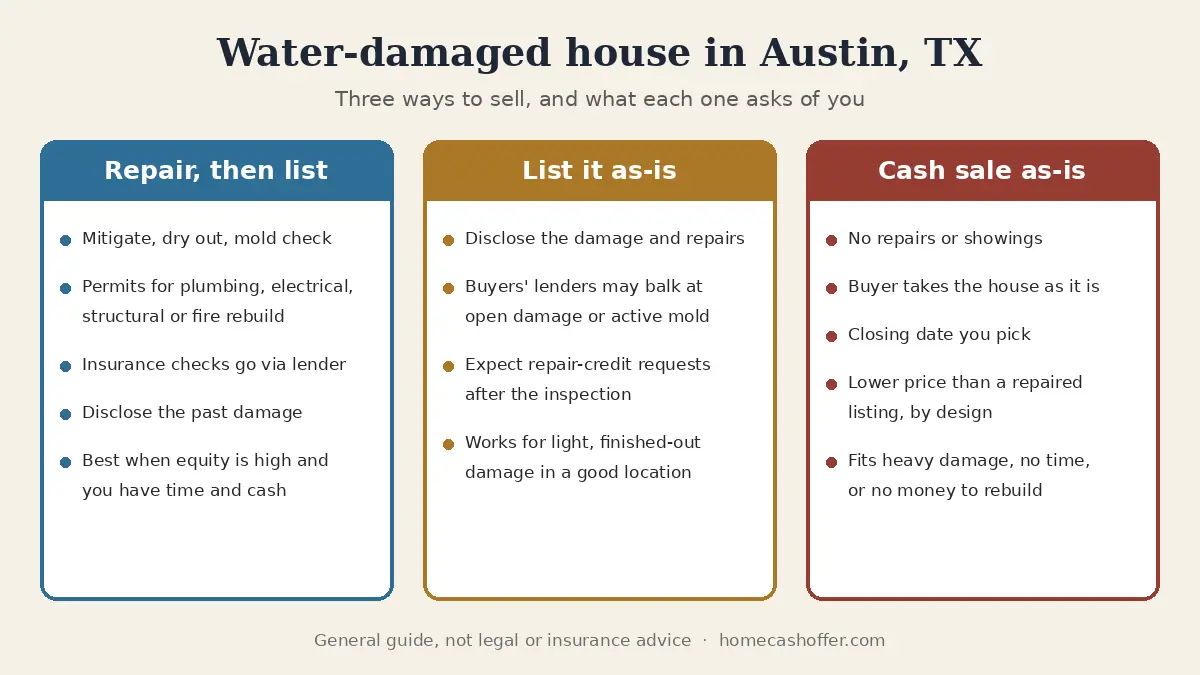
| Repair, then list | List as-is | Cash sale as-is | |
|---|---|---|---|
| Upfront money | Yours plus released claim funds | Little | None |
| Permits and inspections | Yes, for most rebuild work | Buyer’s inspector will dig | Not your problem |
| Financing risk | Low once repaired | Buyers’ lenders may balk | None, no lender |
| Price | Highest gross | Discounted for damage | Lowest gross, fewest costs |
| Timeline | Months | Weeks to months | Days to a few weeks |
Gross price isn’t what you keep. Compare what’s left after agent commissions, closing costs, months of mortgage, insurance and utility payments on an empty house, and repair overruns. Our cash offer vs. listing comparison walks through that net-sheet math.
When is a cash sale the wrong call?
Be honest with yourself about these:
- The damage is small and finished. If the leak was caught fast, the drywall is replaced, the mold check came back clean and you have the paperwork, list it. Austin buyers will pay for a finished house.
- The insurer is paying full replacement cost and you have time. Repairing with the insurer’s money and then listing usually beats a discount, if you can manage contractors.
- You want to stay. If the house fits your life and the claim covers the work, keep it. Selling is a one-way door.
- You haven’t checked the 50% rule or the exemption trap. Get those answers first. They change every offer, including ours.
From our deals
The water-damaged houses we see usually have the same story: the claim got paid partly, the servicer is holding the rest, the contractor’s estimate came in higher than the adjuster’s, and the owner is paying a mortgage on a house they can’t live in. What helps most is when the seller already has the adjuster’s estimate, the servicer’s statement of any funds it’s holding, and a note on whether the City or the appraisal district has sent anything. With those in hand we can make an offer that accounts for the real condition, and you can compare it to a repair-and-list plan line by line.
What should I send for a cash offer?
The address, a few photos of the damaged rooms, the date and cause of the damage, the adjuster’s estimate if you have it, and whether a mortgage or a pending claim is involved. Call (405) 622-8705 or request a cash offer, and we’ll tell you plainly whether a cash sale makes sense or whether you’d do better listing.
HomeCashOffer is a nationwide cash home buyer. We aren’t lawyers, insurance adjusters or public adjusters, and nothing here is legal or tax advice. For disclosure questions or a disputed claim, talk to a Texas real estate attorney or a licensed public adjuster. HomeCashOffer, 3000 W Memorial Rd, Ste 123 Unit 308, Oklahoma City, OK 73120, (405) 622-8705.
Related reading: Selling a fire-damaged house in New Orleans · Fire or water damage in Charlotte · Fire-damaged house in Birmingham · Selling a Houston house in probate · Relocating out of San Antonio · Tired landlord in Dallas
Sell your house fast in these markets
Local cash offer pages—or start with a nationwide request.
Frequently asked questions
Does a burst pipe count as a flood on the Texas Seller's Disclosure Notice?
Not usually. The Texas form under Property Code 5.008 lists 'Water Damage Not Due to a Flood Event' as its own item, separate from the flood section that asks about water penetration from a natural flood event, flood claims and FEMA or SBA help. A supply line or frozen pipe that failed inside the house generally goes under water damage. Creek or rain water that came in from outside goes in the flood section. If you're unsure which box fits, ask your Texas real estate attorney before you sign the form.
My insurance check is made out to me and my mortgage company. Can I still sell the house?
Yes. Texas Department of Insurance guidance says that if you have a loan, the insurer usually sends the payment to the mortgage company, which must contact you within 10 days of getting it. You then work with the servicer to release money for repairs. If you sell instead, the payoff at closing clears the loan, and what happens to any money the servicer is still holding depends on your loan and policy. Ask the servicer and your insurer in writing before you sign a contract.
Do I need a City of Austin permit to fix water damage before I sell?
It depends on the work. Austin Development Services says painting, flooring, cabinets and small drywall repairs generally don't need a permit, and simple plumbing repairs like stopping a leak may not either. Plumbing work beyond that, electrical repairs and any fire rebuild of structural parts need permits, and no gas work is exempt. If the house is in a floodplain, check with the Floodplain Office first, because major damage can trigger the substantial-damage rules.
What is the 50% substantial damage rule in Austin?
If your house is in a floodplain and the cost to repair it equals or exceeds 50% of the structure's value before the damage, the City of Austin treats it as substantially damaged. The repairs then have to meet floodplain rules, which can mean elevating or otherwise bringing the house into compliance. That can turn a repair job into a much bigger project, so get the determination before you sign a contractor agreement or price the house.
Can I sell an Austin house with mold without hiring a licensed remediator?
You can sell a house with mold as long as you disclose what you know. Texas doesn't require you to remediate before selling. If you do remediate, TDLR says areas of visible mold of 25 contiguous square feet or more generally need a licensed assessor and a separately licensed remediator, and a properly completed project gets a Certificate of Mold Damage Remediation that you can give a buyer.
My house was damaged after I signed a contract with a buyer. What happens?
Unless your contract says otherwise, Texas Property Code 5.007 says that if all or a material part of the house is destroyed without the buyer's fault before title or possession transfers, you can't enforce the contract and the buyer can get back what they paid. Many Texas resale contracts have their own casualty clause that controls instead, so read yours and talk to your agent or attorney right away.
Will selling an uninhabitable house cost me my homestead exemption?
It can, if you used the special rule in Tax Code 11.135 to keep the exemption while the house was unlivable and you sell before the replacement or repair is finished. In that case the law imposes an additional tax equal to the tax you saved for each year, plus 7% annual interest, and a tax lien attaches to the property when you sell. Ask the Travis Central Appraisal District and your title company how it applies before you list.
Ready to see what a cash offer looks like?
No repairs required. No agent commissions when you sell to us. No obligation to accept.
Request your no-obligation cash offer
Prefer a dedicated form? Visit Get a Cash Offer Today.
Get My Cash Offer
Share your name, phone, and property address. No obligation. We will follow up shortly.