
Selling a Spokane, WA House With Back Taxes or Liens: The Three-Year Clock, the December Tax Sale, and What Else Has to Be Paid
Behind on Spokane County property taxes, or carrying a utility or contractor lien? Washington is a tax-deed state, not a tax-lien-certificate state. How the April 30 and October 31 due dates, 9% interest on a 1-4 unit house, the Certificate of Delinquency and the December 7, 2026 auction work, plus REET and city utility liens. Call (405) 622-8705.
Short answer: You can sell a Spokane house that has back taxes or other liens, and a normal closing can pay those bills from the proceeds if the house is worth enough. Washington does not sell tax lien certificates; it is a tax-deed state. Spokane County taxes are due April 30 and October 31. Once any one tax is three full years delinquent, the treasurer can file a Certificate of Delinquency and, if you do not redeem, sell the property at the county’s once-a-year auction, which in 2026 is set for December 7 and 8.
By HomeCashOffer Team. For the broader market, see our Spokane metro guide and Spokane city page.
Does Washington sell tax lien certificates?
No. The Spokane County Treasurer’s foreclosure FAQ is direct: Washington is a tax-deed state, not a tax-lien state. The county does not auction a certificate that a private investor can later foreclose. What gets sold, if a tax stays unpaid long enough, is the property itself.
That is a different clock from states that sell certificates each spring and leave you redeeming from a private holder. Here, the adversary on a tax delinquency is the county, and the end of the road is a treasurer’s deed after a public sale. HomeCashOffer does not stop a tax foreclosure. A timely sale to a buyer, including a cash buyer, can pay the delinquency before the auction, which is a different thing.
When are Spokane County taxes due, and what interest applies if you’re behind?
The first half is due April 30. If the bill is $50 or more and half is paid by that date, the second half is due October 31, under RCW 84.56.020. If a due date falls on a weekend or holiday, the treasurer takes payment the next business day. A mailed payment is timely if it has an official U.S. Postal Service postmark by the due date.
Interest is not the same for every kind of property. For a residential house with four or fewer units, including a manufactured or mobile home, the statute sets interest at 9% per year, or 0.75% per month, on taxes levied in 2023 or after, and it does not add the June or December penalties. Other real property and personal property accrue 12% interest, plus a 3% penalty on June 1 and an 8% penalty on December 1 if those taxes remain unpaid. The Treasurer’s interest and penalty page also notes that stormwater, flood and irrigation charges are not assessed a penalty, and aquifer charges are not assessed interest or penalty.
The treasurer can offer a payment agreement or accept partial payments on delinquent years, and those payments are applied first to the oldest year unless you ask otherwise. Once a parcel is far enough along toward foreclosure, you will want a current payoff letter rather than guessing from last year’s bill.
When does Spokane County start tax foreclosure?
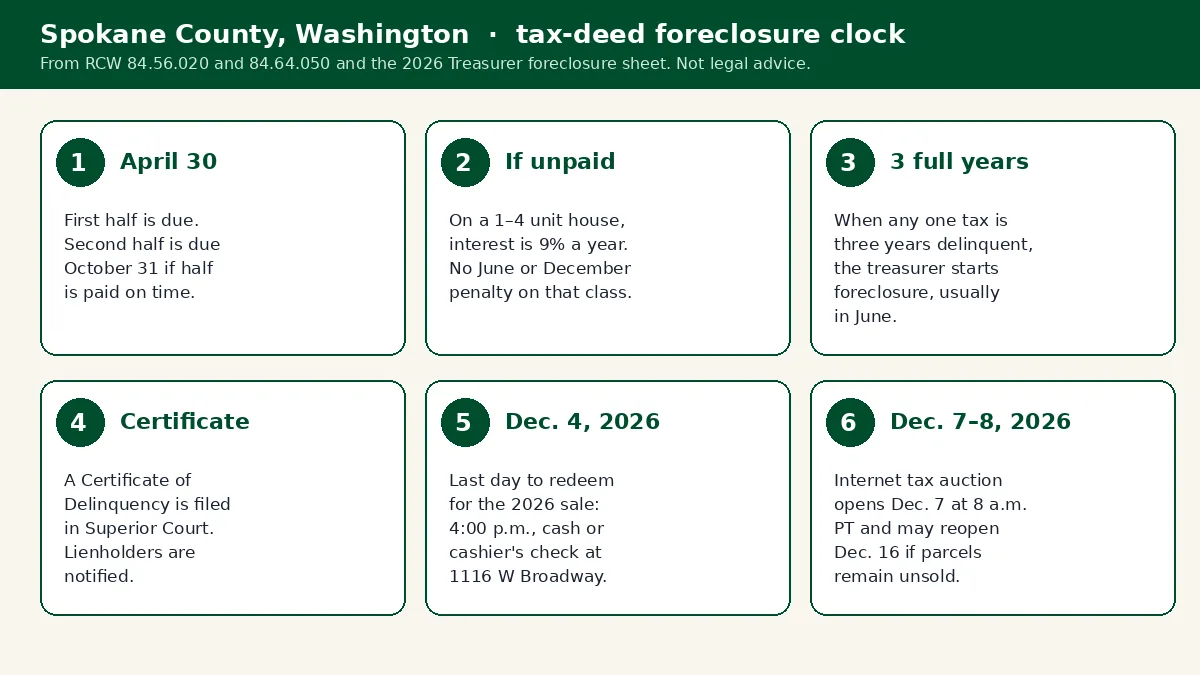
The treasurer has to start foreclosure once any one tax is three full years delinquent. A useful example from the county: if the 2023 tax that was due April 30, 2023, went entirely unpaid, foreclosure would not start until April 30, 2026. If half of that 2023 tax was paid on time by October 31, 2023, that year would not go to sale until 2027.
The office usually begins the annual process in June. With the prosecuting attorney, it files a Certificate of Delinquency in Spokane County Superior Court, under RCW 84.64.050. The treasurer orders title reports, notifies recorded owners and lienholders by certified mail, and publishes a list in a local newspaper. The certificate is evidence of the unpaid tax and has the effect of a lis pendens. You still own the house, and you can still sell it, until a tax deed is issued after the auction.
Property tax has priority over most other liens, under RCW 84.60.010. That matters at a tax sale, where many junior liens may be wiped out, and it also matters at a regular closing, because the tax bill gets paid first out of the proceeds. The Treasurer cautions that some liens can survive a tax sale and that it makes no guarantees; a Washington attorney should review a specific title report.
What is the 2026 Spokane County tax sale calendar?
The county holds one real-property tax sale a year. For 2026, the Treasurer’s foreclosure information sheet sets an internet auction for December 7, 2026, starting at 8:00 a.m. Pacific Time, closing December 8, with a possible reopening on Wednesday, December 16, if unsold properties remain. Public notice was tentatively set to be published on Friday, November 13, 2026. A current list is kept in the Treasurer’s Office and on the county website and is updated monthly.
The last day to redeem and keep a property out of that sale is Friday, December 4, 2026, by 4:00 p.m. Pacific Time. Payment has to be in the office, in cash or a cashier’s check payable to the Spokane County Treasurer, at 1116 W Broadway Ave, Spokane, WA 99260. After a sale, a tax deed is typically issued within 30 days after the treasurer deems the entire auction closed. If the high bid is more than the taxes, interest, penalties and costs, the excess is held for three years for the person who held title on the day the Certificate of Delinquency was filed.
If you are trying to sell the house yourself, treat December 4 as a hard stop for a 2026 case, not a target. A closing has to fund early enough for the treasurer to receive the payoff in the form the office requires.
What other liens show up on a Spokane title search?
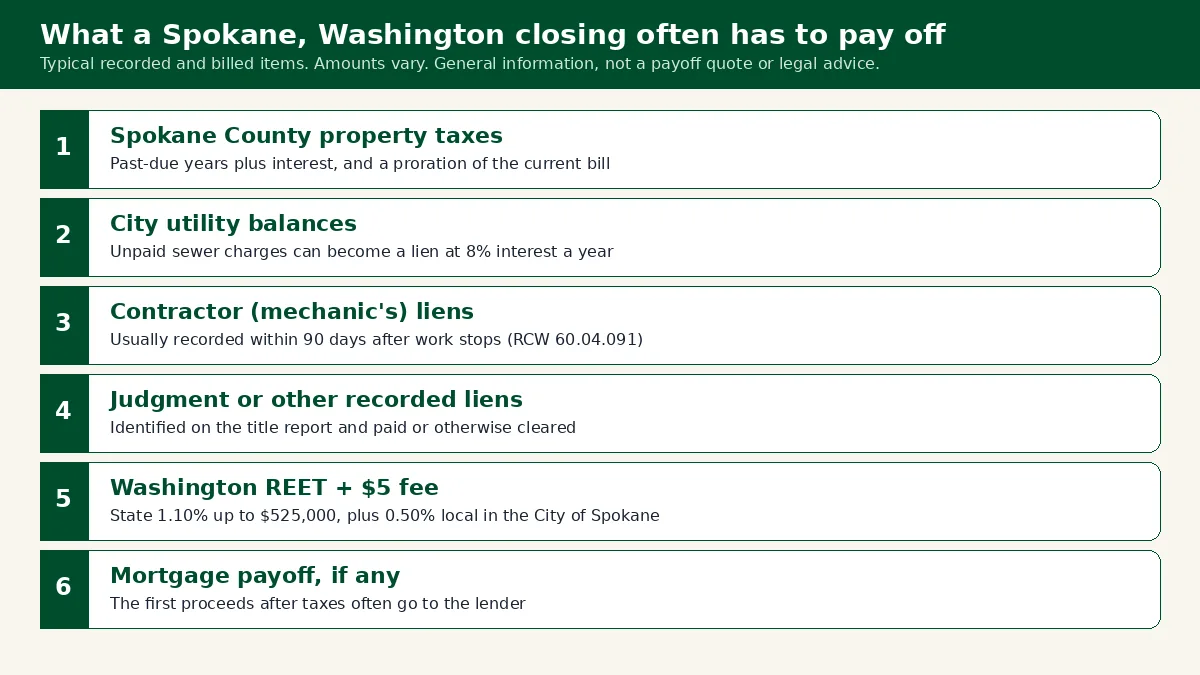
Back taxes are often not the only line on the payoff. A City of Spokane sewer bill that goes unpaid becomes a lien against the premises under Spokane Municipal Code 13.03.0904, with interest on delinquencies at 8% per year, computed monthly (see RCW 35.67.200). The city can also enforce that lien by shutting off water in the circumstances the statute allows. Water and other city utility charges can create similar collection problems, and a closing typically needs a utility cutoff or payoff bill.
Contractor claims are another common surprise on a house that had a roof, sewer or remodel started and then stalled. Washington’s Department of Labor & Industries explains the mechanics-lien process. Under RCW 60.04.091, a claimant generally has to record the lien within 90 days after stopping work or last furnishing labor or materials. A recorded lien has to be paid, bonded around or otherwise cleared before a buyer will take title.
Judgment liens, IRS liens and, on some properties, homeowners-association balances can appear as well. None of these automatically prevent a sale. They do have to be identified early, because the offer, the closing date and whether there is any cash left for you all depend on the full payoff stack, not only the tax bill. If the house is community real property, both spouses or domestic partners generally have to join in the deed under RCW 26.16.030, which our Spokane hub covers in more detail.
Do you still owe Washington’s real estate excise tax when you sell to pay the liens?
Yes, on a regular sale. Washington’s real estate excise tax is usually paid by the seller at closing, and unpaid REET can itself become a lien. The state portion, for sales in 2026, is 1.10% of the price up to $525,000 and 1.28% of the portion from $525,000.01 to $1,525,000 (higher brackets apply above that). Local REET is added on top. The Department of Revenue’s local rates effective May 1, 2026 list 0.50% for the City of Spokane, for Spokane Valley and for unincorporated Spokane County (a few smaller towns in the county use a lower local rate). There is also a $5 state technology fee on each transfer.
On a $370,000 City of Spokane sale, the state portion at 1.10% is $4,070 and the local 0.50% is $1,850, before that small fee. The state price thresholds rise on January 1, 2027, when the 1.10% bracket is scheduled to go up to $551,000. Inheriting a house is generally exempt from REET; selling it later is not. When you sell to HomeCashOffer, escrow calculates REET and pays it from the proceeds, and the written offer says which closing costs we cover.
Do you still have to give the buyer a Form 17?
On most sales of a house with one to four units, yes. The seller delivers Washington’s seller disclosure statement within five business days after mutual acceptance unless the buyer waives it, and the buyer then has three business days to accept it or rescind, under RCW 64.06.030. A sale by the personal representative of a decedent’s estate is exempt, as are some other transfers, including certain foreclosures and transfers to a spouse, parent or child. Our Spokane metro guide walks through those exemptions. If you have not been inside the house in months, say that clearly rather than guessing about the roof, oil tank, sewer or a wet crawlspace, which are regular issues on older South Hill, West Central, Hillyard and Browne’s Addition houses.
What is a lien-burdened Spokane house worth in this market?
A clean, updated house and a house with unpaid taxes are not the same listing, even on the same block. Over the three months ending October 2026, Redfin reported a Spokane median sale price of $369,743, down 0.78% from a year earlier, with a median of 29 days on the market and a sale-to-list ratio of 98.9%. Those figures describe closed sales in general, not only houses with tax or contractor liens, which often take longer and sell farther from list.
Financing is still expensive relative to the last decade. Freddie Mac’s Primary Mortgage Market Survey put the 30-year fixed rate at 7.11% as of November 12, 2026, down from 7.18% the week before. A cash buyer does not need that loan, which can matter when a retail buyer would otherwise ask the lender to swallow a tax payoff, a utility lien or unfinished work.
Should you pay the taxes first, list the house, or sell direct?
If there is enough equity, you do not have to bring a cashier’s check to Broadway before you sell. A title or escrow company can pay the treasurer, the city utilities and any recorded contractor or judgment liens from the seller’s proceeds at closing, then hand you what is left. Paying the oldest year down yourself can still be smart if it stops interest or pulls a parcel back from an approaching sale date, and the treasurer can discuss a payment agreement.
A retail listing can net more if the house will show well, you can clear the smaller liens up front, and someone can manage the sale through a 29-day (or longer) market. A direct cash sale is often cleaner when the December 4 redemption date is close, the house is empty or in poor condition, you live on the west side of the state or out of state, or the work needed to list it would cost more than you want to spend. Get a local agent’s net sheet, a current tax-and-lien payoff, and a written direct offer, then compare.
Owners in Spokane Valley should use the same county tax calendar; only the city utility accounts and the mailing address change. Our Spokane Valley page is the local entry point for that side of the metro.
From our deals
The Spokane and Spokane Valley files we see with liens usually have more than one problem stacked on the same house: a tax year or two unpaid, a city utility balance that kept accruing after someone moved, and sometimes a contractor lien from a roof or sewer that was never finished. The sellers who get a firm number faster are the ones who send the treasurer’s payoff, the city utility account numbers, and any lien recordings before we walk the house. The ones who wait until a Certificate of Delinquency is already on file still can sell, but the closing date has to work backward from the treasurer’s redemption cutoff, and there is less room for a delay in signing.
When is a cash sale the wrong call for a Spokane seller with liens?
A cash sale is the wrong call when the house would sell well on the open market and you have time and a way to clear, or escrow, the smaller liens. Skip a direct offer, or at least test the market first, if:
- the house is in good condition, the only issue is one recent tax half, and a local agent can list it with the payoff handled at closing;
- a retail price, after commission, REET and a longer timeline, would clearly net you more, and the next auction date is not close;
- the liens and the mortgage together would exceed any offer, which needs a Washington attorney and your lender before any buyer;
- you have not compared a local agent’s net sheet with a written direct offer and a current payoff letter from the treasurer.
How does a HomeCashOffer sale work, and what it does not do?
It does not stop a tax foreclosure, and it does not erase a lien by itself. What it can do is buy the house as it is and let escrow pay the taxes, utilities and recorded liens from the proceeds on a closing date you choose, as long as the numbers work and the treasurer can be paid in time.
Send us the address, photos, the latest Spokane County tax statement or payoff, and any city or contractor notices. After a walk-through with you on video or with a key holder you choose, we send a written, no-obligation cash offer. No repairs, no commission. If you accept, a Washington closing agent handles title, the REET affidavit and the payoffs, and you can sign with a notary where you live. Both spouses or partners should plan to sign if the house is community property.
To start, call (405) 622-8705 or ask for your cash offer here, or read our Spokane, WA page first.
HomeCashOffer’s office is at 3000 W Memorial Rd, Ste 123 Unit 308, Oklahoma City, OK 73120, and we buy in Spokane, Spokane Valley and across the country. For questions about a specific tax bill, lien, title problem or contract, talk to a Washington attorney or CPA. HomeCashOffer is not a law firm and this isn’t legal advice.
Related reading: Selling a house fast in Spokane · Selling a Greenville, SC house with back taxes or liens · Selling a St. Louis house with back taxes or liens · Selling an inherited house in probate in Seattle
Sell your house fast in these markets
Local cash offer pages—or start with a nationwide request.
Frequently asked questions
Does Washington sell tax lien certificates on a Spokane house?
No. The Spokane County Treasurer is clear that Washington is a tax-deed state, not a tax-lien state. The county does not sell a certificate that a private investor can later foreclose. If a tax stays unpaid long enough, the treasurer files a Certificate of Delinquency and, if it is not redeemed, sells the property itself at a public auction.
When are Spokane County property taxes due?
The first half is due April 30. If the bill is $50 or more and you pay half by April 30, the second half is due October 31 (RCW 84.56.020). If a due date falls on a weekend or holiday, the treasurer accepts payment the next business day. For mailed payments, the official U.S. Postal Service postmark is the payment date.
What interest and penalties apply to unpaid 2026 taxes on a single-family Spokane house?
For residential real property with four or fewer units, including manufactured or mobile homes, RCW 84.56.020 sets interest at 9% per year (0.75% per month) on taxes levied in 2023 or after, and it does not add the June or December penalties that apply to other property. Other real property and personal property accrue 12% interest, plus a 3% penalty on June 1 and an 8% penalty on December 1 if those taxes go unpaid. Stormwater, flood and irrigation charges are not assessed a penalty; aquifer charges are not assessed interest or penalty.
When does Spokane County start tax foreclosure, and when is the 2026 sale?
The treasurer has to start foreclosure once any one tax is three full years delinquent. The office usually begins that work in June by filing a Certificate of Delinquency in Spokane County Superior Court. The 2026 internet auction is set for December 7, 2026, starting at 8:00 a.m. Pacific Time, and it closes December 8. It may reopen on December 16 if unsold properties remain. The last day to redeem and keep the property out of that sale is Friday, December 4, 2026, by 4:00 p.m., in cash or cashier's check, at the Treasurer's Office, 1116 W Broadway Ave, Spokane, WA 99260.
Do unpaid City of Spokane sewer or water bills become a lien?
They can. Spokane Municipal Code 13.03.0904 says unpaid sewer charges become a lien against the premises, with interest on delinquencies at 8% per year, computed monthly, under RCW 35.67.200. The city can also enforce a sewer lien by shutting off water in the circumstances the statute allows. A title company will look for these balances, along with other city utility charges, and they are typically paid at closing.
Do I still pay Washington's real estate excise tax if I sell to pay off back taxes?
Yes, on a regular sale to a buyer. The state portion is 1.10% of the selling price up to $525,000 and 1.28% of the portion from $525,000.01 to $1,525,000, plus the local rate. The Washington Department of Revenue's rates effective May 1, 2026, list a 0.50% local rate for the City of Spokane, Spokane Valley and unincorporated Spokane County. The seller usually pays REET at closing. The state price brackets change on January 1, 2027. A tax-foreclosure deed at the county auction is a different kind of transfer; this guide is about selling the house yourself before that happens.
If the house sells at the tax auction for more than the taxes owed, do I get the extra money?
Possibly. The Treasurer says any amount above the taxes, interest, penalties and costs is excess funds, held for the person or people who held title on the day the Certificate of Delinquency was filed. You have three years to claim them. The Treasurer's Office notifies the title holder of record and sends an application. Be cautious of anyone who contacts you offering to 'help' claim money that the county will already reach out to you about.
Ready to see what a cash offer looks like?
No repairs required. No agent commissions when you sell to us. No obligation to accept.
Request your no-obligation cash offer
Prefer a dedicated form? Visit Get a Cash Offer Today.
Get My Cash Offer
Share your name, phone, and property address. No obligation. We will follow up shortly.