
Behind on Newark Property Taxes or Water Bills? Selling a House With a Tax Sale Certificate, Judgments, or Contractor Liens in New Jersey
Got a tax sale notice from the City of Newark? How New Jersey tax sale certificates, redemption interest and penalties, the 2024 equity-protection law, statewide judgment liens, construction liens and the nonresident GIT/REP rules work when you sell a Newark house. Call (405) 622-8705.
Short answer: Yes, you can sell a Newark house that has a tax sale certificate, judgment or contractor lien on it, and the sale is often the cleanest way to pay them all, because the settlement agent pays each lienholder straight from your proceeds. The thing to understand about New Jersey is that the City doesn’t sell your house when taxes go unpaid. It sells a lien on it to an investor, who earns interest until you pay and can eventually foreclose. The earlier you sell or pay, the more of your equity you keep.
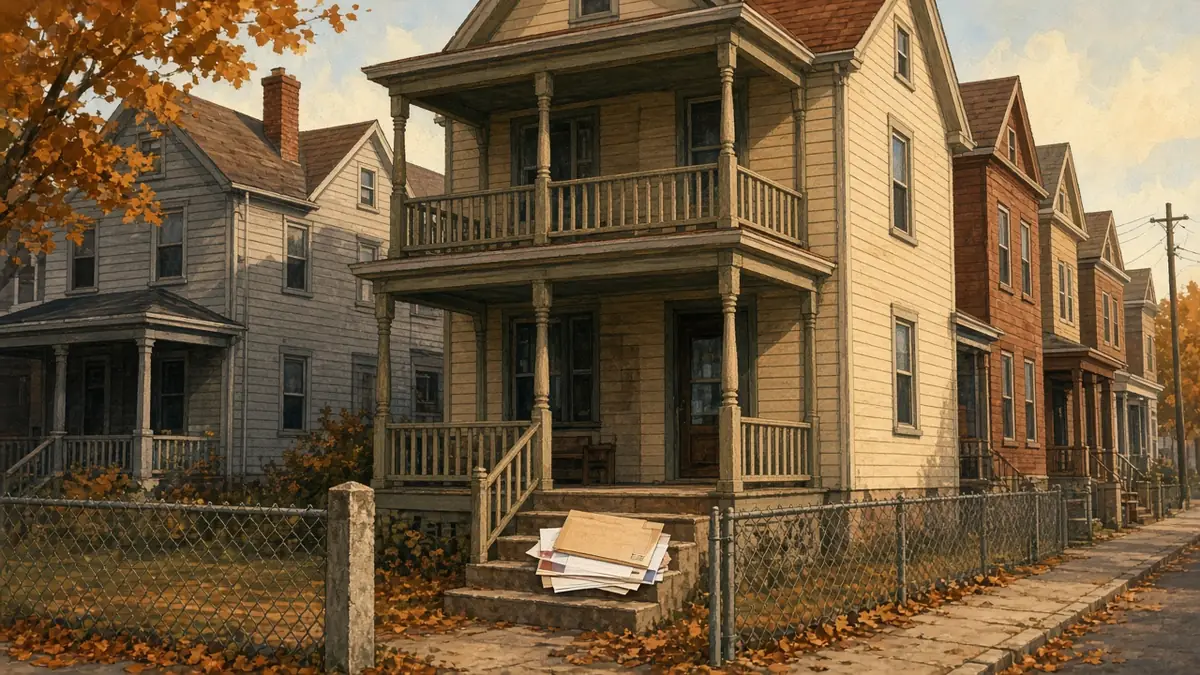
This guide is written for one kind of owner. You own a two-family house in Vailsburg, the North Ward or Weequahic. You live on one floor and rent the other, or you used to. A tenant stopped paying, then moved out and left the water running up a bill. You fell a few quarters behind on the property tax while you sorted it out. Then a notice arrived saying the property is on the list for the City’s tax sale. Maybe a roofer you never finished paying has also filed something with the county.
Newark is a renter’s city, which is why so many owners here are small landlords whether they planned to be or not. The Census Bureau’s 2020–2024 American Community Survey puts Newark’s owner-occupied housing rate at 24.4% and the median value of owner-occupied homes at $373,700 (U.S. Census Bureau QuickFacts, Newark city). Recent sale prices are well above that figure, which matters a lot when you’re deciding whether a lien is worth fighting or selling around.
For the regional picture, see our Newark and Jersey City cash buyer hub and the Newark, NJ city page.
What actually happens at a Newark tax sale?
The City sells a lien, not your house. New Jersey requires municipalities to enforce unpaid taxes and municipal charges through a tax sale, and Newark’s Finance FAQ explains it in plain terms: when prior years’ taxes or other municipal charges are still owed in the current year, the City offers them for sale, which causes a tax lien certificate to be sold and filed against the property (City of Newark Finance FAQ).
A few Newark specifics worth knowing:
- The sale is usually late in the year. In 2025 the Municipal Council adopted a resolution authorizing a tax sale “on or before December 31, 2025” for 2024 and earlier taxes and other municipal charges (Newark Council File 25-1021). The 2024 sale was held as an online auction.
- There can be an accelerated sale. The same FAQ says that when the current year’s charges are still unpaid after the November 10 due date, the City may sell a certificate on those too.
- Partial payments go to the oldest bill first. If you owe three quarters and pay some, the City applies it to the oldest quarter’s principal and interest. A partial payment won’t necessarily keep the newest charges off the list.
- Water and sewer count. Newark bills water and sewer separately from property tax, but unpaid municipal charges can be included in the sale. On a two-family house that’s often where the surprise is.
At the auction, bidders compete by bidding the interest rate down from 18%. If it hits a floor, they bid a premium instead. Whoever wins pays the City and gets the certificate. From then on, you owe that investor, not the City, for that amount.
How much does a New Jersey tax lien cost you while it sits there?
More than the original bill, and it keeps growing. Before the sale, New Jersey lets a municipality charge interest on a delinquency of up to 8% a year on the first $1,500 and 18% a year on anything above $1,500, plus a year-end penalty of up to 6% if the delinquency is over $10,000 (N.J.S.A. 54:4-67).
After the sale, the payoff to redeem the certificate generally includes:
- The certificate amount the investor paid.
- Interest at the winning bid rate, up to 18% a year.
- A one-time redemption penalty of 2% on certificates over $200, 4% over $5,000 and 6% over $10,000 (N.J.S.A. 54:5-61).
- Allowed costs such as recording and searching fees.
- Later taxes the holder paid for you, which the holder is allowed to add on, with interest.
That last item is the one owners miss. If the investor keeps paying your new quarterly bills to protect their position, your payoff can grow well beyond the old balance. Always get a written redemption figure from the Newark tax collector’s office with a good-through date before you agree to a price.
When can the lien holder take the house, and what changed in 2024?
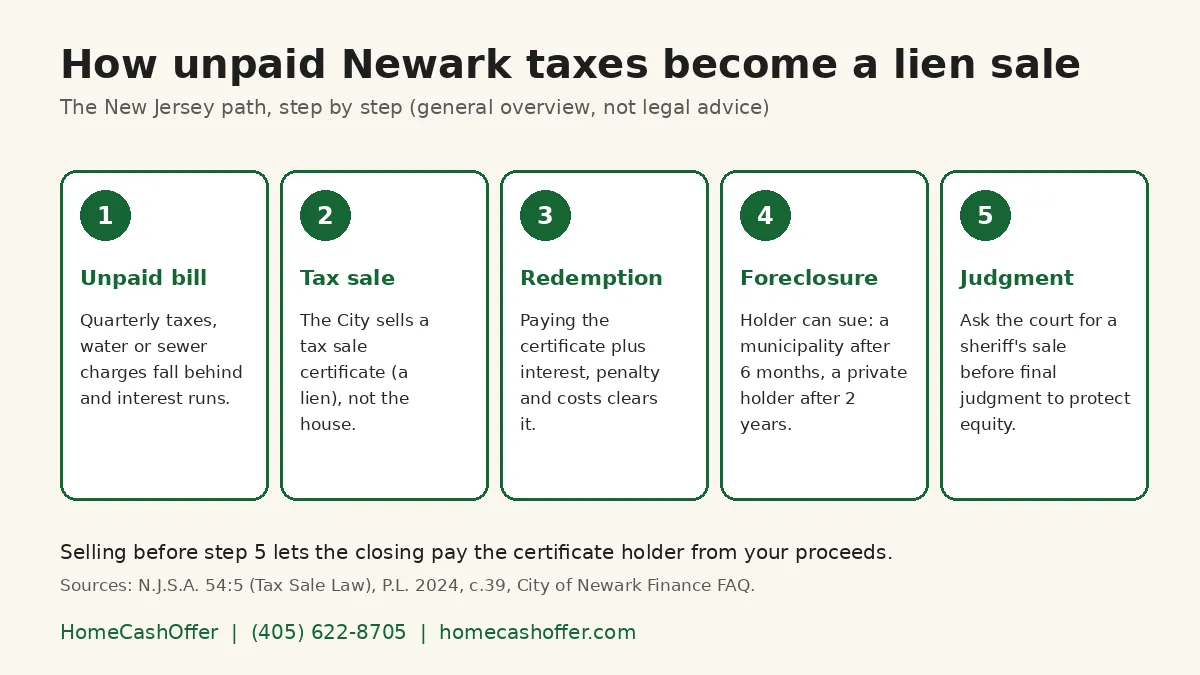
A private certificate holder generally has to wait two years after the sale before suing to foreclose your right to redeem, and a municipality holding its own certificate can sue after six months, under N.J.S.A. 54:5-86 as amended in 2024. Abandoned properties can move faster. Until a final judgment is entered, you can still pay it off, or sell and let the closing pay it off.
The cost also jumps once lawyers get involved. Before a private holder files, it normally sends at least 30 days’ written notice by certified mail showing the amount needed to redeem (it can’t collect its search and counsel fees without that notice), and it can then add a title search fee of up to $350 and up to $150 in attorney’s fees. Once a foreclosure complaint is filed, the 2024 law adds $2,500 in attorney’s fees to the redemption amount, plus filing, service and publication costs (P.L. 2024, c.39, amending N.J.S.A. 54:5-97.1 and 54:5-98). That notice letter is the moment to act, not the complaint.
For decades, a New Jersey tax foreclosure meant the certificate holder could end up with the whole house, even if the lien was small and the house was worth far more. In January 2025 the New Jersey Supreme Court held that the pre-2024 version of the Tax Sale Law violated the Takings Clause because lienholders “are not entitled to surplus equity in property that exceeds” what they’re owed (257-261 20th Avenue Realty v. Roberto, a Paterson case).
The Legislature had already changed the law. Under the same 2024 law, approved July 10, 2024, the owner or the owner’s heirs can make a written request to the Superior Court before final judgment that the property be sold through a sheriff’s sale or a sheriff’s internet auction. The certificate holder is paid first, with costs and fees, and the surplus goes to the court clerk for the owner. The catch is in the same section: if you don’t ask, the holder can foreclose without a sale and you have no claim against them for your equity.
So if you’ve already been served with a tax foreclosure complaint in Essex County, call a New Jersey attorney now. A sheriff’s sale protects some equity, but a sheriff’s sale price is usually not the best price. A sale you control, listed or for cash, before judgment generally leaves you more.
Which other liens show up on Newark houses?
Tax certificates are the most common, but rarely the only one. Here’s what a title search on an older Newark two- or three-family often turns up.
Judgments. In New Jersey, a docketed Superior Court judgment works as a statewide lien on real property the debtor owns, binding real estate from the time it’s entered on the court’s records (N.J.S.A. 2A:16-1). An old credit card judgment or a judgment from a tenant dispute in another county can still sit on your Newark deed. Your title company will search the statewide judgment index and ask for a payoff or proof it isn’t you (common names cause false hits).
Contractor liens. Under the Construction Lien Law, a contractor on a residential job has to file a Notice of Unpaid Balance first and lodge the lien claim within 120 days of the last work; on non-residential work it’s 90 days (N.J.S.A. 2A:44A-6). If the roofer or plumber from last spring filed in time, the lien gets paid or bonded off at closing. If they filed late or skipped the steps, a real estate attorney can tell you whether it’s valid.
Mortgage arrears. Not technically a lien problem, but often in the same pile. A tax certificate sitting ahead of your mortgage gets your lender’s attention, and some loan agreements let the lender pay the taxes and add them to your balance.
Inheritance tax liens. If you inherited the house, New Jersey’s inheritance tax creates a lien until the Division of Taxation issues a waiver. Our Newark and Jersey City hub covers the Form 0-1 and L-9 waiver basics.
How does a sale pay off a tax certificate and the other liens?
At closing, the settlement agent (in North Jersey that’s usually the buyer’s attorney working with a title company) orders payoffs from everyone with a claim and pays them from the sale price before you get your share. In practice:
- Title search. The title company finds every recorded lien, tax certificate, judgment and open municipal charge.
- Payoff letters. The agent requests a redemption statement from the Newark tax collector, a payoff from your mortgage servicer, and payoffs or releases from judgment creditors and contractors.
- Settlement statement. Each payoff appears as a line on the seller’s side. Current-year taxes are usually prorated between you and the buyer.
- Your net. What’s left after liens, the New Jersey realty transfer fee and any agreed closing costs is wired to you.
One more line item catches people who have moved away. If you’re a nonresident of New Jersey when you sell, the state generally requires an estimated income tax payment at closing on Form GIT/REP-1. It’s the greater of 2% of the sale price or your gain times the top state rate, unless an exemption on Form GIT/REP-3 applies, such as the sale of your principal residence (NJ Division of Taxation GIT/REP FAQs). That’s a credit toward your New Jersey return, not a penalty, but it’s money you won’t see at the closing table.
What is a Newark house with liens likely to sell for?
Newark’s market has been active, which works in your favor. Redfin’s data for the three months ending September 2026 shows a median sale price of $557,235, down 3.9% from a year earlier, a median of 70 days on market, and 64.1% of homes selling above list price (Redfin Newark housing market). Those medians mix renovated multifamily, condos and houses needing work, so they tell you the market is liquid, not what your particular house is worth.
What it means for a lien seller: in most Newark neighborhoods there’s real equity above a typical tax certificate. That’s the strongest reason not to let a certificate run to judgment. It’s also why listing can beat a cash sale when the house is in good shape.
When should you NOT sell your Newark house for cash?
Be honest with yourself about these:
- The house is in good shape and the liens are small. If the payoff is a few thousand dollars and the house would show well, listing with an agent will likely net more, and the closing pays the certificate the same way.
- You want to stay. Paying off the certificate, getting on a payment arrangement with the City for current charges, or applying for New Jersey’s property tax relief programs may let you keep the house. Ask the tax office what’s available for your situation.
- Your tenant situation can be fixed. If the second unit can be re-rented at a fair rent, the income may cover the arrears in a reasonable time.
- A judgment might not be yours. Clear up a false judgment hit before you price the house as if you owe it.
A cash sale tends to make sense when the house needs major work (old knob-and-tube wiring, a failing roof, a basement that takes water), when several liens have stacked up, when a foreclosure complaint has already been filed, or when you simply need a firm date and don’t want showings in an occupied two-family.
From our deals
Across the lien and back-tax houses we’ve looked at, the pattern is usually the same. The owner knows about one debt and is surprised by the second and third. Someone believes they owe a year of taxes, and the title search shows a tax certificate, a later subsequent-tax charge the investor paid, an unpaid water balance and an old judgment. The houses where sellers keep the most money are the ones where they asked for real payoff figures early, before interest and penalties kept climbing and before anyone filed in court. We’d rather tell you a listing nets more than buy a house that doesn’t make sense for you.
How do you sell a Newark house with liens to HomeCashOffer?
- Call (405) 622-8705 or request an offer online. Tell us what you know about the liens, even if it’s rough.
- We look at the house in person or through someone you trust, including both units if it’s a two- or three-family.
- You get a written as-is offer and a plain explanation of how the known liens would come off at closing.
- A New Jersey title company and attorney handle payoffs, including the tax collector’s redemption figure, any judgments, and the realty transfer fee.
- You pick the closing date, subject to clear title. If a tax foreclosure is already in court, closing has to happen before final judgment, so earlier is better.
Weighing other options too? Compare how back taxes work in Raleigh, where the county can garnish wages, in Tampa, where Florida also sells tax certificates, and in St. Louis. If a mortgage default is the bigger problem, read about facing foreclosure in Boston.
HomeCashOffer, 3000 W Memorial Rd, Ste 123 Unit 308, Oklahoma City, OK 73120. (405) 622-8705. We’re a nationwide cash home buyer, not a law firm, tax advisor or title company.
Related reading: Sell my house fast in Newark and Jersey City · Newark, NJ city page · Jersey City, NJ city page · Cash offer vs. listing with an agent · How cash home buyers work
Sell your house fast in these markets
Local cash offer pages—or start with a nationwide request.
Frequently asked questions
Does Newark sell my house at the tax sale?
No. At a New Jersey tax sale the City sells a tax sale certificate, which is a lien on the property for the unpaid taxes and municipal charges. You still own the house and can still sell it. What changes is that someone else now holds the lien, it earns interest at the rate bid at the auction, and after a waiting period the holder can sue to foreclose your right to pay it off.
Can unpaid Newark water and sewer bills end up in the tax sale?
Yes. Newark's tax sale resolutions cover delinquent taxes and other municipal charges, and the City's Finance FAQ says unpaid prior-year taxes or municipal charges can cause a tax lien certificate to be sold and filed against the property. If you own a two- or three-family house and a tenant's usage pushed the water bill up, check that balance along with the property tax account.
What does it cost to pay off a tax sale certificate in New Jersey?
The certificate amount, plus interest at the rate the winning bidder bid (up to 18% a year), plus a one-time redemption penalty under N.J.S.A. 54:5-61 of 2% if the certificate is over $200, 4% if over $5,000 and 6% if over $10,000, plus allowed costs. If the holder also paid later taxes for you, those are added too. Get the exact figure in writing from the Newark tax collector before you sign a sale contract.
How long do I have before a tax lien holder can foreclose on my Newark house?
Under the Tax Sale Law, a private certificate holder generally has to wait two years after the sale before filing to foreclose the right of redemption, and a municipality that holds the certificate can file after six months. You can still pay off the certificate, or sell and have it paid at closing, until a final judgment is entered, so don't treat the two years as spare time.
What is the 2024 change to New Jersey's tax foreclosure law?
After the U.S. Supreme Court's Tyler v. Hennepin County decision, New Jersey passed P.L. 2024, c.39. It lets the owner or the owner's heirs demand, in writing to the Superior Court before final judgment, that the property be sold through a sheriff's sale or a sheriff's internet auction instead of simply going to the certificate holder. Surplus money after the holder is paid goes to the court clerk for the owner. If you don't make that demand, you can lose any claim to your equity, so talk to a New Jersey attorney as soon as you're served.
I'm a New Jersey seller but I moved to Pennsylvania. Will they hold back money at closing?
Probably. New Jersey requires a nonresident individual, estate or trust selling New Jersey real property to make an estimated Gross Income Tax payment at closing on Form GIT/REP-1, equal to the greater of 2% of the sale price or the gain times the top tax rate, unless an exemption on Form GIT/REP-3 applies. Box 2 on that form covers a sale of your principal residence. Ask your settlement agent which form fits you early, since it changes your cash at closing.
Should I sell my Newark house for cash just because there's a tax lien?
Not automatically. Newark homes have been selling above list price on average in 2026, so a house in decent shape with real equity may net more listed with an agent, and paying off the certificate might make sense if you plan to stay. A cash sale tends to fit when the house needs major work, several liens are stacked up, a foreclosure complaint has already been filed, or you need a firm closing date.
Ready to see what a cash offer looks like?
No repairs required. No agent commissions when you sell to us. No obligation to accept.
Request your no-obligation cash offer
Prefer a dedicated form? Visit Get a Cash Offer Today.
Get My Cash Offer
Share your name, phone, and property address. No obligation. We will follow up shortly.