
Selling an Atlanta House During a Divorce: Fulton's Standing Order, Who Owns the Equity, and When a Cash Sale Fits
Divorcing in Atlanta? Why Fulton County's automatic standing order stops either spouse from contracting to sell alone, how Georgia's source-of-funds rule splits equity in a house one spouse owned first, who pays the temporary 2026 Fulton tax bill, what the Atlanta market says, and when cash is the wrong call. Call (405) 622-8705.
Short answer: Yes, you can sell an Atlanta house while a divorce is pending, but once a Fulton County Family Division case is filed, neither spouse can sign a sale contract alone. Fulton’s automatic standing order blocks either party from selling or contracting to sell marital property without the other’s agreement or a judge’s permission. Agree in writing first, decide how the proceeds will be split or held, and then pick the exit (buyout, listing or direct sale) that fits your timeline and the house’s condition.
Here’s the situation this guide is written for. A couple owns a 1920s bungalow in Kirkwood, a brick ranch off Cascade Road, or a 1990s two-story in a Sandy Springs subdivision. One spouse has already signed a lease on an apartment in Midtown or Decatur. The other is still in the house with the kids and a mortgage they can’t carry on one income. The petition was served last month, and a stapled “Automatic Domestic Standing Order” came with it. Everyone agrees the house has to go. Nobody agrees on how, when or for how much.
The rules below are Georgia rules, with Fulton County details where they apply. The City of Atlanta reaches into DeKalb County too, and many metro couples file in Cobb, Gwinnett, DeKalb or Clayton. If your case is there, read the order attached to your own papers, because each superior court sets its own.
What does the Fulton County standing order actually stop you from doing?
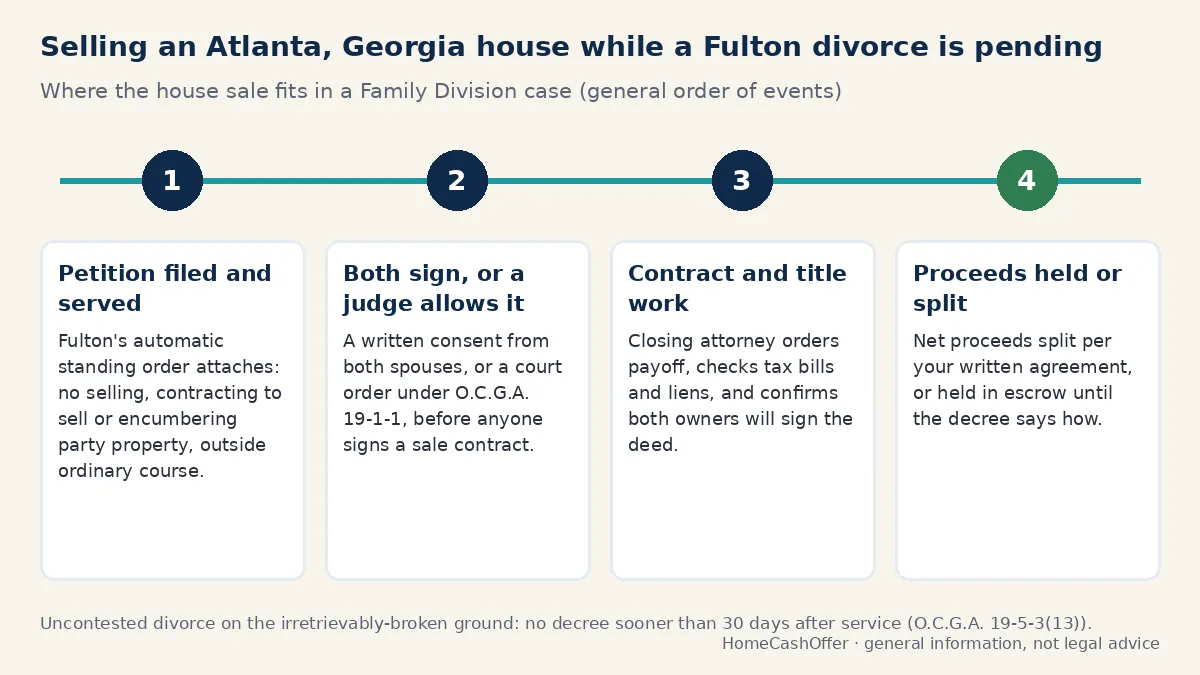
It stops either spouse from selling, encumbering or even contracting to sell party property on their own. That covers the house. Under the Fulton County Superior Court Family Division’s Automatic Domestic Standing Order (signed January 23, 2025), each party to a divorce or separate maintenance case is “enjoined and restrained from selling, encumbering, trading, contracting to sell, or otherwise disposing” of property belonging to the parties, except in the ordinary course of business. The order stays in effect until the final order in the case.
The legal basis is O.C.G.A. 19-1-1, which lets a Georgia court issue a standing order when a domestic relations case is filed. The statute’s version adds the words “without the permission of the court.” That’s your way through: a sale both spouses sign off on in writing, usually through a consent order, or an order a judge enters after a hearing.
Three other parts of the Fulton order matter for a house sale:
- Utilities stay on. Neither spouse may disconnect, or cause the disconnection of, water, gas, electricity or other utilities at the marital residence. If the house is half-empty, that rule keeps it showable and inspectable. It also protects it from frozen pipes on the rare hard-freeze nights Atlanta gets in January.
- A 30-day status conference. Each party is told to complete a Domestic Intake Worksheet and bring it to the 30-day status conference. If you both already know you want to sell, that early conference is a natural place to say so.
- Contempt risk. The order warns that failing to follow it can lead to contempt, fees or other sanctions. A side deal with a buyer that one spouse signs alone isn’t worth that risk.
Is the whole house marital property, or only part of it?
It depends on when and how it was bought, and Georgia’s answer is often “part of it.” Georgia divides marital property equitably, not by a fixed 50/50 formula. GeorgiaLegalAid.org lists the factors a judge or jury weighs: the length of the marriage, each spouse’s age, health and earning ability, each spouse’s contributions to the family, debts against the property, and whether the split stands in for alimony. Property owned before the marriage, or received by gift or inheritance, is generally separate. Whose name is on the deed doesn’t decide it.
The tricky case is common in intown Atlanta. One spouse bought a house in Ormewood Park or Reynoldstown before the wedding. The couple then paid the mortgage from joint paychecks for years and maybe finished the basement. Georgia handles this with the “source of funds” rule. In Hubby v. Hubby (2001), the Supreme Court of Georgia said the property is “both separate and marital in proportion to the contributions” each side made. It also held that the marital share is entitled to its part of the increase in equity, “whether resulting directly from those payments or indirectly from market forces.”
That matters for selling. If one spouse expects to walk away with most of the equity and the other expects half, you won’t agree on a minimum price until your attorneys work through that math. Get the down payment records, the original closing statement and any renovation invoices together early. A sale that closes with the money held in escrow can go ahead while that argument is settled.
Do you have to wait for the decree to sell?
No. With written consent or court permission, you can close before the decree, and many couples prefer to. Selling first turns the house into a number, and a number is easier to divide than a house. The minimum timeline for the divorce itself: O.C.G.A. 19-5-3(13) says a divorce on the “irretrievably broken” ground can’t be granted until at least 30 days after the other spouse is served. O.C.G.A. 19-5-2 requires six months of Georgia residency before filing. Contested cases run much longer.
If the decree comes first, the settlement agreement usually says what happens to the house: a deadline to list, who controls the price, who pays the mortgage in the meantime, and what happens if it doesn’t sell by a set date. Read those clauses closely before you call any buyer. Your closing attorney will want to see them.
Who pays the 2026 Fulton tax bill, and what about later adjustments?
Whoever your agreement says. If it says nothing, that’s worth fixing now, because this year’s bill isn’t final. Fulton County said in August 2026 that 2026 bills were temporary, based on the preliminary tax digest and 2025 millage rates under a court-authorized temporary collection order. It said a refund or revised bill would be issued only as needed after final rates are set. City of Atlanta taxes were due September 30, 2026, and Fulton County and other jurisdictions’ taxes were due October 15, 2026. Interest starts the next day, and a 5% penalty is added every 120 days, up to 20%.
In a divorce, those dates cause real fights. Typical questions: who paid the September bill, whether that payment came from a joint account, and who gets a refund check mailed to the house after it’s sold. Put one sentence in your agreement covering prorations, refunds and revised bills. Your closing attorney will prorate the year’s taxes on the settlement statement either way.
The other closing cost people ask about is Georgia’s transfer tax. The Georgia Department of Revenue sets it at $1 for the first $1,000 and 10 cents for each additional $100, so about $400 on a $400,000 sale. The seller is liable unless the contract shifts it. It comes out of the proceeds before you split them.
What is the Atlanta market telling a divorcing seller right now?
That a well-priced house still sells, but not instantly, and most sellers give up a little on price. Redfin’s Atlanta housing market page shows these figures for the three months ending October 2026:
- A median sale price of $399,722, up 2.5% year over year.
- A median of 64 days on market, down from 75 a year earlier.
- 1,378 homes sold in October 2026, down 20% from the year before.
- A 97.2% sale-to-list ratio, with 17.0% of homes selling above list and 36.0% of listings taking a price drop.
Mortgage rates are working against buyouts. Freddie Mac’s Primary Mortgage Market Survey put the 30-year fixed rate at 7.21% on November 25, 2026, compared with 6.23% a year earlier. For the spouse who wants to keep the house, that gap shows up quickly. At 7.21%, every $100,000 borrowed on a 30-year loan costs roughly $679 a month in principal and interest. At last year’s rate it was about $614. That’s before taxes and insurance, and it has to qualify on one income.
Put those together and the timeline is clear. About two months on market, then a 30- to 45-day financed closing. That’s roughly a quarter of a year of two housing payments for a couple who are already paying for two homes. A move-in-ready house in Virginia-Highland or Brookhaven can usually carry that. An older house with a wet crawl space, decades-old wiring or a 25-year-old roof often can’t. Those are common in Atlanta’s prewar intown stock and in post-war ranches across southwest Atlanta. The same goes for a house where neither spouse will pay for repairs.
Buyout, listing or a direct cash sale: which exit fits your case?
Pick the one whose requirements you can actually meet, not the one that looks best on paper.
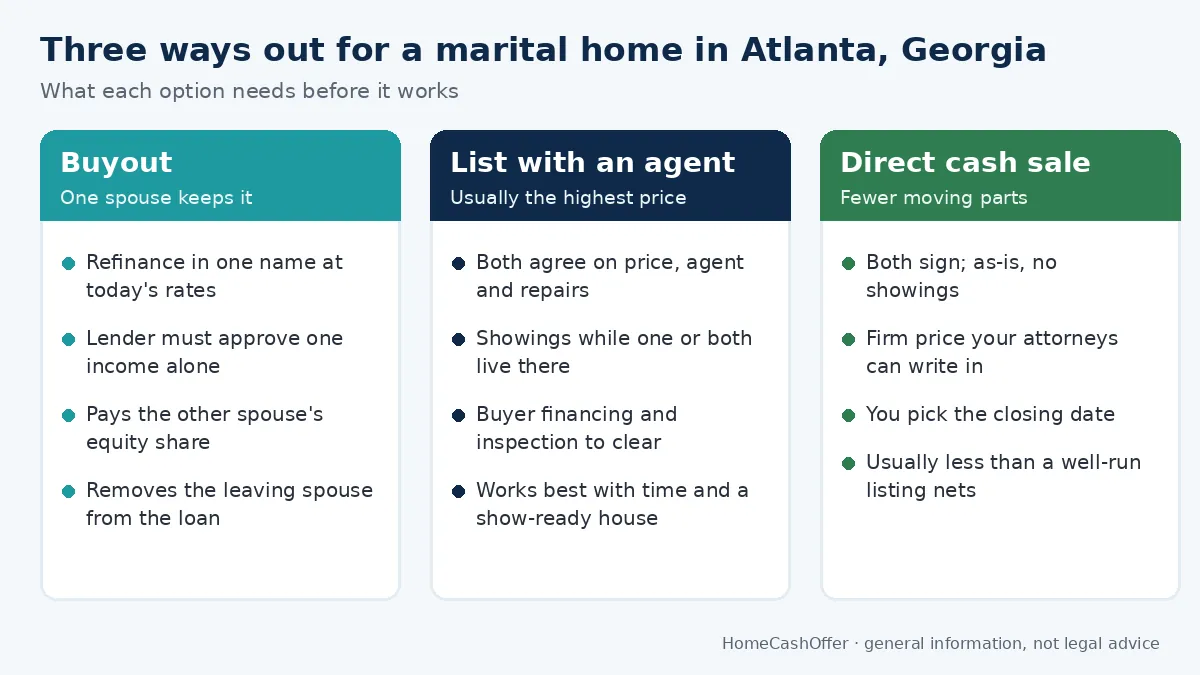
- Buyout. Works when one spouse can refinance alone and truly wants to stay, for example to keep the kids in their Atlanta Public Schools or Fulton County Schools zone. Get a written pre-approval before you negotiate the equity figure. Removing the departing spouse from the deed doesn’t remove them from the loan. Only a refinance or the lender’s release does that.
- Listing. Usually the highest price when the house shows well and you have time. It also takes the most cooperation: choosing an agent, agreeing on list price and price cuts, keeping the house clean for showings while one of you lives in it, and getting through inspection repair requests.
- Direct sale. Trades some price for certainty. One as-is number, no showings, no repair requests, and a closing date you choose. It fits best when the house needs work, the carrying costs are hurting, or the two of you can agree on one number but not on fifty small decisions.
If you’re comparing the last two, our guides on cash offers versus listing with an agent and selling as-is versus fixing up walk through the net-proceeds math.
What does a Georgia closing need from two divorcing owners?
Two signatures, one payoff and clear instructions about the money. Georgia residential closings are typically handled by a closing attorney. They’ll order the mortgage payoff, search title for liens (an old judgment against either spouse can show up here), and prepare the deed. Every owner on the deed has to sign it. Signing doesn’t require you to be in the same room. Closings can often be scheduled separately or by mail-away for a spouse who has moved.
Tell the closing attorney at the start that the sale is part of a divorce. Send the consent order or the settlement agreement, and give one shared instruction for the net proceeds: wire to each spouse in agreed amounts, or hold in escrow until the court rules. If the house has an HOA, common in Cobb and Gwinnett subdivisions and in many intown townhome communities, ask for the HOA payoff letter early. Unpaid dues are a frequent late surprise.
On taxes, IRS Publication 523 is the place to start. It covers the up-to-$250,000-per-person exclusion ($500,000 married filing jointly). It says an owner who has moved out can still treat the house as a residence while the spouse is allowed to live there under a divorce or separation instrument and uses it as a main home. It also says a transfer of the house to a spouse as part of a divorce settlement generally isn’t a taxable sale. Ask a tax preparer how those rules apply before you choose between a buyout and a sale.
From our deals
In divorce sales we’ve been part of, the expensive stretch is usually the months after one spouse moves out and before anyone agrees to anything. The house is half-furnished. The yard goes uncut. A small roof leak goes unreported because each person assumes the other will handle it, and a minor repair turns into a ceiling stain an inspector will write up. The sales that go smoothly tend to start with a short written agreement covering who has access, who pays which bill, and the lowest price both will accept. That’s usually agreed before anyone calls a buyer or an agent.
When is a cash sale the wrong move in an Atlanta divorce?
When you have equity, time and a house that shows well. Then a listing in this market should net more, even after commissions and a couple of months of carrying costs. A direct sale is also the wrong call if:
- The standing order is still in place and you don’t have written consent or a court order. Get that first, whoever the buyer is.
- You haven’t settled whether the house is fully marital under the source-of-funds rule, and you can’t agree to hold proceeds in escrow until you do.
- One spouse can genuinely qualify for the buyout and wants the house. Compare a real pre-approval before you sell to a third party.
- You’re behind on the mortgage and hoping a sale will “stop” a foreclosure. No buyer can stop one. A sale can only pay the loan off at closing if the timing and numbers work. Read our Atlanta foreclosure guide and talk to a HUD-approved housing counselor first.
How would a HomeCashOffer offer fit your Georgia divorce?
As one firm, written, as-is number that both of you and both attorneys can see at the same time. HomeCashOffer has bought houses since 2013 and buys in all 50 states, including across metro Atlanta. We look at the house, give a written offer, and close through a Georgia closing attorney on the date you choose, before or after the decree. Both owners sign, or a court order authorizes the sale. We don’t charge commissions or ask for repairs, and we don’t take sides.
Compare our figure with a realistic listing net from a local agent. Our Atlanta cash buyer hub and the Atlanta city page cover neighborhoods and closing costs in more depth, and the Georgia page explains how we buy statewide. If you’re comparing notes with family in other states, our divorce guides for Miami and Knoxville show how different the rules are elsewhere.
Call (405) 622-8705 or request a cash offer online. Have the deed, the latest mortgage statement, your case number and any consent order ready.
HomeCashOffer, 3000 W Memorial Rd, Ste 123 Unit 308, Oklahoma City, OK 73120. (405) 622-8705. We buy houses; we are not a law firm or a tax advisor.
Sell your house fast in these markets
Local cash offer pages—or start with a nationwide request.
Frequently asked questions
Can I sell our Atlanta house by myself once the divorce is filed?+
Not on your own. If the case is in the Family Division of Fulton County Superior Court, the automatic domestic standing order bars each spouse from selling, encumbering, trading, contracting to sell or otherwise disposing of property belonging to the parties, except in the ordinary course of business, until the final order. O.C.G.A. 19-1-1 lets Georgia courts issue that kind of order. In practice you need both spouses' written agreement or a judge's permission before signing a listing or purchase contract.
My spouse owned the house before we married. Do I get any of it in a Georgia divorce?+
Possibly part of it. Georgia courts use the 'source of funds' rule for a house one spouse brought into the marriage. The equity is treated as partly separate and partly marital, in proportion to the separate money and the marital money (such as mortgage payments made from marital income or renovations) that went into it. The Supreme Court of Georgia applied this in Hubby v. Hubby (2001), holding that the marital share includes its share of market appreciation. An attorney can run the numbers on your house.
How fast can an uncontested divorce be finished in Georgia?+
For a divorce on the ground that the marriage is irretrievably broken, O.C.G.A. 19-5-3(13) says the court cannot grant it until at least 30 days after the other spouse is served. One spouse must also have been a Georgia resident for six months before filing under O.C.G.A. 19-5-2. Many cases take longer because of scheduling, custody issues or disputes over property, and the house sale can close before or after the decree.
Who pays the Fulton County property tax bill if we sell mid-divorce?+
Your settlement agreement or a court order should say. At closing, the closing attorney normally prorates the year's taxes between seller and buyer. Fulton County's 2026 bills were issued as temporary bills based on the preliminary digest and 2025 millage rates, and the county said a refund or revised bill would be issued only as needed. So it helps to state in writing which spouse gets any refund or pays any revised amount after the sale.
Who pays Georgia's real estate transfer tax when we sell?+
The Georgia Department of Revenue says the tax is $1 for the first $1,000 of the sale price and 10 cents for each additional $100, which works out to roughly $1 per $1,000. The seller is liable for it, although contracts sometimes shift it to the buyer. In a divorce sale it is normally paid out of the proceeds at closing before the split.
If one of us moved out, can we still use the home-sale tax exclusion?+
Often yes. IRS Publication 523 says a separated or divorced owner can treat the home as their residence while the spouse or former spouse is allowed to live there under a divorce or separation instrument and uses it as a main home. The exclusion is up to $250,000 of gain per person, or $500,000 for a married couple filing jointly. Check your facts with a tax preparer before closing.
Does HomeCashOffer need both spouses to sign?+
Yes, when both of you are on the deed or the house is part of the divorce. We give one written as-is offer to both sides, which you and your attorneys can review together, and nothing closes unless both owners sign or a court order authorizes the sale. We do not take sides or advise either spouse on the divorce.
Ready to see what a cash offer looks like?
No repairs required. No agent commissions when you sell to us. No obligation to accept.
Request your no-obligation cash offer
Prefer a dedicated form? Visit Get a Cash Offer Today.
Get My Cash Offer
Share your name, phone, and property address. No obligation. We will follow up shortly.