
Selling a Phoenix House As-Is: The 10-Day Inspection Clock, Leased Solar, Tired AC and Unpermitted Arizona Rooms
Selling an older Phoenix house as-is? Why an 'as-is' listing still gives Arizona buyers a 10-day inspection and a BINSR repair request, what to do about leased solar under A.R.S. 44-1763, how to check City of Phoenix permit history for an enclosed carport, what the October 2026 Phoenix market says, and when cash is the wrong call. Call (405) 622-8705.
Short answer: You can sell a Phoenix house as-is, but on a normal Arizona listing “as-is” doesn’t stop the buyer from inspecting it and walking away. The standard contract gives the buyer an inspection period, usually ten days, to disapprove items and either cancel or ask you to fix them. A direct as-is sale to a cash buyer removes that repair round. Whether it’s worth the lower price depends on what the inspector would likely find and how long you can carry the house.
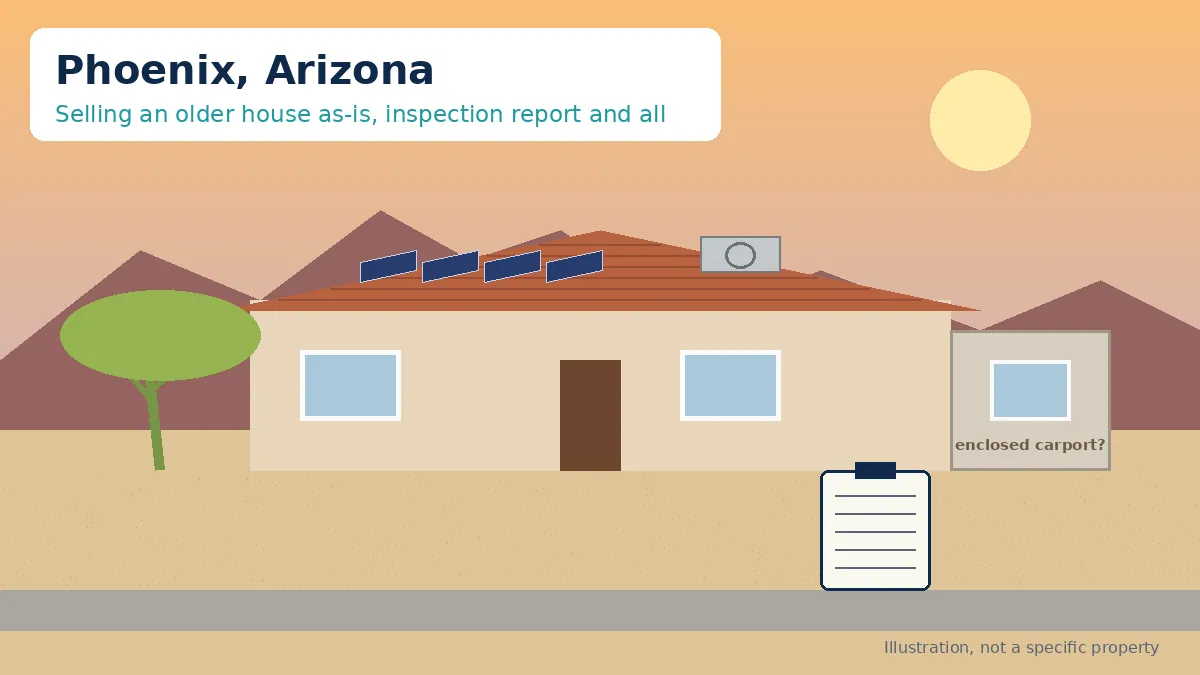
This guide is for a Phoenix owner with a known list: a 1960s block ranch in Maryvale or Encanto, or a 1990s stucco house in Ahwatukee, with a near-original AC, a tile roof that left a ceiling stain after the last monsoon, a carport someone enclosed years ago and solar panels you may not own. You’d like to sell without spending a summer fixing things.
The contract and disclosure rules below apply statewide. Permit records are City of Phoenix; in Mesa, Glendale or Chandler, ask that city.
Does “as-is” in a Phoenix listing stop buyers from asking for repairs?
No. It changes how you answer repair requests, not whether buyers can make them. Most Phoenix resale listings close on the Arizona REALTORS® Residential Resale Real Estate Purchase Contract. Under its due diligence section, the buyer gets an inspection period (ten days unless the parties write in a different number). During that window the buyer can order any inspections they want. Before it ends, they deliver one notice listing every item they disapprove of.
The Arizona REALTORS® explanation of the inspection and disapproval section walks through what happens next. The buyer picks one of two paths on the BINSR form (Buyer’s Inspection Notice and Seller’s Response):
- Cancel. If they list the items they disapprove of, their earnest money comes back to them.
- Give you a chance to fix or address the items. You have five days to answer in writing. Silence counts as a refusal. If you won’t do everything they asked, the buyer then has five days to cancel or accept your answer and close without those repairs.
So an “as-is” label mostly sets expectations. You can answer every BINSR with “Seller is unwilling to correct,” but a buyer who finds an expensive surprise can cancel, and you’re back on the market weeks later. Many as-is sellers end up giving a credit to keep the deal together. That second negotiation is what a direct as-is sale replaces.
Which Phoenix inspection findings tend to change the price?
The ones tied to heat, water and paperwork. Phoenix’s climate is hard on equipment. The National Weather Service’s 2024 climate review says 2024 was the warmest year in Phoenix records, which go back to 1896, with an average high of 90.4°F. For the next 30 years, First Street’s data, published on Redfin’s Phoenix market page, rates 79% of Phoenix properties at extreme heat risk (as of 2026). A buyer’s inspector knows all this, and so do insurers.
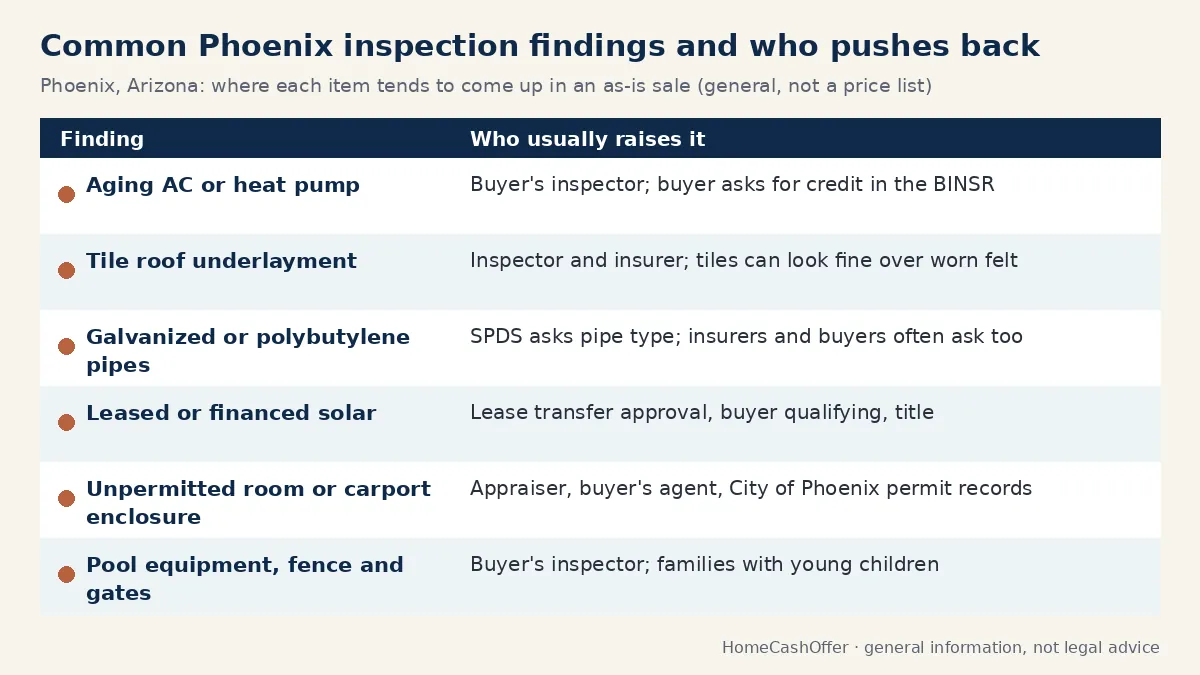
Here’s what tends to come up on older Valley houses, and why:
- Cooling. An older AC or heat pump that still runs will still get flagged for age, refrigerant type, duct leaks or a condenser that’s rusted through. In a Phoenix July, buyers treat a weak system as a near-term replacement, and they’ll ask for a credit to match.
- Tile roofs. Concrete and clay tiles often last longer than the felt underlayment beneath them. Inspectors look for cracked or slipped tiles, worn underlayment at the edges and valleys, and staining in the attic. That ceiling stain from monsoon season is exactly what they’re looking for. Flat or foam roof sections over additions get their own close look.
- Plumbing. The Arizona seller disclosure form asks whether you know your pipe type and lists galvanized, copper, PVC, CPVC, PEX and polybutylene. Older supply lines and hard water deposits are common in Phoenix ranch houses. Some insurers ask about polybutylene in particular.
- Pools. A buyer’s inspector will test the pump, filter and heater and look at the fence and gates, especially if the buyer has young children.
None of these stops a sale. Each is a line on the BINSR.
What happens to a leased or financed solar system when you sell?
It has to be dealt with before closing, usually by transferring the agreement to the buyer or paying it off. Arizona’s solar consumer law, A.R.S. 44-1763, requires a solar lease or finance agreement to disclose any restrictions on transferring the system or the house it’s attached to. It also has to say whether a third party must approve the transfer and give that approver’s name, address and phone number. Find the agreement before you list.
Three things make solar a common snag in Phoenix sales:
- The buyer may have to qualify. A company that approves transfers may check the buyer’s credit. Some buyers won’t take over a lease at all, so a buyout figure becomes part of your net sheet.
- Title may find a filing. Some financed or leased systems have a filing recorded against the property that title will want released or handled.
- The roof and the panels are linked. The same statute requires installers to tell owners that the roof may need repair or replacement during the agreement. Unless the installer caused the damage, the owner may have to pay to remove and reinstall the system. If your tile roof is tired, the buyer will price that in too.
The Arizona disclosure form asks whether any power system is leased and for the leasing company’s contact details. List it and attach the agreement.
How do you find out whether your Arizona room or enclosed carport was permitted?
Look it up before a buyer’s agent does. The City of Phoenix owner’s guide to residential permits explains that the Planning and Development Department’s online Building Permit Search shows a home’s permit history from 1995 to the present. For older permits it points you to the records area on the third floor of City Hall, 200 W. Washington St. The same guide lists room additions, porch enclosures, carport enclosures, patio covers, wall removals and water softeners among the projects that need permits.
It also warns that unpermitted work can bring citations, fines, removal at the owner’s cost and insurance trouble, and that “issues often arise when you go to sell your house.”
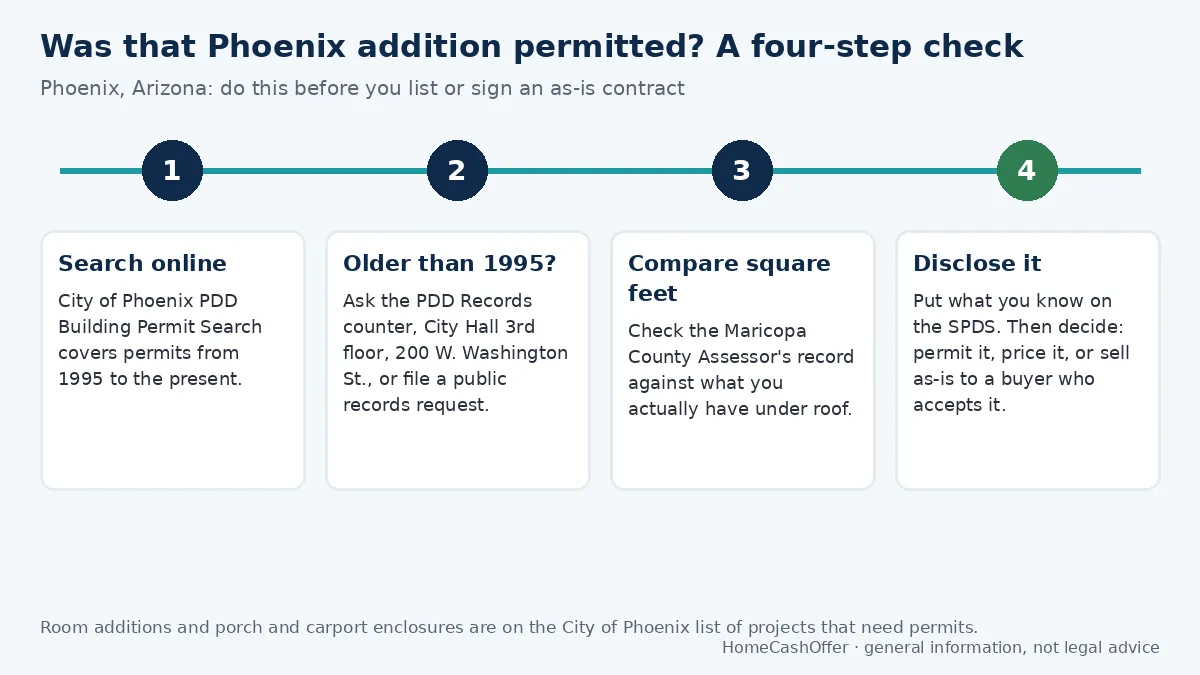
Then compare what you find with the Maricopa County Assessor’s record for your parcel. If the assessor shows 1,400 square feet and you’re living in 1,750 because of a converted carport, an appraiser will notice. A financed buyer’s appraisal may leave out the unpermitted space or flag it. You can permit the work after the fact (which may mean opening walls), price the house without the space, or sell as-is to a buyer who accepts the risk. Either way, disclose it.
Which repairs are worth doing before you list a Phoenix house?
Small ones that remove a “walk away” item for a financed buyer, and little else. Some rules of thumb:
- Fix active leaks and safety items. A roof leak or a dead GFCI outlet by the pool costs less to fix than the price cut it causes.
- Get a cooling evaluation and decide on the AC either way. If you replace it, the city’s owner’s guide lists replacing an existing air conditioner without increasing its size, capacity or location as work that generally doesn’t need a permit. Water heater replacement by a licensed contractor is on the same list. Check current rules with the city, confirm the contractor’s license on the Arizona Registrar of Contractors search, and keep the invoice for buyers.
- Skip the cosmetic flip. New flooring won’t change what the inspector writes about the roof or the carport.
- Mind the calendar. Repairs and showings are harder in summer, and a vacant house still needs the AC running.
Our as-is vs fixing up guide shows how to run those numbers, and our Tucson as-is guide covers septic transfer inspections and swamp coolers, which come up more often in Pima County.
What is the Phoenix market telling as-is sellers right now?
Buyers have room to negotiate, and that carries over into the BINSR. According to Redfin’s Phoenix housing market data, in October 2026 the city’s median sale price was $449,687, down 0.07% from a year earlier. Homes took a median 59 days to sell, the average sale-to-list ratio was 97.7%, and 39.9% of listings had a price drop. Sales fell 7.3% from a year earlier, to 3,592 homes.
Freddie Mac’s weekly survey put the 30-year fixed rate at 7.21% for the week of November 25, 2026, up from 6.23% a year earlier. A buyer stretching for that payment has less cash left for a new AC or roof, so they ask you for it.
The Census Bureau’s QuickFacts for Phoenix shows a median owner-occupied home value of $420,700 and an owner-occupancy rate of 57.3% (2020-2024 American Community Survey), so many houses are rentals or former rentals, where deferred maintenance tends to build up.
An updated Phoenix house still sells. An older one with findings competes with plenty of reduced listings, so expect a detailed BINSR.
What do you still have to disclose when you sell an Arizona house as-is?
What you know. The Arizona REALTORS® disclosure form (SPDS) tells sellers they’re obligated by law to disclose known material facts, and buyers may rely on the answers. “As-is” and cash don’t change that. Write down the roof leak, the carport, the solar lease and any pipe repair, and attach invoices.
Two other pieces of paperwork apply no matter who buys:
- Lead paint for pre-1978 houses. Federal rules require sellers of most homes built before 1978 to give the EPA lead-based paint disclosure and any reports they have. Plenty of Phoenix ranch houses fall in that range.
- The Affidavit of Property Value. Arizona doesn’t charge a percentage transfer tax, but under A.R.S. 11-1133 the deed is recorded with an affidavit stating the sale price and terms. The title company prepares it.
Our Phoenix cash buyer hub covers the Maricopa County tax calendar, trustee sales and the affidavit of disclosure for unincorporated land.
From our deals
When we buy older Valley houses, the problems that surface late are usually paperwork, not condition. Panels the seller thought were paid off turn out to be financed when title runs. An enclosed carport is a bedroom on the listing and a carport on the county record. Sellers who find the solar agreement and run a permit search before asking for a number tend to get a cleaner offer and a closing date that holds, whoever they sell to.
When is an as-is cash sale the wrong move for a Phoenix house?
When the findings are small and the house shows well. In that case a listing should net you more, even after commissions and a BINSR credit. A direct sale is also probably the wrong call if:
- The only real issue is an old AC unit. A replacement or a credit to a financed buyer may cost less than the discount a cash buyer would take.
- You have a solar lease that a buyer must take over, and you haven’t asked the company what the transfer requires. Get that answer first. It affects every buyer.
- The real problem is missed mortgage payments and a trustee sale date on the calendar. Selling to anyone, us included, can’t cancel that sale; a closing can only pay off the loan if it happens first and the price covers what’s owed. Call your servicer and a HUD-approved housing counselor before you pick a buyer.
- You haven’t compared a realistic listing net from a local agent with a written as-is figure.
How does a HomeCashOffer as-is offer work in Phoenix?
We give you one written number for the house as it stands, and there’s no repair request after an inspection. HomeCashOffer has been buying houses since 2013, in all 50 states, and that includes older homes across the Phoenix metro. We walk the house, ask about the roof, cooling, solar and additions, make a written as-is offer and close through an Arizona title and escrow company on the date you pick. No commissions, and no need to fix the AC, permit the carport or clean out the garage.
If you want to compare, our Phoenix city page covers neighborhoods and closing details. The Arizona page explains how we buy statewide, and our Phoenix divorce guide is for co-owners who also have to agree on the sale. If you’re deciding whether to wait for a better season, see how long it takes to sell a house in Phoenix.
Call (405) 622-8705 or request a cash offer online. It helps to have your latest mortgage statement, any solar agreement, and the list of repairs you know about.
HomeCashOffer, 3000 W Memorial Rd, Ste 123 Unit 308, Oklahoma City, OK 73120. (405) 622-8705. We buy houses; we are not a law firm, inspector or tax advisor.
Sell your house fast in these markets
Local cash offer pages—or start with a nationwide request.
Frequently asked questions
If I list my Phoenix house 'as-is,' can the buyer still back out after the inspection?+
Usually yes. On the standard Arizona REALTORS® resale contract, the buyer gets an inspection period (ten days unless the contract says otherwise) and can disapprove items in a Buyer's Inspection Notice and Seller's Response (BINSR). The buyer can cancel outright or give you a chance to fix or address the items. 'As-is' wording mainly tells buyers you don't plan to make repairs. It doesn't remove their right to inspect and cancel inside that window unless the contract is written differently.
How long do I have to answer a BINSR in Arizona?+
Five days after the buyer delivers it, unless the contract sets a different number. If you don't answer in writing in time, the contract treats that as a refusal to correct anything. The buyer then has five days to cancel or accept your answer. Talking it over doesn't extend those deadlines; only a written agreement signed by both sides does.
Can I sell a Phoenix house that has a leased solar system?+
Yes, but the buyer usually has to take over the lease or you have to buy it out, and the solar company may need to approve the transfer. Arizona law (A.R.S. 44-1763) requires solar lease and finance agreements to disclose any restrictions on transferring the system or the house and who approves a transfer. Find your agreement early, call the company for its transfer packet and any buyout figure, and list the system as leased on the seller's disclosure.
How do I check whether my Arizona room or enclosed carport was permitted in Phoenix?+
Use the City of Phoenix Planning and Development Department's online Building Permit Search, which covers permits from 1995 to the present. For older work, the city's owner's guide points you to the records counter on the third floor of City Hall, 200 W. Washington St., or a public records request. The city lists room additions and porch and carport enclosures among projects that need permits.
Do I need to replace my old AC before selling a Phoenix house?+
Not necessarily. You can sell with an older unit and disclose its age, and let the price or a credit reflect it. If you do replace it, the City of Phoenix owner's guide says swapping an existing unit without increasing its size, capacity or location generally doesn't need a permit, but confirm with the city, use a contractor licensed by the Arizona Registrar of Contractors and keep the receipts to show buyers.
Does a cash buyer still get a seller disclosure in Arizona?+
Usually yes. The SPDS form used in most Arizona sales reminds sellers that they're obligated by law to disclose known material facts, and that duty doesn't disappear because the buyer pays cash. A cash buyer may skip a lender appraisal and repair requests, but you should still tell them what you know about the roof, plumbing, permits and anything else important.
Is there a transfer tax when I sell a house in Phoenix?+
Arizona doesn't charge a percentage transfer tax on home sales. The deed is recorded with an Affidavit of Property Value under A.R.S. 11-1133, signed by or for the buyer and seller, and the title company handles that and the small recording fees. Your bigger closing costs are usually title insurance, escrow fees and any commissions.
Ready to see what a cash offer looks like?
No repairs required. No agent commissions when you sell to us. No obligation to accept.
Request your no-obligation cash offer
Prefer a dedicated form? Visit Get a Cash Offer Today.
Get My Cash Offer
Share your name, phone, and property address. No obligation. We will follow up shortly.